Bird size profile
Indian Peafowl
Pavo cristatus
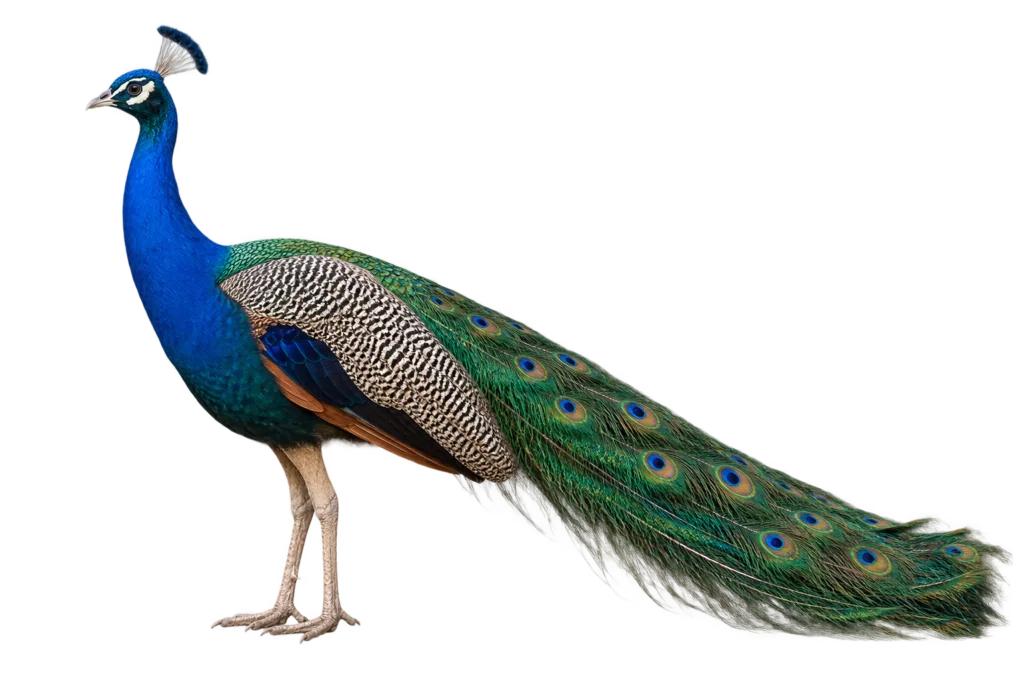
Size at a glance
How big is an Indian Peafowl?
Compare
Compare Indian Peafowl with another bird
Search by common or scientific name.
Morphology
Detailed measurements
Taxonomy
Classification
Indian Peafowl Pavo cristatus have an unusual size profile because the adult male carries a long ornamental train that can nearly double the length recorded from bill to the end of the bird. This makes a simple “length” figure easy to misread. The male is a large, heavy pheasant even without the ornament, but much of his famous length comes from feathers extending well beyond the true tail.
Why Indian Peafowl Length Can Mean Two Different Things
An adult peacock measures about 100–115 cm (39–45 in) from the bill to the true tail. With a fully developed train included, the same bird can reach roughly 195–225 cm (77–89 in).
A peahen is much shorter when total length is compared, commonly measuring around 95 cm (37 in). The contrast is not simply the result of a male having a body twice as long. Much of the difference comes from the ornamental feathers behind him.
A measurement ending at the male’s true tail describes the bird’s body more directly. A measurement extending to the tip of the train describes his full external length while those ornamental feathers are present. Both can be valid, but they answer different questions.
The Peacock’s Train Is Not His True Tail
The long feathers usually called a peacock’s “tail” are actually elongated upper tail coverts. They grow from the area above the true tail. The real tail underneath is much shorter and consists of stiffer feathers that help support the train when the male raises it into a fan.
This distinction explains why measurements that include the train can make the male appear exceptionally long without representing an equally large increase in skeletal body size.
Studies of adult males have recorded train lengths exceeding one metre, with individual measurements varying according to the bird, age and stage of feather growth. A biomechanical study of displaying adults worked with fully grown trains around 1.5 m long, while field measurements from another peafowl population recorded trains from about 104 to 153 cm.
The train is also remarkably light for its visual size. Its long feathers form a broad display surface without adding anything close to the mass that a solid structure of the same dimensions would require.
Male and Female Size Differences Extend Beyond the Train
Indian Peafowl show strong sexual dimorphism. Adult males generally weigh about 4–6 kg (8.8–13.2 lb), while females commonly fall around 2.75–4 kg (6.1–8.8 lb). The male therefore remains the heavier bird even when the train is excluded from a length comparison.
| Measurement | Adult Male | Adult Female | What It Represents |
|---|---|---|---|
| Body length | About 100–115 cm | About 95 cm | Male measurement without extending to the end of the ornamental train |
| Length with full train | About 195–225 cm | Not comparable | Male external length when the mature train is included |
| Body mass | About 4–6 kg | About 2.75–4 kg | Physical body mass rather than apparent feather size |
The sexes also differ strongly in outline and plumage. Adult males have the familiar blue neck and breast, long train and numerous eyespots. Females are mainly brown with green areas around the neck and lack the male’s greatly elongated train. Both sexes have the characteristic fan-shaped crest on the head, so the crest itself is not a male-only feature.
A Peacock Does Not Have the Same External Length All Year
The full train is not a permanent structure. Adult males shed the elongated coverts after the breeding period and grow them again. A male measured when the train is fully developed can therefore have a very different total length from the same bird during molt or early regrowth.
Age creates another source of variation. Young males do not immediately acquire the proportions associated with a mature peacock. The ornamental feathers begin developing as males mature, and train length increases during the first several years. A fully developed adult train is generally associated with males around four years old and older.
As a result, a short-trained male is not necessarily a naturally small adult. He may be immature, molting or still regrowing the seasonal ornament.
The Display Makes the Male Look Larger Than a Length Measurement Suggests
A normal length measurement follows the bird from front to back. Courtship changes the visual geometry completely. The male raises and spreads the train into a broad fan, turning a long, narrow profile into a much larger-looking display.
The true tail helps hold this feather fan upright. During train-rattling, the male also vibrates the display feathers rapidly. Research on the mechanics of this behavior has measured train-rattling frequencies around 25–28 Hz in displaying males. The movement produces both visible shimmering and an audible rattling effect.
The apparent size of the display is further strengthened by iridescence. The blue and green colors of male Indian Peafowl are produced largely through microscopic structures in the feathers that interact with light. Research on peacock plumage has shown ordered arrangements of melanosomes, air spaces and keratin within the feather barbules. Their optical effect changes with viewing angle, helping explain why a stationary bird can appear to shift in brightness and color as either the bird or observer moves.
How to Interpret an Indian Peafowl Size Comparison
For a side-by-side scale comparison, the most important question is whether the male is being represented by body length or full length with the train. A 2-metre-plus peacock is not a bird with a two-metre skeletal body. It is a roughly metre-long large pheasant carrying an ornament that extends far behind the true tail.
Body mass tells a different part of the story. At up to about 6 kg, an adult male is genuinely heavy for a pheasant, so his large appearance is not created by feathers alone. The train mainly changes length, outline and display area rather than serving as a measure of body bulk.
Standing height, body length, train length and displayed-fan dimensions should also remain separate measurements. None can be reliably substituted for another. A folded male seen from the side, a peacock with a freshly molted train and a mature male displaying a full fan can look like birds of very different dimensions even though all belong to the same species.
Data
Measurement sources
- Data status
- Measured
- Size measurements
- AVONET — Tobias et al. (2022)
- Morphology source
- AVONET — Tobias et al. (2022)
- Morphology dataset
- AVONET v7 — BirdLife taxonomy
- Morphology dataset license
- CC BY 4.0
Full source links, dataset definitions, licensing details and measurement methodology are maintained on the Data Sources & Methodology page.