Bird size profile
Kea
Nestor notabilis
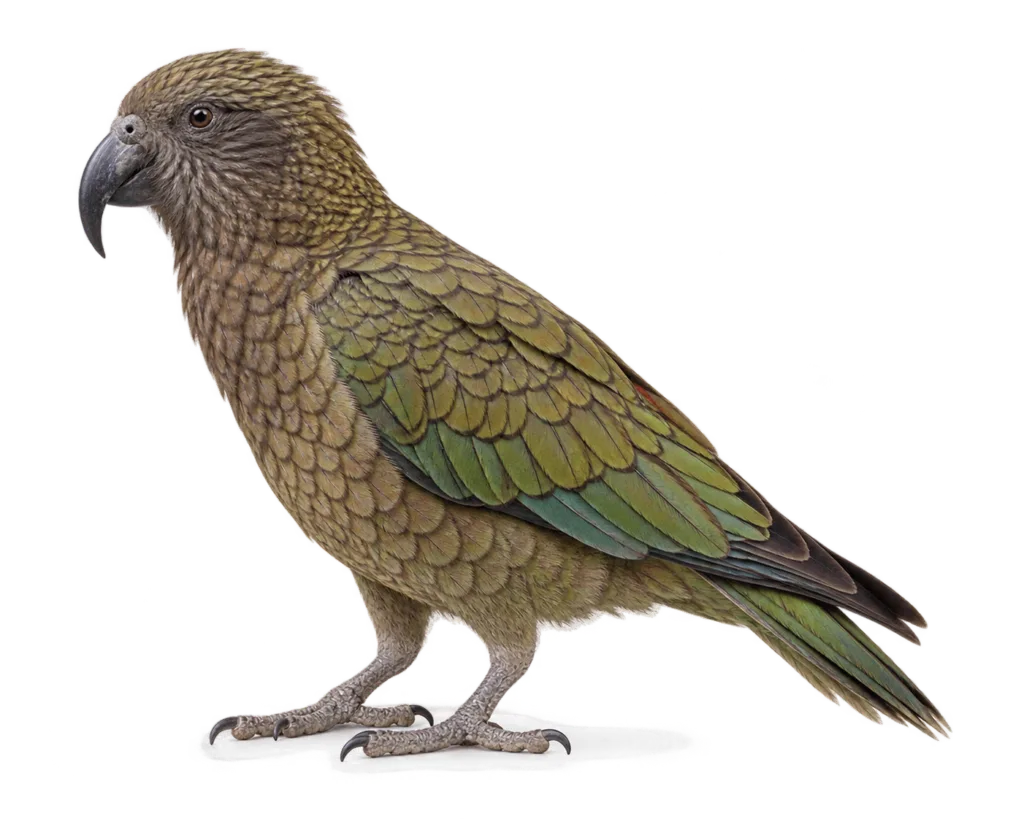
Size at a glance
How big is a Kea?
Compare
Compare Kea with another bird
Search by common or scientific name.
Morphology
Detailed measurements
Taxonomy
Classification
The kea (Nestor notabilis) is a large, strongly built parrot with a compact body, broad wings, a relatively short tail, and a long curved upper bill. Published references generally place adult total length around 46–50 cm. Body mass shows a clearer difference between the sexes: males commonly fall around 900–1,100 g, while females are often around 700–900 g.
Kea Size Comes From a Stocky, Broad-Winged Build
Total length alone does not fully describe the size of a kea. Much of the bird’s visual bulk comes from its deep body and broad wings. The tail is fairly short relative to the rest of the bird, so an adult often looks compact rather than elongated when perched.
Published length figures also depend on the birds and measurement series involved. New Zealand bird references commonly give about 46 cm, while other detailed accounts place adults within a range of roughly 46–50 cm. These figures describe total body length, normally measured from the bill tip to the tail tip, rather than a wing measurement.
Wing chord measures one folded wing from the wrist area to the end of the longest primary. It should not be treated as wingspan or converted into wingspan by simply doubling it. Total length is a separate head-to-tail measurement.
Male and Female Kea Differ Most in Mass and Bill Size
Kea show measurable sexual dimorphism, although the difference is less obvious than in species where the sexes have different plumage. A large morphometric study using sexed museum specimens, captive birds, and wild kea found that males averaged about 5% larger in linear body measurements than females.
The difference in body mass is greater. In the wild-caught sample used in that study, males averaged 956 g and females averaged 779 g. Modern New Zealand species information expresses the same pattern as broader field ranges, with males typically heavier than females and female body mass about one-fifth lower.
The overlap matters in field identification. A heavy bird with a long bill is more likely to be male, while a smaller bird with a shorter bill may be female, but morphology does not provide a certain result for every individual. Current kea husbandry guidance uses molecular DNA testing when reliable sex determination is required.
The Male Kea’s Upper Bill Is Disproportionately Longer
The bill creates one of the clearest structural differences between male and female kea. Both sexes have a long, narrow, down-curved upper mandible, but males tend to have a longer, thicker bill with a slightly stronger curve.
The 1991 morphometric study found that the male upper bill was about 12–14% longer even though overall male body dimensions were only about 5% greater. The researchers found that the bill difference remained after accounting for general body size. Male kea therefore do not simply have proportionally enlarged versions of the female bill.
This distinction also has an ecological connection. Later research reviewed by New Zealand’s Department of Conservation links bill dimorphism with differences in foraging. Male and female kea can use food resources differently, and the larger male bill may help with some forms of probing, digging, tearing, and scavenging.
Wing Chord and Tail Length Show Much Less Sex Separation
Measurements from sexed specimens show that some parts of the kea differ far less between males and females than the bill or body mass. Mean wing chord in one large morphometric dataset was about 307 mm for males and 301 mm for females. Mean tail length was almost the same: about 155 mm in males and 154 mm in females.
This helps explain why sex can be difficult to judge from a flying bird. The wings and tail do not show the same degree of separation as the bill. A kea in flight presents the broad-winged, short-tailed outline typical of the species regardless of sex.
The underside of the wing also changes the bird’s appearance in flight. A perched kea is dominated by olive-green plumage, while an open wing reveals orange-red underwing coverts, yellow barring and darker flight feathers. These colors can make the wings appear more visually prominent without changing their actual dimensions.
Juvenile Kea Change Most Around the Bill and Eyes
Young kea already have the basic body form of the species, so age is often easier to judge from soft-part coloration than from overall size. Juveniles have conspicuous yellow to yellow-orange coloring around the cere and eye rings. The lower mandible can also appear yellow-orange.
These areas become greyer as the bird matures. Adults have a much more subdued grey cere and surrounding bare parts. The change is useful when estimating age class because a young bird may approach adult dimensions before every juvenile color feature has disappeared.
Rainforest Kea Can Have Longer Bills and Larger Heads
Kea morphology also varies within the species. Research summarized by the Department of Conservation reports that birds from western lowland rainforest populations can have longer bills and larger heads than kea breeding in higher-altitude montane areas.
The pattern has been associated with differences in feeding ecology. Kea use a wide range of foods and foraging methods, and populations living in contrasting environments do not necessarily face the same feeding opportunities. This means that bill or head measurements from one locality should not automatically be treated as exact dimensions for every kea population.
For size interpretation, the species is therefore best represented by measured ranges and clearly defined measurement types. Sex, individual variation, locality, and the part of the bird being measured can all change the number without indicating that any of the measurements are incorrect.
Data
Measurement sources
- Data status
- Measured
- Size measurements
- AVONET — Tobias et al. (2022)
- Morphology source
- AVONET — Tobias et al. (2022)
- Morphology dataset
- AVONET v7 — BirdLife taxonomy
- Morphology dataset license
- CC BY 4.0
Full source links, dataset definitions, licensing details and measurement methodology are maintained on the Data Sources & Methodology page.