Bird size profile
Keel-billed Toucan
Ramphastos sulfuratus
Size at a glance
How big is a Keel-billed Toucan?
Compare
Compare Keel-billed Toucan with another bird
Search by common or scientific name.
Morphology
Detailed measurements
Taxonomy
Classification
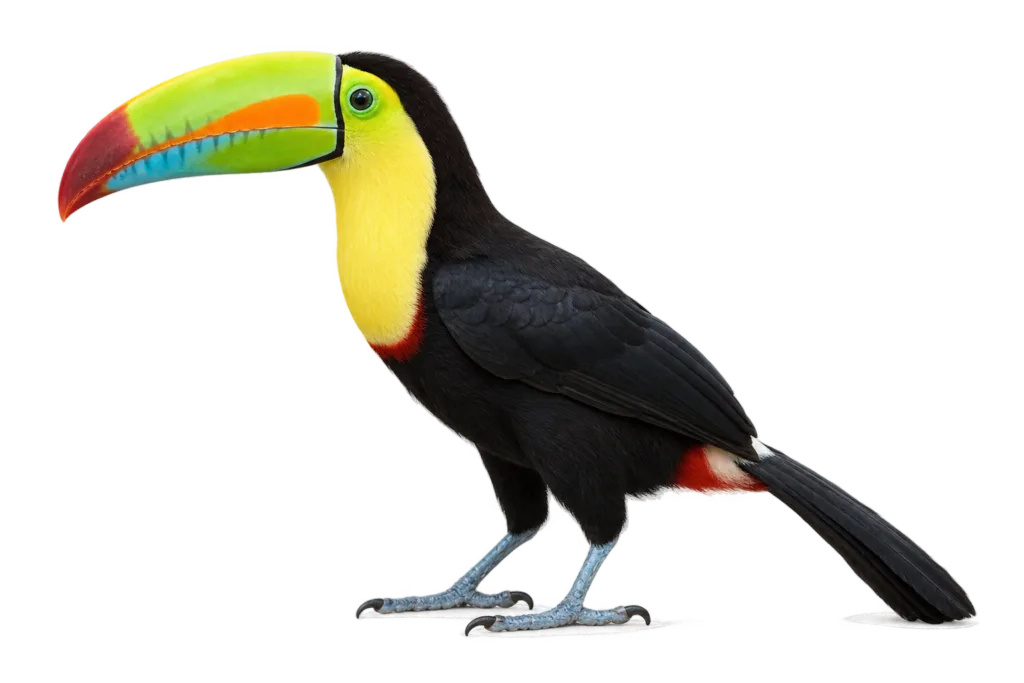
The Keel-billed Toucan (Ramphastos sulfuratus) is a large-bodied toucan whose visible size is strongly shaped by its oversized bill. Adults are generally about 42–55 cm (17–22 in) long and commonly weigh roughly 380–500 g (13–18 oz). The bill alone is often around 12–15 cm (4.7–5.9 in), giving the bird a much longer profile than its body mass might suggest.
Why Total Length Can Be Misleading
A measurement of 42–55 cm is the bird’s total length, not the length of its feathered body alone. The bill accounts for a large share of that measurement. This matters when interpreting the toucan’s size because a bird near 50 cm long does not have the same body proportions as another bird of similar total length with a much smaller bill.
The commonly reported total length includes the bill. With a bill of roughly 12–15 cm, close to a third of the visible head-to-tail profile in some individuals is associated with this single structure. Total length therefore makes the Keel-billed Toucan look proportionally larger than its moderate body mass alone would indicate.
The torso is comparatively compact. The tail is long and fairly square, while the wings are broad and relatively short. Together, these proportions produce the characteristic toucan outline: a large head and bill at the front, a compact central body, and a distinct tail extending behind it.
The Bill Is Large Without Being Proportionally Heavy
The 12–15 cm bill is the feature that most changes the apparent scale of the Keel-billed Toucan. It is tall, laterally flattened and much deeper than the narrow bills of many similarly weighted birds. Its green base color, orange areas, red tip and blue markings make its boundaries especially easy to see, which further emphasizes its size.
Its appearance can suggest a heavy solid structure, but toucan bills are built to keep mass low. The external covering is keratin, while the interior is supported by a lightweight network of bony material rather than being a solid mass throughout. Research on toucan bill structure has shown how this type of construction can combine a large external volume with relatively little weight.
This distinction is important for understanding the bird’s proportions. A large bill does not mean that an equivalent fraction of the toucan’s body mass is concentrated in front of its head. The bird can carry a structure that occupies a large part of its visible length without adding the weight expected from a solid bill of the same dimensions.
Body Shape Reflects Life in the Canopy
The Keel-billed Toucan has broad, short wings rather than the long pointed wings typical of birds built for sustained high-speed travel. In flight it commonly alternates several wingbeats with a glide, producing a noticeably undulating flight profile.
Its legs and feet are also distinctive. The feet are zygodactyl, with two toes directed forward and two backward. This arrangement gives the foot opposing contact points around branches. Combined with the compact body and relatively broad wings, it fits a bird that spends much of its time moving through trees rather than traveling continuously through open air.
The long tail forms another substantial part of the silhouette. When perched, the combination of long bill and tail can make the central body appear smaller than expected. This is one reason body mass is useful alongside total length when judging the actual physical size of the species.
Color Does Not Separate Males and Females
Adult males and females share essentially the same plumage pattern. Both have a largely black body, a bright yellow throat and chest, red undertail coverts and the multicolored bill that gives the species its familiar appearance. Sex cannot therefore be determined reliably from plumage color alone.
There is, however, measurable size-related sexual dimorphism in the bill. Adult males tend to have longer bills than females. A 2023 morphometric study of Keel-billed Toucans found sex-related differences in several measurements, including curved bill length, straight bill length, total culmen length and the straight ventral length of the lower bill.
The straight ventral measurement of the gnathotheca, the keratin-covered lower part of the bill, was the strongest predictor of sex among the traits examined in that study. Earlier work had also found overlap between male and female bill measurements, so bill size should not be treated as an infallible visual sexing method.
This produces an unusual form of dimorphism: males and females can look nearly identical in color and general shape while still differing statistically in bill dimensions. A particularly long-billed adult is more likely to be male, but individuals near the overlapping part of the measurement range cannot be assigned confidently from apparent bill size alone.
Data
Measurement sources
- Data status
- Measured
- Size measurements
- AVONET — Tobias et al. (2022)
- Morphology source
- AVONET — Tobias et al. (2022)
- Morphology dataset
- AVONET v7 — BirdLife taxonomy
- Morphology dataset license
- CC BY 4.0
Full source links, dataset definitions, licensing details and measurement methodology are maintained on the Data Sources & Methodology page.