Bird size profile
King Vulture
Sarcoramphus papa
Size at a glance
How big is a King Vulture?
Compare
Compare King Vulture with another bird
Search by common or scientific name.
Morphology
Detailed measurements
Taxonomy
Classification
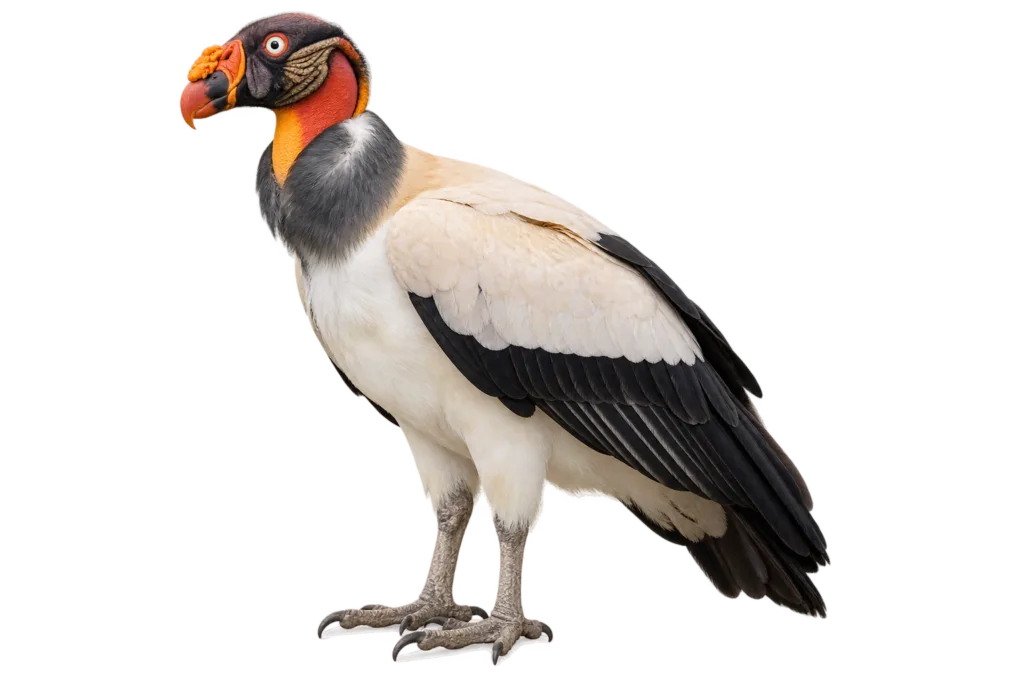
The King Vulture (Sarcoramphus papa) is a large New World vulture with a heavy body, broad wings, a short tail, and one of the most powerful-looking head-and-bill combinations in the Cathartidae. Published size ranges place adults at roughly 71–81 cm (28–32 in) in total length, with a wingspan around 180–198 cm (71–78 in). Adult mass is commonly reported around 3.0–4.5 kg (6.6–9.9 lb), although values can vary among individuals and datasets.
Why the King Vulture Looks Larger Than Its Body Length Suggests
Total length does not fully describe the proportions of a King Vulture. The bird combines a relatively compact body with very broad flight surfaces. When perched, the folded wings add considerable depth to the body outline, while the thick neck, large head, and substantial bill create a heavier appearance than length alone would imply.
The wings also account for much of the bird’s visual scale in flight. Their breadth produces a large silhouette, while the tail remains comparatively short and broad. This proportion is better suited to soaring than a long, narrow-winged profile would be.
Broad Wings and a Short Tail Define the Flight Profile
King Vultures are built for extended soaring. The wings are broad, with long primary feathers at the outer edge, and the tail is short relative to the overall span. This gives the bird a wide, compact flight outline rather than the stretched shape seen in many long-tailed birds.
Wing measurements taken directly from specimens describe only part of this structure. Published morphological datasets include flattened wing lengths in roughly the 481–530 mm range. A folded-wing measurement is not the same measurement as wingspan: wing length is taken on one closed or extended wing from an anatomical reference point, while wingspan measures the distance from one wingtip to the other with both wings spread.
A wing length near 500 mm should not be doubled and treated as a calculated wingspan. The two measurements use different anatomical endpoints and are recorded under different methods.
The Head and Bill Add Much of the Bird’s Structural Bulk
The King Vulture has a large head relative to its body, paired with a deep, strongly hooked bill. The upper mandible curves sharply toward the tip, while the cutting edges provide the structure needed to work through carrion. Compared with the slender bills of some scavenging birds, the King Vulture’s bill appears short, deep, and mechanically powerful.
The head and upper neck are largely bare rather than feathered. In adults, exposed skin carries red, orange, yellow, and darker tones, and the cere supports a prominent fleshy caruncle above the bill. This ornament changes the apparent outline of the head, so visual estimates of head size can be misleading when compared with skeletal or standardized morphometric measurements.
The neck also has to combine strength with mobility. A scavenging bird must be able to position the head precisely while pulling and cutting food, so the visible thickness of the head-neck region is part of a functional anatomical system rather than simply an ornamental feature.
Male and Female Size Differences Are Subtle, Not Absent
Male and female King Vultures look extremely similar in plumage and head coloration, which is why the species has traditionally been described as externally monomorphic. Visual inspection alone generally does not provide an obvious sex marker.
More recent morphometric research has refined that picture. Measurements from molecularly sexed birds found moderate male-biased size differences. Head length and bill depth were especially informative, while some wing measurements also contributed to the separation between males and females.
This does not mean that every male is visibly larger than every female. The measurement ranges overlap. The strongest separation occurs toward the extremes, so an individual bird with intermediate measurements cannot reliably be sexed simply by judging its apparent size.
King Vultures remain difficult to sex by appearance in the field. The newer evidence instead shows that external similarity can coexist with measurable average differences in structural dimensions, especially around the head and bill.
Adult Proportions Develop Alongside Major Plumage Changes
Young King Vultures differ strongly from adults in coloration. Juveniles begin with a much darker overall appearance and acquire the contrasting pale adult body plumage gradually. The brightly colored bare head and the fully developed adult caruncle also become more pronounced with maturity.
This age-related change matters when judging apparent body form. A dark immature bird lacks much of the high-contrast pattern that makes an adult’s pale body, dark flight feathers, bare head, and heavy bill visually distinct from one another. Two birds with similar structural dimensions can therefore look different in size simply because plumage boundaries alter how the eye reads their outlines.
The adult combines a pale body with dark flight feathers and tail, a thick dark neck ruff, and a brightly colored bare head. The contrast makes individual anatomical regions easy to distinguish, but those color boundaries should not be mistaken for measurement landmarks.
How King Vulture Measurements Should Be Read
Published figures for this species do not always match exactly. Total length can differ depending on specimen posture and measurement method, body mass naturally changes among individuals, and wing data may represent wingspan, flattened wing length, or individual feather measurements.
For that reason, a range is usually more informative than a single supposedly exact figure. The commonly reported adult dimensions describe a bird roughly three-quarters of a meter long, weighing several kilograms, with an extended wingspan approaching two meters. More detailed morphometric work then separates that overall size into structural traits such as head length, bill depth, and wing length.
Data
Measurement sources
- Data status
- Measured
- Size measurements
- AVONET — Tobias et al. (2022)
- Morphology source
- AVONET — Tobias et al. (2022)
- Morphology dataset
- AVONET v7 — BirdLife taxonomy
- Morphology dataset license
- CC BY 4.0
Full source links, dataset definitions, licensing details and measurement methodology are maintained on the Data Sources & Methodology page.