Bird size profile
Laughing Kookaburra
Dacelo novaeguineae
Size at a glance
How big is a Laughing Kookaburra?
Compare
Compare Laughing Kookaburra with another bird
Search by common or scientific name.
Morphology
Detailed measurements
Taxonomy
Classification
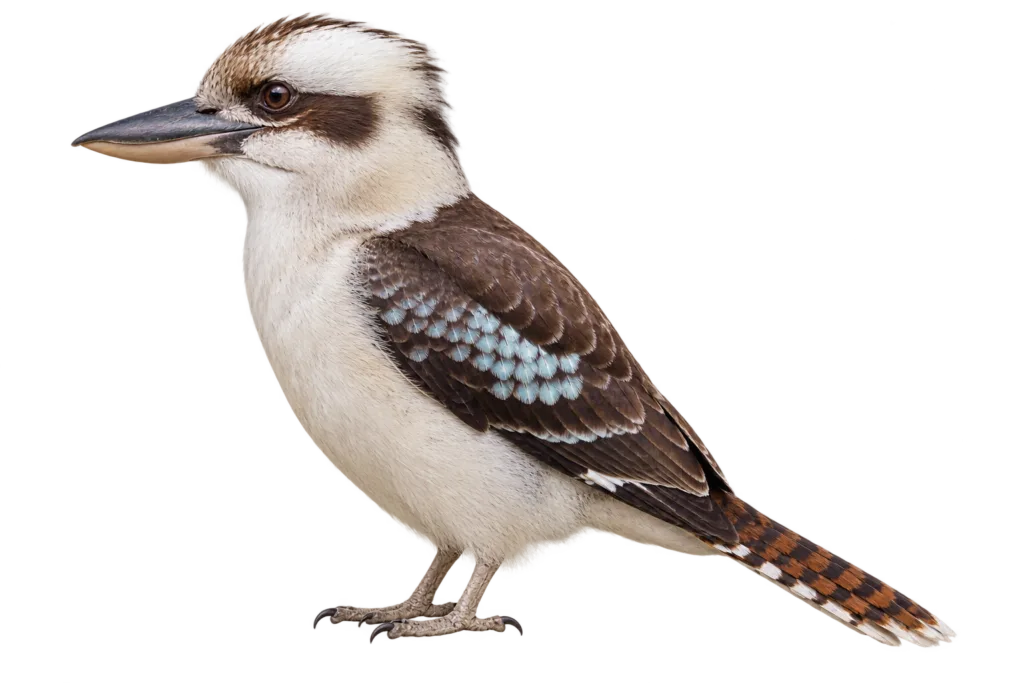
The Laughing Kookaburra (Dacelo novaeguineae) is built more heavily than its length alone suggests. The Australian Museum lists a size range of 40–45 cm, while Victorian wildlife guidance records adults at 410–470 mm. Its large head, deep body and powerful bill give the bird its characteristically solid outline.
Measured Size of an Adult Laughing Kookaburra
Total length provides a useful sense of scale, but measurements taken from birds in the hand show how much individual variation sits behind that figure. Wing chord, tail length and body mass all cover fairly broad ranges.
| Measurement | Adult Male | Adult Female |
|---|---|---|
| Wing chord | 188–237 mm | 198–231 mm |
| Tail length | 123–171 mm | 137–170 mm |
| Weight | 196–450 g | 245–468 g |
| Total head length | 102–127 mm | 111–129 mm |
These banding measurements show especially wide overlap between individuals. A relatively light adult and a much heavier bird can therefore belong to the same species without representing different age classes or visibly different body types.
Why the Bird Looks So Heavy-Bodied
The Laughing Kookaburra has a compact torso, a large head and a strong, elongated bill. The neck appears short when the bird is resting, so the head seems to merge directly into the body. Short legs add to the low, sturdy appearance when it is perched.
The head and bill are functional parts of this build. Laughing Kookaburras commonly hunt from a perch, dropping onto prey below. Larger prey may be carried back to a perch and struck against a branch or other hard surface before being swallowed. A strong bill is therefore involved in handling prey as well as capturing it.
The tail is also substantial without being extremely long relative to the body. Published banding measurements place it broadly between about 12 and 17 cm in adults, depending on sex and individual variation. This helps preserve the species’ compact silhouette rather than giving it the elongated outline seen in birds dominated by a long tail.
Females Can Be Larger Without Being Easy to Sex by Size
Research on Laughing Kookaburras has found reverse sexual size dimorphism, with adult females growing larger on average than males. One study described females as about 15% larger. That population-level difference does not mean that a large individual can safely be identified as female.
Measurements from captured adults overlap heavily. Male and female wing lengths overlap, their tail ranges overlap, and body mass can overlap across much of the recorded range. Australian Bird Study Association guidance consequently notes that size is not a reliable way to sex Laughing Kookaburras in the field.
Breeding males can show a strongly blue lower back and rump, but plumage differences are not dependable for every individual. Adult helpers and immature birds can be particularly difficult to separate by external appearance alone.
Juvenile Structure Changes Subtly With Age
Young Laughing Kookaburras already have the basic large-headed, heavy-billed shape of the adult, so age differences are easier to detect in feather condition and coloration than in overall proportions.
Juveniles initially appear darker. Their tail feathers have more pointed tips, whereas older birds develop rounder tail-feather tips. The lower mandible is also darker in young birds and becomes paler during the months after fledging. Much of the obvious juvenile appearance fades within roughly six months, and by the end of the first year an immature bird may be difficult to distinguish from an adult using plumage alone.
The Features That Define Its Silhouette
Size is only part of what makes a Laughing Kookaburra recognizable. The pale head is crossed by a dark brown eye stripe, the back and wings are predominantly brown, and small areas of blue occur around the wings and rump. The tail is rufous with dark barring. Against that plumage, the oversized head and heavy bill remain the strongest structural features.
Those proportions also explain why two birds of similar total length can look very different in the field. Much of the kookaburra’s visual mass is concentrated around the torso and head rather than being distributed through long legs, a slender neck or an exceptionally long tail.
Data
Measurement sources
- Data status
- Measured
- Size measurements
- AVONET — Tobias et al. (2022)
- Morphology source
- AVONET — Tobias et al. (2022)
- Morphology dataset
- AVONET v7 — BirdLife taxonomy
- Morphology dataset license
- CC BY 4.0
Full source links, dataset definitions, licensing details and measurement methodology are maintained on the Data Sources & Methodology page.