Bird size profile
Lesser Flamingo
Phoeniconaias minor
Size at a glance
How big is a Lesser Flamingo?
Compare
Compare Lesser Flamingo with another bird
Search by common or scientific name.
Morphology
Detailed measurements
Taxonomy
Classification
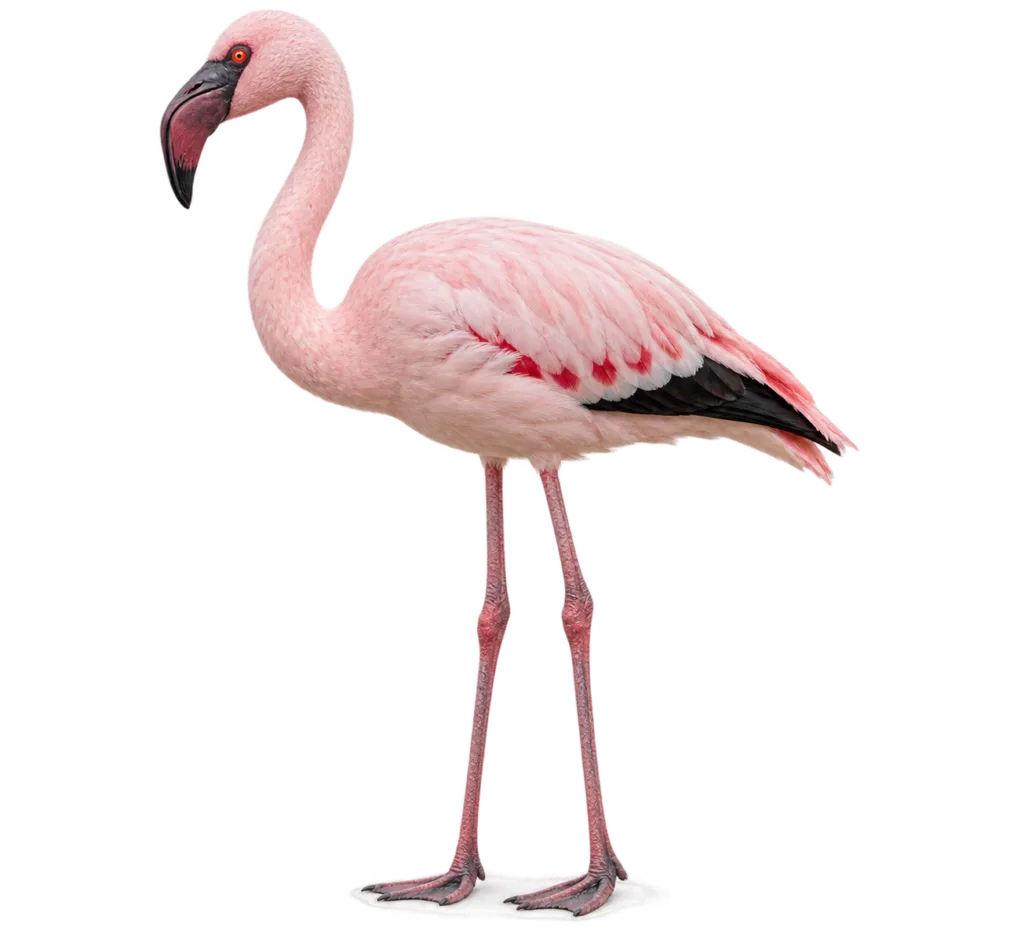
The Lesser Flamingo (Phoeniconaias minor) is the smallest living flamingo species, but “lesser” can be misleading when judging its scale. An adult still stands about 80–90 cm (31–35 in) high, with much of that height coming from exceptionally long legs and an upright neck rather than a large, heavy body.
How Large Is a Lesser Flamingo?
Typical adults weigh around 1.5–2.0 kg (3.3–4.4 lb) and have a wingspan of roughly 95–100 cm (37–39 in). The combination produces an unusual shape: a relatively light body supported high above the ground, with a long neck extending the bird’s vertical profile even farther.
Height, body length, wing measurements and wingspan describe different parts of the bird and should not be treated as interchangeable. Standing height is especially dependent on posture because a flamingo can hold its neck fully upright, curve it downward while feeding or tuck it back toward the body while resting.
A Light Body on Long Legs
The Lesser Flamingo’s body is much more compact than its standing outline suggests. Its chest and abdomen occupy only a portion of the space between the feet and head. The long tarsi and lower legs provide much of the visible height.
This proportion becomes particularly clear when the bird lowers its head to feed. The neck can reach toward the water while the body remains elevated above the surface. When the neck is raised again, the same bird appears markedly taller even though its structural dimensions have not changed.
Males Average Larger Than Females
Male and female Lesser Flamingos have the same basic body plan and plumage pattern, so body size alone is not a reliable way to sex an isolated bird. Measurements from adult birds do, however, show that males average larger.
| Measurement | Adult Male Average | Adult Female Average |
|---|---|---|
| Body Mass | 1,798 g | 1,529 g |
| Wing Length | 346.5 mm | 322.5 mm |
| Tarsus Length | 242.8 mm | 213.4 mm |
| Culmen Length | 102.2 mm | 94.1 mm |
The difference appears across several structures rather than in body mass alone. A male may have a longer wing, tarsus and bill on average, giving it slightly larger overall proportions. There is still individual variation, so these averages should not be read as fixed dimensions for every bird.
The Bill Gives the Head Its Distinctive Scale
The head looks small relative to the legs and neck, yet the bill is a substantial structure. Adult measurements place average culmen length at about 10.2 cm in males and 9.4 cm in females.
The bill is deep, strongly bent downward and extensively dark toward the outer portion. Its shape is closely tied to the Lesser Flamingo’s specialized filtering method. Fine filtering structures inside the bill help separate very small food particles from water.
The dark area covers a large portion of the bill, creating a strong visual boundary against the pale pink head. The bill can therefore appear proportionally larger than its linear measurement alone might suggest.
Wingspan Is Close to One Metre
A standing Lesser Flamingo looks narrow because the wings are folded tightly against the body. Once extended, they span approximately 95–100 cm, close to one metre from wingtip to wingtip.
Flight also changes the apparent proportions of the bird. Instead of the compact, vertical outline seen while standing, the neck extends ahead of the body and the long legs trail behind. This produces a much longer horizontal silhouette while the wings provide most of the visible width.
The wings contain dark flight feathers that are partly concealed when the bird is standing. Their exposure in flight makes the wing structure more obvious and gives the flying bird a different visual balance from one resting or feeding in shallow water.
Juveniles Look Heavier Even Without Being Larger
Young Lesser Flamingos lack the clean pink appearance of adults. Juvenile plumage is grey-brown, especially around the head and neck. The darker, less uniform feathering can make the body look visually denser than that of a pale adult.
Body proportions also continue to develop as young birds mature. Because plumage, bill coloration and overall appearance change with age, perceived size in the field does not always match a bird’s actual measurements. Posture adds another layer of variation: a bird with its neck lowered can look much shorter than another individual standing fully erect only a short distance away.
Data
Measurement sources
- Data status
- Measured
- Size measurements
- AVONET — Tobias et al. (2022)
- Morphology source
- AVONET — Tobias et al. (2022)
- Morphology dataset
- AVONET v7 — BirdLife taxonomy
- Morphology dataset license
- CC BY 4.0
Full source links, dataset definitions, licensing details and measurement methodology are maintained on the Data Sources & Methodology page.