Bird size profile
Little Penguin
Eudyptula minor
Size at a glance
How big is a Little Penguin?
Compare
Compare Little Penguin with another bird
Search by common or scientific name.
Morphology
Detailed measurements
Taxonomy
Classification
The Little Penguin, Eudyptula minor, sits at the smallest end of the penguin size spectrum. Its compact body can make simple size figures misleading, however, because published sources may describe standing height, overall body length, or mass rather than the same physical measurement.
The Smallest Penguin Has More Than One Useful Size Figure
A Little Penguin described as roughly 25 cm tall is therefore not necessarily in conflict with a source giving a measurement near 40 cm. Standing height and body length are different dimensions. A penguin’s neck, posture and angled body make that distinction especially important.
A measurement should be compared only with the same type of measurement. Height, total length, flipper length and bill length cannot be substituted for one another or converted reliably from a single published figure.
A Compact Body Changes How Size Looks
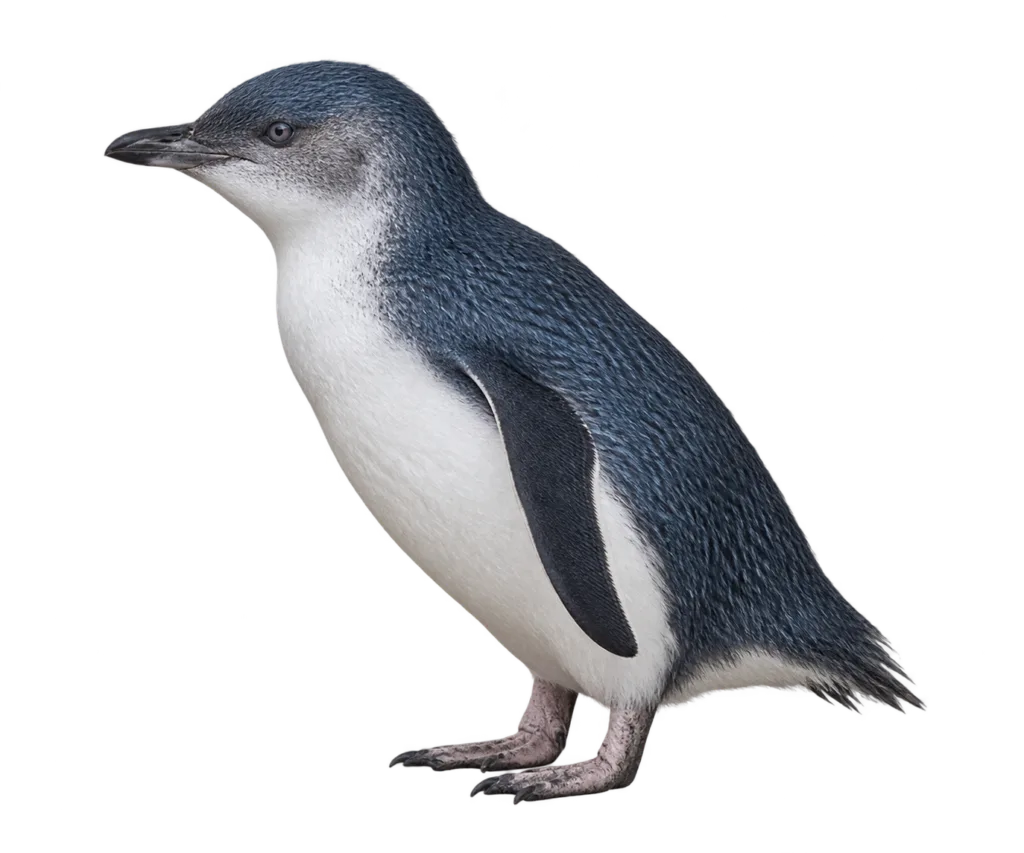
Little Penguins have a short, streamlined outline rather than the tall profile associated with larger penguins. The head blends into a thick neck, the trunk is rounded, and the legs are short. Their feet sit well toward the rear of the body, contributing to the upright stance and characteristic waddle seen on land.
The wings have become stiff, flattened flippers. In an adult they are only a fraction of total body length, but they give the bird a broader silhouette when held away from the sides. With the flippers tucked close to the body, the same penguin can look much narrower.
This shape also explains why photographs can be poor guides to scale. A front-facing bird emphasizes the chest and upright posture, while a side view shows more of the long, tapered body extending behind the legs.
Bill Shape Reveals Differences That Plumage Often Does Not
Adult males and females look very similar in plumage, and their overall size ranges overlap. Researchers have found more useful sex-related differences in the bill. Males generally have longer and deeper bills, although the degree of separation varies among populations.
This matters when interpreting measurements from individual birds. A slightly heavier or larger-looking penguin cannot safely be identified as male from appearance alone. Morphometric studies usually combine carefully defined bill measurements, and methods developed for one colony may not perform equally well elsewhere.
Body Mass Is More Variable Than Skeletal Size
A figure near 1 kg is a useful description of Little Penguin body mass, but weight is not a fixed species measurement. Food intake, breeding activity, geographic population and time of year can all affect what an adult weighs when measured.
Moult produces an especially important change in body condition. Penguins must remain ashore while replacing their plumage, so they build reserves beforehand and lose mass while fasting. A weight taken around this period does not represent the same condition as a measurement from a bird actively feeding at sea.
Research on Australian colonies has also found geographic differences in body mass and bill dimensions. For that reason, a single population average should not be treated as an exact value for every Little Penguin throughout its range.
Blue Plumage Helps Define the Little Penguin’s Outline
The upperparts are blue to dark blue rather than the solid black associated with many other penguins. The underside is pale, producing a clear boundary along the neck, chest, belly and lower surfaces of the flippers. The bill is dark, while the feet are generally much paler.
Young birds can appear brighter blue and may have a finer-looking bill than mature adults. These age-related differences can change the impression of body proportions even when a photograph provides no reliable scale.
The combination of small absolute size, short legs, narrow flippers and a relatively fine bill gives Eudyptula minor a compact profile. Accurate size interpretation depends less on one headline number than on knowing exactly which part of that profile was measured.
Data
Measurement sources
- Data status
- Measured
- Size measurements
- AVONET — Tobias et al. (2022)
- Morphology source
- AVONET — Tobias et al. (2022)
- Morphology dataset
- AVONET v7 — BirdLife taxonomy
- Morphology dataset license
- CC BY 4.0
Full source links, dataset definitions, licensing details and measurement methodology are maintained on the Data Sources & Methodology page.