Bird size profile
Mallard
Anas platyrhynchos
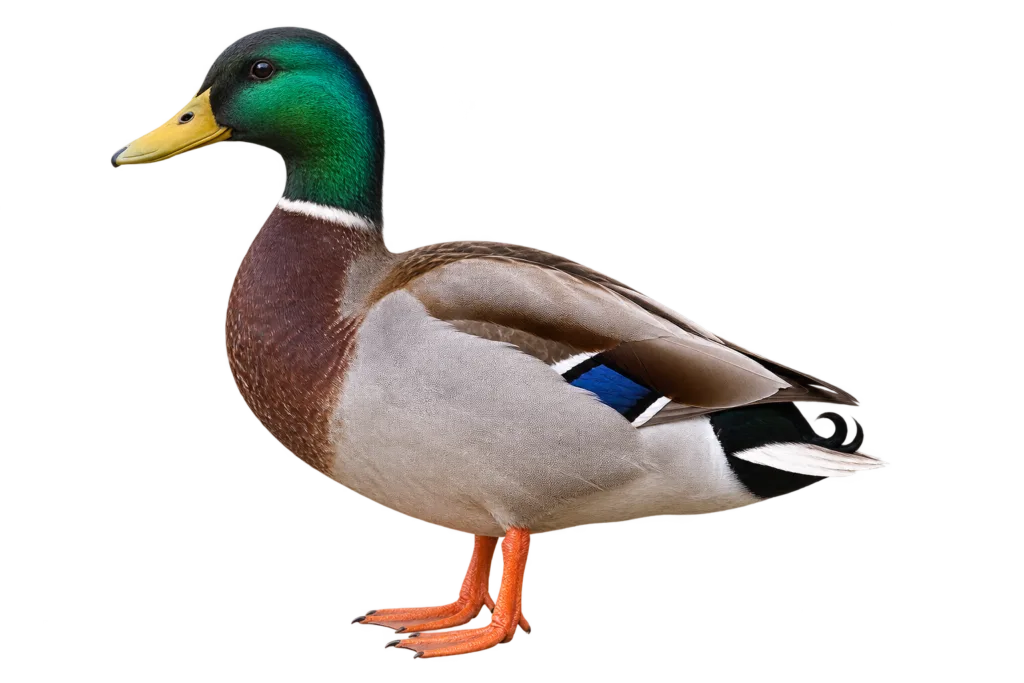
Size at a glance
How big is a Mallard?
True-scale visual
Mallard compared with a 175 cm person
When a transparent species asset and body-length data are available, BirdSize places the real bird asset and the fixed human reference on one mathematical centimetre scale.
Compare
Compare Mallard with another bird
Search by common or scientific name.
Morphology
Detailed measurements
Taxonomy
Classification
A wild Mallard (Anas platyrhynchos) is a fairly large, heavy-bodied duck. Adults are commonly about 50–65 cm (19.7–25.6 in) long, with a wingspan around 82–95 cm (32.3–37.4 in). Those numbers describe different dimensions, however, and neither one alone captures how broad and substantial a Mallard can look on the water.
How Large Is a Mallard?
Length is the most useful measurement for judging how much space a Mallard occupies from bill to tail. It does not mean that a standing or swimming duck rises 50–65 cm vertically. Much of that distance runs horizontally through the bill, head, body, and tail.
Wingspan describes something different. A Mallard with its wings folded looks much narrower than its 82–95 cm flight span suggests. When the wings open, the bird suddenly occupies a space approaching a metre across even though its body remains only a little over half a metre long.
Weight is also independent of length. Two adults with similar body lengths can differ noticeably in mass because of sex, body condition, age, and seasonal changes. This is one reason a single weight should not be treated as the defining size of the species.
Males Tend to Be Heavier Than Females
Mallard drakes and hens overlap greatly in overall dimensions, but biometric records show a clear average difference in mass. British Trust for Ornithology data from live adults give an average body weight of about 1,270 g for males and 1,130 g for females.
The difference is easier to notice when a male and female stand close together than when either bird is viewed alone. Plumage can strengthen the impression: a breeding drake’s solid chestnut breast, gray sides, dark rear, and rounded green head give the body visually distinct blocks, while a hen’s mottled brown pattern can soften its outline.
Measured wing length shows the same general sex difference. BTO records give averages of about 281 mm for adult males and 265 mm for adult females. These biometric wing measurements should not be confused with total wingspan, which measures the distance across both extended wings.
The Mallard’s Shape Adds to Its Apparent Size
Mallards have a long, hefty body, a rounded head, and a broad, flat bill. The neck is not extremely long, so the head often appears closely integrated with the body rather than projecting far forward. On the water, the tail typically rides high and gives the rear of the bird a blunt profile.
This build makes a Mallard look more substantial than a slimmer bird of comparable length. Body length therefore works best when considered alongside shape. A narrow bird can extend over a similar front-to-back distance while containing much less body volume.
Why the Same Mallard Can Look Different on Water and in Flight
A floating Mallard reveals only part of its body because the lower torso and legs sit at or below the waterline. The visible shape is dominated by the head, bill, back, breast, and raised tail. This can make judging its full body size from a pond-side view difficult.
On land, more of the body is visible, but the legs are relatively short compared with those of long-legged waterbirds. A Mallard therefore remains low to the ground despite having a body more than half a metre long in larger individuals.
Flight changes the proportions most dramatically. The neck extends forward, the feet are drawn toward the body, and the broad wings open to a span considerably greater than body length. A duck that looked compact while swimming can therefore appear much larger as soon as it takes off.
The wings are also set relatively far back on the body. Combined with a broad wing shape, this gives a flying Mallard a different outline from the dense, rounded form seen when it is resting on water.
Where Mallards Sit Among Familiar Waterfowl
Mallards occupy the larger end of the familiar dabbling-duck range. They are plainly bigger than small teal and somewhat larger than species such as the Northern Shoveler, yet they remain far smaller than a typical goose.
| Bird | Typical Length Range | How It Compares |
|---|---|---|
| Blue-winged Teal | About 36–41 cm | Much smaller and more compact than a Mallard |
| Northern Shoveler | About 44–51 cm | Usually shorter and lighter |
| Mallard | 50–65 cm | Large, heavy-bodied dabbling duck |
| Common Merganser | About 54–71 cm | Often longer, with a more elongated profile |
These comparisons also show why length should not be used as a substitute for shape. A Common Merganser may overlap a Mallard in length, but its longer, narrower bill and more stretched body produce a very different silhouette. Mallards retain the broad, compact look associated with a large dabbling duck.
Wild Mallard Measurements Do Not Fit Every Park Duck
Size estimates are most dependable when the bird is a typical wild Mallard. Domestic ducks complicate comparisons because most domestic duck breeds descend from Mallards and may differ greatly in mass, proportions, plumage, or posture. Domestic and Mallard-derived birds are also common around urban ponds.
A very heavy duck with Mallard-like coloring is therefore not automatically evidence that wild Mallards exceed their normal size range. Likewise, unusual white patches, altered body proportions, crests, or exceptionally bulky builds can point toward domestic ancestry rather than ordinary variation within a wild Mallard.
Hybridization can create another source of variation. Mallards interbreed with several closely related ducks, and some hybrids retain much of the Mallard’s general body form. For accurate size comparison, a clearly identifiable wild-type adult provides a better reference than an unusually colored or unusually heavy pond duck.
Data
Measurement sources
- Data status
- Measured
- Size measurements
- Cornell Lab of Ornithology – All About Birds
- Morphology source
- AVONET — Tobias et al. (2022)
- Morphology dataset
- AVONET v7 — BirdLife taxonomy
- Morphology dataset license
- CC BY 4.0
Full source links, dataset definitions, licensing details and measurement methodology are maintained on the Data Sources & Methodology page.