Bird size profile
Mandarin Duck
Aix galericulata
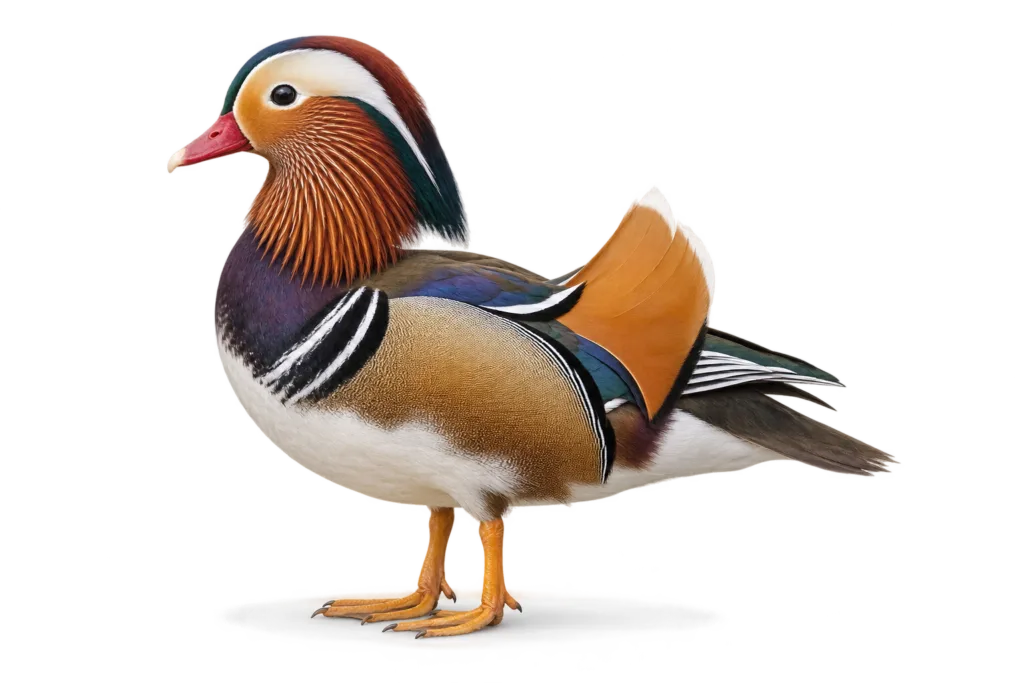
Size at a glance
How big is a Mandarin Duck?
Compare
Compare Mandarin Duck with another bird
Search by common or scientific name.
Morphology
Detailed measurements
Taxonomy
Classification
The Mandarin Duck (Aix galericulata) is a compact perching duck whose elaborate plumage can make its size surprisingly difficult to judge. Adults are generally about 41–49 cm (16–19 in) long, with a wingspan of roughly 65–75 cm (26–30 in). The breeding male often appears larger than these measurements suggest because its crest, long facial feathers, and raised orange “sails” extend the visible outline of the bird.
A Compact Duck With an Expanded Visual Profile
Mandarin Ducks have a relatively short, compact body rather than the long outline seen in many larger waterfowl. The head is crested, the neck is fairly short, and the body sits low on the water. This combination gives the bird a rounded appearance when swimming.
The drake’s most unusual size-related feature is not its body but its plumage. During breeding plumage, two enlarged orange feathers rise above the back like small sails. Together with the crest and elongated facial feathers, they increase the apparent height and volume of a resting male without representing a comparable increase in body size.
Male and Female Size Overlap Closely
The difference between the sexes is much more obvious in plumage than in physical size. Measurements from live adult birds show males averaging somewhat heavier and having slightly longer wings, but there is broad overlap between the sexes.
| Adult Measurement | Male | Female |
|---|---|---|
| Average wing length | 239.4 mm | 231.1 mm |
| Recorded wing-length range | 230–251 mm | 220–240 mm |
| Average body weight | 634.5 g | 600.8 g |
| Typical measured weight range | 550–700 g | 500–700 g |
An adult male therefore tends to be a little heavier and longer-winged, but sex cannot be determined reliably from size alone. A large female can overlap with a smaller male in both measurements.
Why Breeding Males Look Larger
Male Mandarin Ducks provide a clear example of the difference between structural size and apparent size. The breeding drake carries a prominent crest, broad reddish facial feathers and the distinctive orange sail feathers. These structures change the outline seen from the side and rear.
The orange sails are especially deceptive when estimating height. They project upward while the bird is resting or swimming, yet they are specialized feathers rather than part of the body itself. The result is a bird that can appear taller and bulkier than a female even though their underlying dimensions remain fairly close.
Wing length and wingspan describe different dimensions. A wing length near 23–24 cm is a measurement of one folded wing, while a wingspan around 65–75 cm measures the distance from one wingtip to the other when both wings are extended.
The Silhouette Changes With Plumage
The familiar breeding male does not keep the same ornate appearance throughout the year. After breeding, males molt into a much plainer eclipse plumage. The loss of the most conspicuous ornamental feathers reduces the exaggerated outline, making the bird appear closer in shape to the female.
This seasonal change affects visual impressions more than actual body dimensions. A male in eclipse plumage remains within the same adult size class even though the reduced crest and missing sails can make it look noticeably smaller at first glance.
Body Proportions Help Explain Its Size
Mandarin Ducks combine a compact torso with relatively broad wings and a crested head. On the water, much of the lower body is hidden, so the visible head, back and ornamental plumage dominate the impression of size. When the bird takes flight, the full wing spread reveals a wider profile than the resting body suggests.
The feet and legs are positioned for both swimming and perching, and Mandarin Ducks readily use trees. Their proportions suit a species that occupies wooded wetlands and nests in tree cavities rather than relying only on open water. The compact body is therefore more representative of the bird’s true scale than the dramatic outline of a breeding drake.
Data
Measurement sources
- Data status
- Measured
- Size measurements
- AVONET — Tobias et al. (2022)
- Morphology source
- AVONET — Tobias et al. (2022)
- Morphology dataset
- AVONET v7 — BirdLife taxonomy
- Morphology dataset license
- CC BY 4.0
Full source links, dataset definitions, licensing details and measurement methodology are maintained on the Data Sources & Methodology page.