Bird size profile
Marabou Stork
Leptoptilos crumenifer
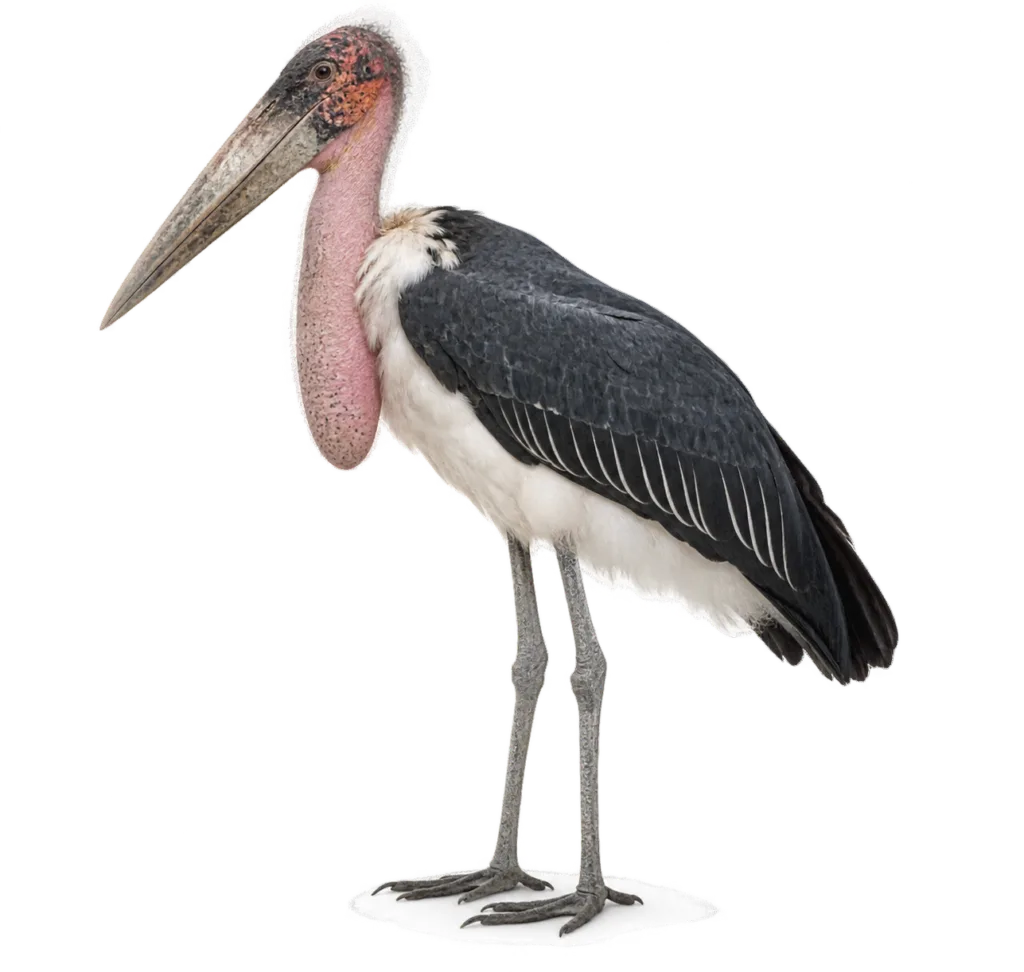
Size at a glance
How big is a Marabou Stork?
Compare
Compare Marabou Stork with another bird
Search by common or scientific name.
Morphology
Detailed measurements
Taxonomy
Classification
The Marabou Stork (Leptoptilos crumenifer) is built on a scale that is unusual even among storks. Adult body length is commonly reported at about 115–152 cm (45–60 in), while the wings usually span roughly 2.25–2.87 m (7.4–9.4 ft). Its mass is much less extreme than its outline suggests, generally falling within a range of about 4–8.9 kg (8.8–19.6 lb).
Its Wingspan Creates Most of the Visual Scale
A standing Marabou Stork already looks tall because long legs support a large, deep-bodied frame. The impression changes further when the wings open. A normal adult wingspan reaches well beyond twice the bird’s body length, giving it the broad silhouette associated with very large soaring birds.
Published figures do not all stop at the upper end of the usual 2.8–2.9 m range. A verified wingspan of 3.2 m (10.5 ft) has been reported for the species. That figure is better treated as an exceptional measurement rather than the expected span of an ordinary adult. Most references place typical adults closer to the mid-two-metre range.
Why the largest number can be misleading
A maximum or record wingspan describes an unusually large individual. It should not be read as the standard size of every Marabou Stork. Published ranges around 2.25–2.9 m give a more useful picture of normal adult wing size.
Body Length, Standing Height, and Wingspan Measure Different Things
Marabou measurements can appear inconsistent because references do not always describe the same dimension. A figure near 1.5 m may refer to the bird’s overall standing height in one source and to body length in another. Those measurements are not interchangeable.
Posture adds another complication. The Marabou often stands with the neck partly drawn in and the shoulders raised, producing its familiar hunched outline. A bird in that posture can look shorter and much heavier than the same individual with its neck extended. Long legs account for a large part of its standing height, while the neck can change the visible height from moment to moment.
Weight varies independently of those linear measurements. Reference ranges extending from about 4 kg to almost 9 kg reflect differences among individuals, while regional descriptions often place adults around 6–7 kg. Males are generally larger than females even though the sexes have broadly similar plumage.
A Large Bill Changes the Proportions of the Head
The bill is one of the strongest contributors to the Marabou Stork’s unusual proportions. It is long, thick and wedge-shaped rather than slender like the bills of many other large wading birds. Very large examples can approach 35 cm (about 14 in) in length.
That bill projects from a mostly bare head and neck, so there are few feathers to soften its outline. The result is a head profile that looks disproportionately large compared with the narrow neck beneath it. The white neck ruff begins lower down and visually separates the bare head from the dark upper body.
Broad Wings
Provide the enormous lateral span seen in flight and support soaring with relatively little continuous flapping.
Heavy Bill
Adds considerable length and visual mass to the head without making the whole bird exceptionally heavy for its size.
Long Legs
Raise the body well above the ground and account for much of the bird’s standing height.
The Throat Pouch Makes the Neck Look Heavier Than It Is
Adult Marabou Storks have a conspicuous inflatable gular sac hanging from the front of the neck. Its size changes the apparent depth of the neck and chest area, especially when viewed from the side. It is not a storage pouch for food. The structure is associated with display and communication.
The pouch, bare neck, massive bill and raised shoulder line can make the bird look bulky when standing. In flight, the proportions become clearer: the body occupies a relatively small part of a very broad wing profile, with the long legs extending behind it.
Why a Marabou Can Look Heavier Than Its Actual Mass
A bird approaching 1.5 m in length with wings spreading close to 3 m might be expected to weigh far more than 6–9 kg. Flight places limits on mass, however, and much of the Marabou’s apparent size comes from elongated structures rather than a massive torso. Long limb bones, an extended neck, a large bill and broad feathered wings all enlarge the visible outline without adding the weight that a similarly sized solid-bodied animal would carry.
This difference is especially noticeable when the wings are folded. The large flight feathers lie over the body and create a deep, cloak-like profile. Once the bird spreads its wings, the same structure produces a wide soaring surface rather than a thick body.
Taxonomic Names Seen in Measurement Sources
Current major taxonomic references use Leptoptilos crumenifer. The form Leptoptilos crumeniferus remains common in older field guides, zoo records and scientific literature. Both names may therefore appear beside otherwise compatible Marabou Stork measurements.
The name difference is worth recognizing when comparing older and newer measurement records. It does not indicate two differently sized African Marabou species.
Data
Measurement sources
- Data status
- Measured
- Size measurements
- AVONET — Tobias et al. (2022)
- Morphology source
- AVONET — Tobias et al. (2022)
- Morphology dataset
- AVONET v7 — BirdLife taxonomy
- Morphology dataset license
- CC BY 4.0
Full source links, dataset definitions, licensing details and measurement methodology are maintained on the Data Sources & Methodology page.