Bird size profile
Muscovy Duck
Cairina moschata
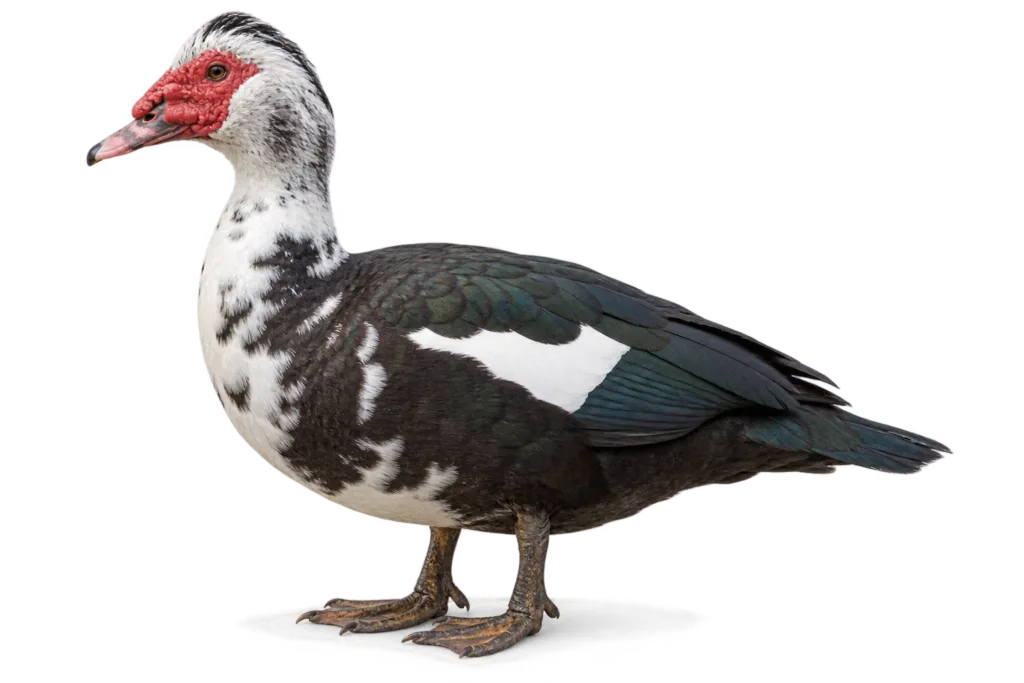
Size at a glance
How big is a Muscovy Duck?
Compare
Compare Muscovy Duck with another bird
Search by common or scientific name.
Morphology
Detailed measurements
Taxonomy
Classification
The Muscovy Duck (Cairina moschata) is a large, heavy-bodied duck with an unusually strong difference in size between adult males and females. Its long neck, broad body, extended tail, sloping forehead, and bare facial skin also give it proportions quite different from the compact outline associated with many familiar ducks.
How Large Is a Muscovy Duck?
These combined measurements cover a broad size range because Muscovy Ducks show pronounced sexual size differences. Adult males occupy the larger end of the range, while females have a noticeably smaller and lighter build. Domesticated birds can also exceed the dimensions commonly seen in wild populations, so measurements from poultry breeds should not automatically be treated as typical measurements for wild birds.
That variation explains why apparently conflicting Muscovy Duck weights appear in reference material. Some accounts focus on wild birds, while others include domestic strains selectively bred for greater body mass. For a species-level size profile, wild and domestic measurements are best kept distinct rather than blended into one expected adult weight.
Male and Female Size Differences
Sexual size dimorphism is one of the most visible features of the species. Adult drakes develop a deeper chest, broader body, thicker neck, and substantially greater overall mass than females. The difference can be large enough that a male and female standing together may initially appear to belong to different size classes.
The difference involves more than body weight. Morphometric studies of Muscovy Ducks have found males larger across several structural measurements, including body length, wing length, bill dimensions, and leg measurements. As a result, sex affects the bird’s overall proportions as well as its mass.
A Long-Necked, Heavy-Bodied Shape
Muscovy Ducks have a substantial body carried beneath a relatively long neck. The bill is fairly long and follows a smooth line toward the forehead, while the tail extends farther behind the body than it does in many shorter-tailed ducks. Together, these features create an elongated profile despite the bird’s considerable body mass.
The wings are also large. A documented wingspan reaching roughly a metre and a half means that the folded wing can look modest beside the bulky body even though the extended wings are broad and powerful. Wild Muscovy Ducks regularly use wooded habitats near water and are associated with tree roosting and cavity nesting, so their structure is not limited to movement on open water.
Facial Structure Changes the Bird’s Apparent Size
The head of an adult Muscovy Duck is visually distinctive because of the bare reddish skin and fleshy caruncles around the face. These structures are especially prominent in mature males and can make the head look heavier and broader than its underlying skeletal dimensions would suggest. Females generally show less developed facial ornamentation.
Head shape is therefore useful when judging the proportions of an adult bird. A large male combines a thick neck, substantial head profile, and broad torso, while a female usually presents a finer version of the same basic body plan. Juveniles are less strongly ornamented, so age can also alter the apparent proportions of the face.
Wild and Domestic Birds Can Look Very Different
Wild Muscovy Ducks are predominantly dark, with glossy greenish or purplish reflections and conspicuous white areas in the wings. Domestic and feral birds occur in a much wider range of plumage patterns, including birds with extensive white, brown, or mixed coloration. Plumage variation can be dramatic, but it does not change the underlying species identity.
Domestic Muscovy Ducks may be considerably heavier than truly wild birds. A weight reported for a farm or domestic strain should therefore not be assumed to represent the normal mass of a wild adult Cairina moschata.
This distinction matters most at the upper end of the size range. Selective breeding and husbandry can produce exceptionally heavy domestic drakes, whereas wild birds retain a leaner flight-capable form. Comparing measurements is most useful when the sex, age, and wild or domestic status of the bird are known.
Data
Measurement sources
- Data status
- Measured
- Size measurements
- AVONET — Tobias et al. (2022)
- Morphology source
- AVONET — Tobias et al. (2022)
- Morphology dataset
- AVONET v7 — BirdLife taxonomy
- Morphology dataset license
- CC BY 4.0
Full source links, dataset definitions, licensing details and measurement methodology are maintained on the Data Sources & Methodology page.