Bird size profile
Mute Swan
Cygnus olor
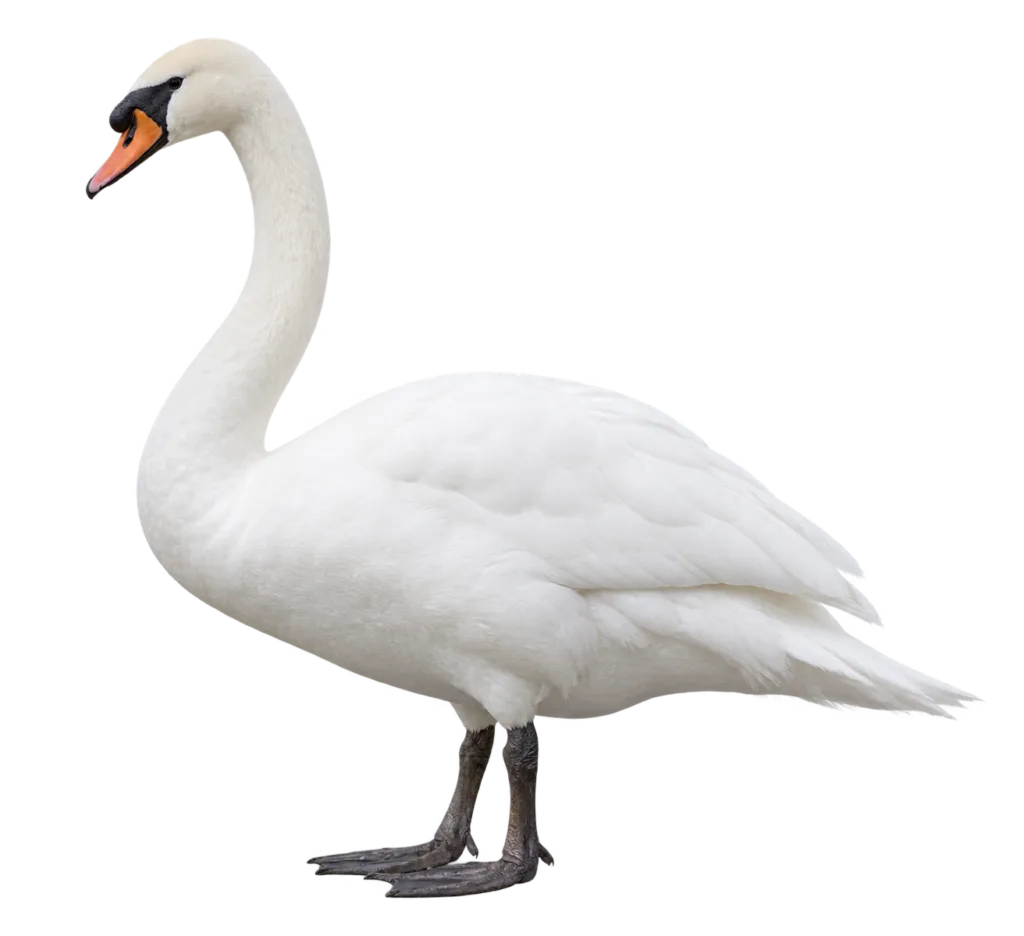
Size at a glance
How big is a Mute Swan?
True-scale visual
Mute Swan compared with a 175 cm person
When a transparent species asset and body-length data are available, BirdSize places the real bird asset and the fixed human reference on one mathematical centimetre scale.
Compare
Compare Mute Swan with another bird
Search by common or scientific name.
Morphology
Detailed measurements
Taxonomy
Classification
The Mute Swan (Cygnus olor) is one of the largest familiar waterbirds, but its size is easy to misread because so much of its apparent length comes from a flexible neck. A bird resting on the water can look compact; the same individual with its neck fully extended has a very different outline.
Published measurements place adults roughly in the 1.3–1.6 m body-length range, while the open wings extend a little over 2 m across. Those figures describe different dimensions. Neither one is the same as the bird’s vertical standing height.
A Long Neck Makes Total Length Easy to Misread
Standard bird length is a head-to-tail measurement, not a measure of how high the bird stands above the ground. That distinction matters especially for a Mute Swan. Its long neck can be held upright, stretched forward, lowered to feed, or curved into the familiar S-shaped posture. The skeleton has not changed, but the visible height can change a great deal.
Total length follows the bird from the front of the head to the end of the tail. Standing height depends on posture. Wingspan is measured across both fully opened wings. One figure should not be substituted for another.
The body itself is deep and heavy, with short legs set well back. On land, the legs add less height than the neck does. On water, part of the body sits below the surface, which can make a swimming swan look smaller than the same bird seen standing nearby.
Cobs Are Noticeably Larger Than Pens
Male Mute Swans, called cobs, are larger than females, or pens. British Trust for Ornithology biometric data give an average adult body mass of about 10.75 kg for males and 8.54 kg for females. That is a difference of a little over 2 kg in the measured samples, so sex can have a strong effect on how large an adult appears.
The same pattern appears in linear measurements. BTO data show longer folded wings in males than females, and a 2026 study of 938 Mute Swans measured across four regions of Poland found males larger than females in every linear trait examined. The study also found effects of age and region, which helps explain why a single published size range cannot describe every adult equally well.
The Bill Knob Changes the Head’s Apparent Size
The black knob at the base of the orange bill is one of the species’ most useful identification features, but it is not a fixed indicator of body size. Both sexes have it. Males usually carry a larger knob, and research following individual birds through the breeding season found that its relative size changes over time.
That matters when judging a swan visually. A large cob can look heavier through the head and bill as well as through the body, while the seasonal growth of the knob can strengthen that impression without changing the bird’s underlying skeletal dimensions. Head shape is therefore useful for context, but it should not be treated as a ruler.
The Hidden Scale Is in the Wings
A swimming Mute Swan keeps most of its wing area folded along the back and flanks. Once the wings open, the scale becomes much clearer. Cornell Lab and RSPB measurements place wingspan at about 208–238 cm, so the span can be much greater than the bird’s head-to-tail length.
This difference also explains why the species can look broad and powerful in flight even though the neck is slender. Mute Swans fly with the neck extended, turning the curved swimming silhouette into a long, nearly straight line from bill to tail while the wings provide most of the width.
Why Published Size Ranges Do Not Match Exactly
Reference sources do not all publish the same body-length limits. Cornell Lab lists 127–152 cm, while the RSPB gives 140–160 cm. Other references use still slightly different ranges. These should be read as dataset-based reference intervals rather than hard biological boundaries.
Several sources of variation are real. Males are larger than females, first-year birds can differ from older birds, and the 2026 Polish biometric study found geographic differences in some measurements. Measurement choice matters too: folded-wing length, forearm length, primary-feather length, head length, total body length, and wingspan are separate traits and should not be merged into one generic idea of “size.”
For visual comparison, the most useful approach is to keep each dimension tied to what it actually measures. Body length describes the bird’s long head-to-tail form, mass describes its bulk, and wingspan shows the much wider profile revealed only when the wings are fully open.
Data
Measurement sources
- Data status
- Measured
- Size measurements
- Cornell Lab of Ornithology – All About Birds
- Morphology source
- AVONET — Tobias et al. (2022)
- Morphology dataset
- AVONET v7 — BirdLife taxonomy
- Morphology dataset license
- CC BY 4.0
Full source links, dataset definitions, licensing details and measurement methodology are maintained on the Data Sources & Methodology page.