Bird size profile
Peregrine Falcon
Falco peregrinus
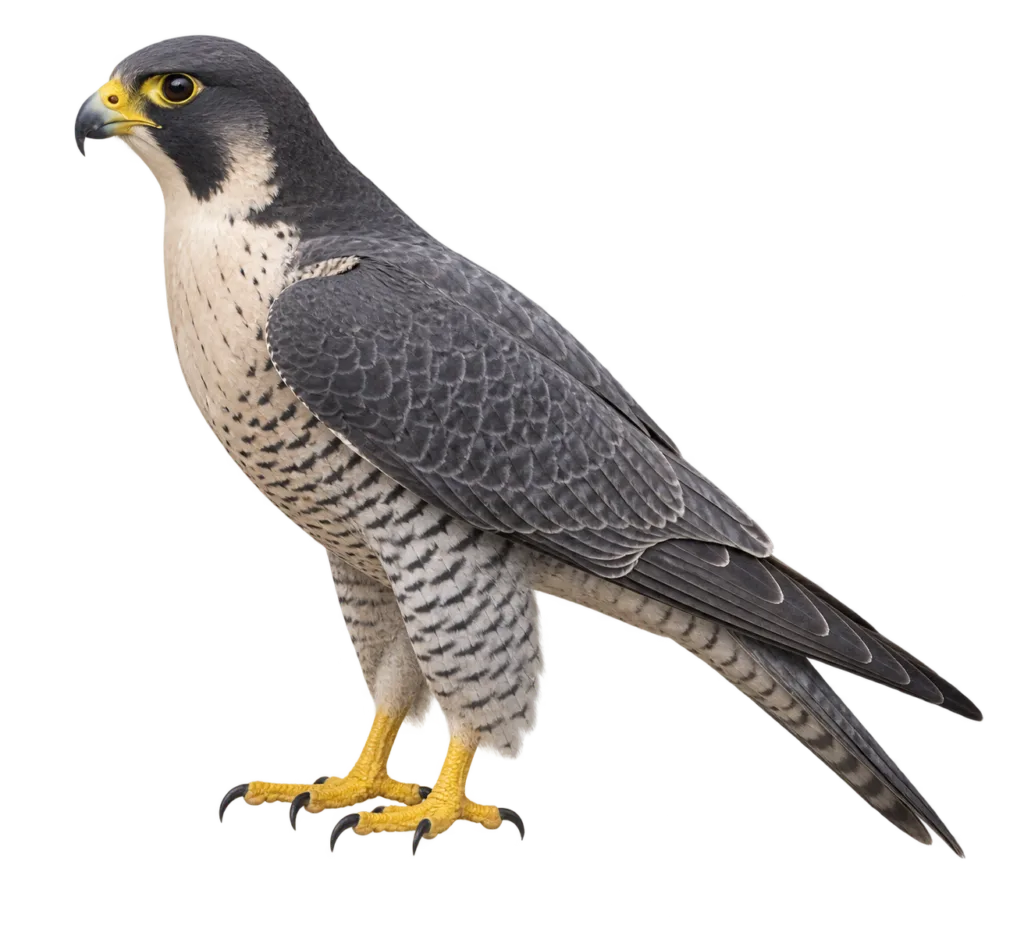
Size at a glance
How big is a Peregrine Falcon?
True-scale visual
Peregrine Falcon compared with a 175 cm person
When a transparent species asset and body-length data are available, BirdSize places the real bird asset and the fixed human reference on one mathematical centimetre scale.
Compare
Compare Peregrine Falcon with another bird
Search by common or scientific name.
Morphology
Detailed measurements
Taxonomy
Classification
The Peregrine Falcon (Falco peregrinus) is often described as crow-sized, but that shorthand hides an unusually broad spread of body sizes. A small male and a large female can look strikingly different in mass, while birds from different parts of the species’ range add another layer of variation. Its long, pointed wings also make the falcon appear larger in flight than its compact perched body might suggest.
Why Peregrine Falcon Size Varies So Much
Sex is one of the main reasons published measurements cover such a wide range. Female Peregrine Falcons are typically about 15–20% longer and 40–50% heavier than males. The difference in mass is much greater than the difference in body length, so a female often looks broader, deeper-bodied, and more substantial rather than simply a longer version of a male.
| Sex | Typical Length Range | Average Mass | Reported Mass Range |
|---|---|---|---|
| Male | 36–49 cm (14.2–19.3 in) | About 650 g (1.43 lb) | 450–1,060 g (15.9–37.4 oz) |
| Female | 45–58 cm (17.7–22.8 in) | About 950 g (2.09 lb) | 800–1,600 g (28.2–56.4 oz) |
Those figures also explain why a single average weight can be misleading. A male near the lower end of the range may weigh less than half as much as a large female. Within the same geographic form, size usually separates the sexes more clearly than plumage does.
Published ranges do not always match exactly because references may cover different populations, sexes, geographic forms, or measurement samples. A broad species-level range should not be interpreted as the normal variation within one local breeding population.
A Long-Winged Shape Around a Compact Body
A Peregrine Falcon is not built like a broad-winged soaring hawk. Its wings are long and strongly pointed, with elongated outer flight feathers creating the narrow falcon silhouette that remains visible even at considerable distance.
When perched, the body looks dense through the chest and shoulders, while the folded wings extend far back along the tail. In North American field descriptions, the Peregrine is notable for having folded wingtips that can reach roughly to the tail tip. This makes the rear half of a perched bird look unusually long even though the torso itself is compact.
That combination matters when judging size in the field. A Peregrine crossing open sky may seem much larger than the same bird sitting on a ledge because extended wings dominate its visible dimensions. Distance can amplify the effect, especially when there is no nearby object for scale.
Male and Female Peregrines Can Look Like Different Size Classes
The smaller male is traditionally called a tiercel. At close range, a paired male and female usually make the size difference obvious. The female has heavier legs and feet, a fuller body, and greater mass, while the male tends to look more compact.
This reverse size pattern is normal in Peregrine Falcons and many other birds of prey. It also creates identification problems when only one bird is visible. A small male Peregrine can approach the apparent size of a larger individual of a smaller falcon species, while a large female can seem surprisingly close to the lower end of a Gyrfalcon’s size.
Size Overlap With Other Falcons
Body length alone is not enough to identify a Peregrine. The Prairie Falcon is a good example: its published length and wingspan ranges overlap heavily with those of the Peregrine even though the two species differ in coloration and several structural details.
| Falcon | Length | Weight | Wingspan |
|---|---|---|---|
| Merlin | 24–30 cm | 160–240 g | 53–68 cm |
| Peregrine Falcon | 36–49 cm | 530–1,600 g | 100–110 cm |
| Prairie Falcon | 37–47 cm | 420–1,100 g | 90–113 cm |
| Gyrfalcon | 48–64 cm | 800–2,100 g | About 123 cm |
The comparison shows why relative size works best at the extremes. A Merlin is normally much smaller, while a Gyrfalcon is generally larger and heavier. A Prairie Falcon may occupy nearly the same apparent size class as a Peregrine, making proportions and plumage more useful than estimated length.
Sex can blur these boundaries further. A large female Merlin can reduce the apparent gap with a small male Peregrine, and a large female Peregrine can approach the lower portion of the Gyrfalcon’s mass range. Without a direct scale reference, exact size estimates from a distant bird should be treated cautiously.
Geography Changes the Scale of the Species
Peregrine Falcons occur across an immense geographic range, and their morphology is not identical everywhere. North American populations show a broad tendency for northern birds to be smaller and some western coastal birds to be larger. Wing proportions can vary as well.
Highly migratory Peregrines breeding in Arctic regions tend to have longer, narrower wings than more resident forms. That difference changes the bird’s outline without necessarily producing the same change in body mass.
Peale’s Peregrine Falcon (Falco peregrinus pealei), associated with the Pacific coast of northwestern North America and nearby regions, sits near the opposite end of the local size spectrum. It is regarded as the largest Peregrine form in North America on average. Reported average masses are about 900 g for males and 1,400 g for females, making a large female Peale’s Peregrine a much heavier bird than the familiar idea of a simple “crow-sized falcon” suggests.
Data
Measurement sources
- Data status
- Measured
- Size measurements
- Cornell Lab of Ornithology – All About Birds
- Morphology source
- AVONET — Tobias et al. (2022)
- Morphology dataset
- AVONET v7 — BirdLife taxonomy
- Morphology dataset license
- CC BY 4.0
Full source links, dataset definitions, licensing details and measurement methodology are maintained on the Data Sources & Methodology page.