Bird size profile
Philippine Eagle
Pithecophaga jefferyi
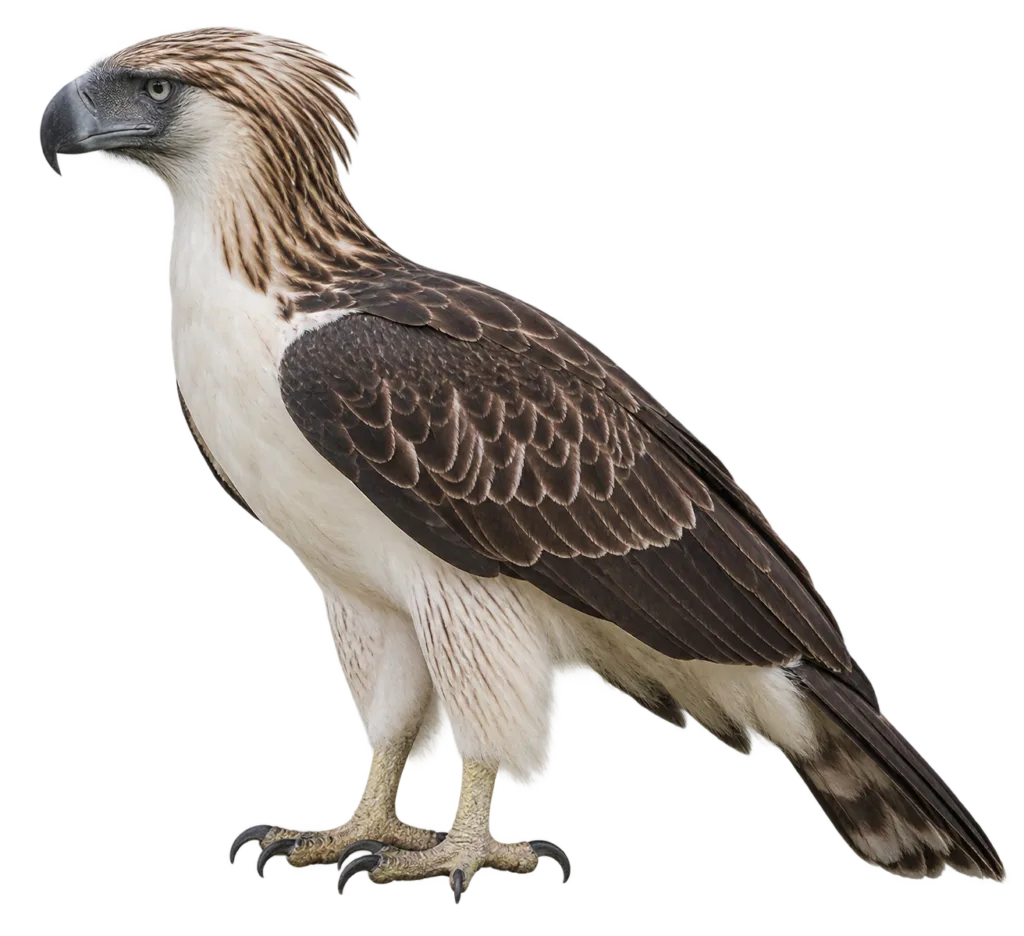
Size at a glance
How big is a Philippine Eagle?
Compare
Compare Philippine Eagle with another bird
Search by common or scientific name.
Morphology
Detailed measurements
Taxonomy
Classification
The Philippine Eagle (Pithecophaga jefferyi) is a very large forest raptor with a long body, broad wings, a deep bill, heavy legs, and an unusually prominent feathered crest. Adults commonly measure about 86–102 cm (34–40 in) in body length, while reported wingspans extend to roughly 184–220 cm (6 ft–7 ft 3 in). Its combination of length, mass, and broad wing area places it among the largest living eagles.
Philippine Eagle Size and Body Proportions
Body length alone does not fully explain how large a Philippine Eagle looks. Much of its visual size comes from the combination of a long torso, long tail, broad wings, thick legs, and a large head. The loose crest feathers can also make the head appear much larger when raised.
Measurements from individual birds can fall outside commonly quoted averages. For example, a young male examined by the Philippine Eagle Foundation in 2026 measured about 90 cm from bill to tail and had a wingspan of about 1.6 m. Age, sex, feather condition, and measurement method can all affect recorded dimensions.
Females Are Noticeably Heavier Than Males
Male and female Philippine Eagles have very similar plumage, so body size is one of the more useful physical differences between the sexes. Females are heavier, and field research has described them as weighing nearly one-third more than males.
Body mass should not be treated as a fixed identification number. Philippine Eagle Foundation records include males around 4.1–4.3 kg in the wild, while measurements of captive birds have produced heavier individuals of both sexes. A set of captive measurements recorded average weights of about 5.1 kg for males and 6.7 kg for females, illustrating how individual and population samples can produce different figures.
Broad Wings and a Long Tail Shape Its Flight Profile
The Philippine Eagle does not have the especially long, narrow wings associated with birds built mainly for open-country soaring. Its wings are broad and rounded, while the tail is long. This produces a distinctive outline when the bird is seen in flight over or between forest canopies.
Even with its large body, the species is relatively compact-winged for its mass. A maximum wingspan of about 220 cm has been documented, yet those wings remain broad rather than extremely elongated. This body plan fits a raptor that lives in dense tropical forest, where control and maneuverability matter as much as sheer span.
The Head and Legs Add to Its Heavy-Built Appearance
The head is dominated by a large, deep, strongly hooked bill and elongated brown-and-cream feathers on the crown and nape. These feathers form the Philippine Eagle’s characteristic shaggy crest. When the crest is raised, the apparent width and height of the head change markedly even though the bird’s underlying skull size has not changed.
The legs are thick and yellow, ending in large feet and strongly curved talons. Together with the deep bill and broad chest, they give a perched Philippine Eagle a heavier appearance than body length alone would suggest. The upperparts are mostly brown, while the belly and much of the underwing are pale or white.
Because males and females are much alike in color, judging sex from a distant view can be difficult. Relative body size and the proportions of the legs may provide clues when two known adults can be assessed under comparable conditions, but measurements or other sexing methods provide firmer evidence.
Why Published Size Figures Do Not Always Match
Philippine Eagle measurements come from different kinds of records, including wild birds, rescued individuals, museum specimens, and birds kept in conservation facilities. Those samples do not always represent the same age, sex, condition, or measurement method.
For that reason, a body length near 90–100 cm and a wingspan around 2 m are more useful as a realistic sense of scale than treating one exact figure as universal. Weight varies even more strongly because females are heavier than males and individual body condition changes over time. A rescued or recently fledged bird may therefore differ considerably from a mature adult measured under different circumstances.
The Philippine Eagle’s size is best read through several measurements together: a body approaching a metre in length, broad wings capable of spanning roughly two metres, a long tail, and a markedly heavier female sex. Those proportions explain the bird’s imposing silhouette without relying on any single measurement.
Data
Measurement sources
- Data status
- Measured
- Size measurements
- AVONET — Tobias et al. (2022)
- Morphology source
- AVONET — Tobias et al. (2022)
- Morphology dataset
- AVONET v7 — BirdLife taxonomy
- Morphology dataset license
- CC BY 4.0
Full source links, dataset definitions, licensing details and measurement methodology are maintained on the Data Sources & Methodology page.