Bird size profile
Pileated Woodpecker
Dryocopus pileatus
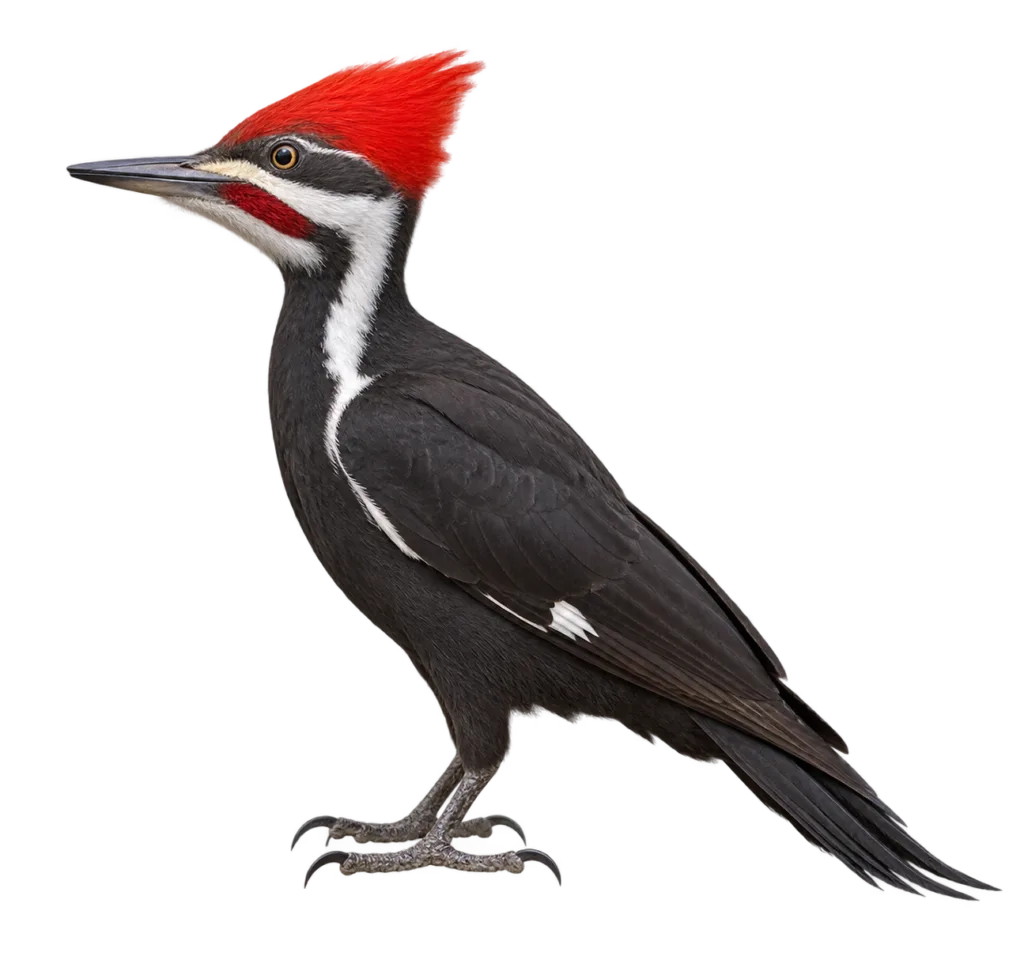
Size at a glance
How big is a Pileated Woodpecker?
True-scale visual
Pileated Woodpecker compared with a 175 cm person
When a transparent species asset and body-length data are available, BirdSize places the real bird asset and the fixed human reference on one mathematical centimetre scale.
Compare
Compare Pileated Woodpecker with another bird
Search by common or scientific name.
Morphology
Detailed measurements
Taxonomy
Classification
The Pileated Woodpecker (Dryocopus pileatus) has a body plan that looks large even before its red crest and bold plumage are considered. Adults measure about 40–49 cm (15.8–19.3 in) from bill to tail, with a long neck, a head-length chisel-shaped bill, broad wings, and a long supporting tail. Those proportions give the bird a tall, elongated profile rather than the compact outline seen in many smaller woodpeckers.
Why the Pileated Woodpecker Looks So Large
Body length tells only part of the story. A Pileated Woodpecker can span roughly 66–75 cm (26.0–29.5 in) across the open wings and typically weighs about 250–350 g (8.8–12.3 oz). The broad wings, extended neck, and long tail make its apparent size change noticeably between a bird pressed against a trunk and one crossing an opening in flight.
The torso itself is fairly streamlined. Much of the impression of bulk comes from the length of the bird from bill tip to tail tip and from the large head-and-neck profile. The pointed crest adds visible height to the head, especially when raised.
Total length follows the bird from the bill to the end of the tail. Wingspan measures the distance between the wingtips when the wings are extended. A Pileated Woodpecker can therefore appear much broader in flight without any change in its actual body length.
The Bill Is Nearly as Long as the Head
The bill is one of the features that separates the Pileated Woodpecker’s shape from a simple large-bird silhouette. It is long, straight, thick at the base, and tapered toward a chisel-like tip. In side view, its exposed length is roughly comparable with the length of the head.
That proportion matters because the bill does not look like a short projection from a large skull. It forms a substantial part of the head profile. Combined with the long neck, it gives a perched bird a forward-reaching shape when it turns away from the trunk.
The head is topped by elongated red crest feathers that sweep backward into a triangular point. The crest can change its apparent shape with posture, so it may look sharply peaked in one view and flatter in another. The underlying head remains large and elongated even when the crest is held down.
The bill also explains part of the species’ distinctive excavation pattern. Pileated Woodpeckers can remove substantial pieces of softened wood while searching beneath the surface, often leaving deep elongated or rectangular openings rather than rows of small probe marks.
Male and Female Differences Are Concentrated on the Head
Adult males and females share the same basic body shape, mostly black plumage, red crest, white facial stripes, and white wing markings. Their most dependable visible sex differences occur around the forehead and malar area beside the bill. Males also average slightly larger, but body size alone is not a dependable way to sex an individual in the field.
From the rear, the sexes can be harder to separate because both have a prominent red crest. A side view of the face is much more informative. The malar stripe is especially useful because its position directly behind the bill makes the difference easy to localize when the head is visible clearly.
The White Wing Pattern Changes the Bird in Flight
A perched Pileated Woodpecker can look overwhelmingly black. White facial and neck stripes remain visible, but much of the wing surface is dark while the wings are folded. Opening the wings reveals a much larger amount of white.
The underwing linings are extensively white, producing broad pale areas beneath the wings during flight. White also appears near the bases of the flight feathers on the upper side of the wing. The contrast can make a flying bird look very different from the same individual moments earlier on a tree trunk.
The wings themselves are broad rather than narrow and pointed. Together with the large body and long neck, this can briefly produce a crow-sized impression at distance. The exposed white wing pattern is then a useful part of recognizing the woodpecker’s actual form.
The Tail Functions as Part of the Climbing Structure
The long black tail is more than an extension of body length. Its central feathers are stiff and shaped to press against bark while the bird clings vertically. The feet grip the trunk while the tail provides another contact point below the body.
Pileated Woodpeckers have two toes directed forward and two backward. This arrangement gives the foot a broad grip around uneven bark. Strong curved claws add purchase, while the relatively short lower legs keep the body close to the climbing surface.
This combination produces the characteristic trunk-clinging posture: feet set against the bark, tail angled downward as a brace, body held away from the surface, and the head free to move forward toward the wood.
Why One Published Size Does Not Fit Every Pileated Woodpecker
The broad measurement ranges reported for this species reflect real variation rather than a single adult size with loose rounding. Males tend to average somewhat larger than females, and geographic variation also affects body dimensions.
Birds from northern parts of the range have historically been described as averaging larger, with longer bills and somewhat greater wing and tail dimensions than birds from farther south. The change is not a sharp visible boundary in every individual. A large southern bird and a small northern bird can still overlap in measurements.
Body mass is even more variable than structural dimensions because it can change without altering the size of the skeleton or feathers. For that reason, a mass value and a total-length value describe different aspects of body size. Neither can be substituted for the other when judging how large an individual bird actually is.
An adult near 49 cm long is still within the normal published range for the species. Sex, geography, individual variation, and the source of a measurement can all influence where a particular bird falls within that range.
Young Birds Already Resemble the Adult Shape
Juvenile Pileated Woodpeckers develop the recognizable long bill, black-and-white body pattern, and red crest before reaching full adult appearance. Their crests can look shorter or less smoothly swept backward, and young birds have darker irises than mature adults.
Sex-linked facial coloring begins early. Young males can develop red in the malar area while still in the nest, so the head pattern is not simply an adult breeding feature that appears much later in life.
As the bird matures, the large structural features remain the most stable part of its appearance: a long neck, heavy straight bill, broad wings, elongated body, and stiff tail. Plumage details refine age and sex identification, while those proportions define the species’ unmistakably large woodpecker form.
Data
Measurement sources
- Data status
- Measured
- Size measurements
- Cornell Lab of Ornithology – All About Birds
- Morphology source
- AVONET — Tobias et al. (2022)
- Morphology dataset
- AVONET v7 — BirdLife taxonomy
- Morphology dataset license
- CC BY 4.0
Full source links, dataset definitions, licensing details and measurement methodology are maintained on the Data Sources & Methodology page.