Bird size profile
Red-and-green Macaw
Ara chloropterus
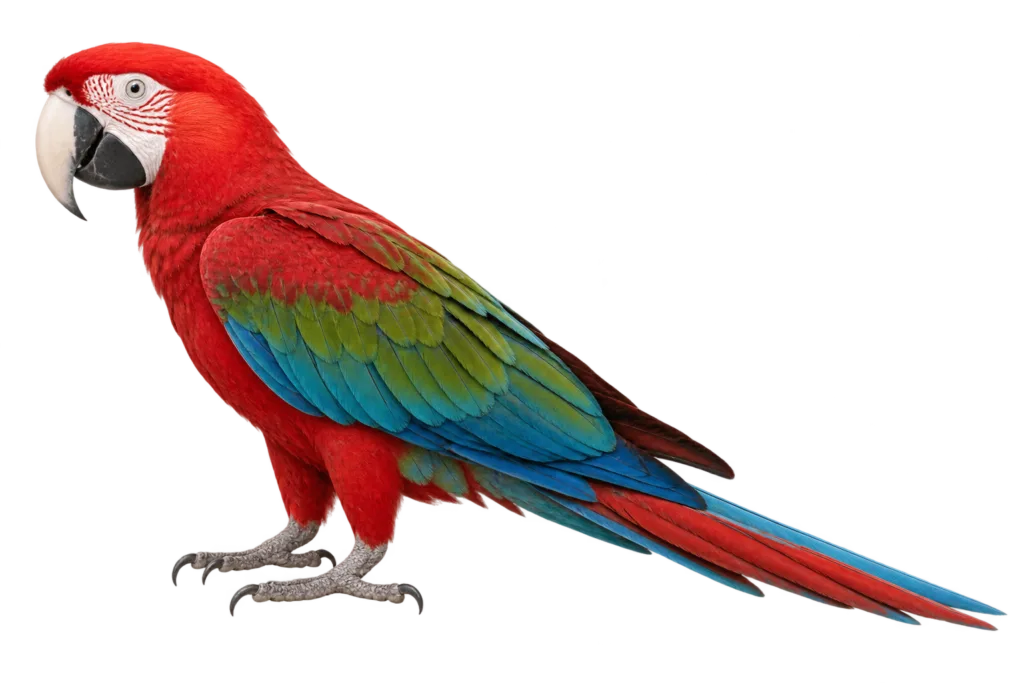
Size at a glance
How big is a Red-and-green Macaw?
Compare
Compare Red-and-green Macaw with another bird
Search by common or scientific name.
Morphology
Detailed measurements
Taxonomy
Classification
The Red-and-green Macaw (Ara chloropterus) is a very large parrot with an adult total length of about 90–95 cm (35.4–37.4 in). A commonly cited adult body-mass range is 1,050–1,320 g (2.3–2.9 lb). Its near-metre total length can be misleading if read as body size alone: a large share of that measurement comes from the long, tapered tail.
How Its 90–95 cm Length Is Built
Total length is measured from the tip of the bill to the end of the longest tail feathers. In this macaw, the central tail feathers can reach roughly 44–53 cm (17.3–20.9 in). The tail therefore creates much of the bird’s long outline, while the trunk itself is far shorter than the full beak-to-tail figure suggests.
Detailed identification measurements also show that the wing, bill and legs occupy very different size ranges. They describe separate anatomical structures and should not be combined to create a new body-length figure.
| Measurement | Male | Female |
|---|---|---|
| Folded wing | 391–420 mm | 380–420 mm |
| Central tail feather | 440–526 mm | 475–531 mm |
| Culmen | 77–84 mm | 71–80 mm |
| Tarsus | 36–43 mm | 36–44 mm |
Measurement Detail
The folded-wing figure is taken from the carpal area to the end of the primary feathers with the wing closed. The culmen is a bill measurement, while the tarsus represents the lower-leg segment used in standard bird measurement.
Folded Wing Length Is Not Wingspan
The 380–421 mm wing figures reported in detailed measurement references are folded-wing measurements. They are sometimes repeated online as “wingspan,” but a 38–42 cm tip-to-tip span would not fit the proportions of a macaw that is about 90–95 cm long.
Institutional zoo references place the open wingspan much wider, roughly 102–125 cm (40–49 in). These two measurements answer different questions: folded-wing length describes one closed wing, while wingspan measures across both fully extended wings.
Body Mass Varies More Than Total Length
World Parrot Trust and field literature commonly give 1,050–1,320 g for adult body mass. Some broader zoological references extend the upper end to about 1,700 g. That wider spread is a reason to treat mass as a measured value from a particular bird or dataset rather than as one fixed number for the species.
The long tail also explains why body mass can seem low beside the bird’s total length. Tail feathers add many centimetres without adding the mass that an equally long trunk would. The large head, deep chest and heavy bill make the front of the bird look substantial, while the tail stretches the overall silhouette behind it.
Male and Female Measurements Overlap
Adult males and females have the same general plumage pattern and are not separated by an obvious size boundary. The recorded folded-wing ranges overlap almost completely, and the tail ranges overlap as well.
The culmen range shows a small shift toward longer measurements in males, but even there the ranges overlap. A male may measure 77–84 mm and a female 71–80 mm, leaving 77–80 mm shared by both. Body size alone is therefore not a dependable way to determine sex in an individual Red-and-green Macaw.
Juveniles Look More Compact
Young birds resemble adults in their basic red, green and blue pattern, but the tail is shorter. Because the tail contributes so much to adult total length, this difference changes the apparent proportions of a juvenile more than a small change in trunk size would.
Juveniles also have a darker, greyer iris than the yellow eye of an adult, and the dark areas of the bill can appear paler. These age-related features are more useful than assuming that every shorter-looking bird is simply a small adult.
The Measurements Match a Distinctive Silhouette
The species combines a broad head, a very large hooked bill, a strong chest, long pointed wings and an exceptionally long tail. The bare white facial area is crossed by fine rows of red feathers. Most of the body is dark red, the middle wing coverts are green, and the outer wing and rear body include blue.
Those structural and color features matter when judging size in the field because distance can make a large macaw look smaller than it is. The green wing area and red feather lines on the white face also help confirm the species without relying on apparent size alone.
Data
Measurement sources
- Data status
- Measured
- Size measurements
- AVONET — Tobias et al. (2022)
- Morphology source
- AVONET — Tobias et al. (2022)
- Morphology dataset
- AVONET v7 — BirdLife taxonomy
- Morphology dataset license
- CC BY 4.0
Full source links, dataset definitions, licensing details and measurement methodology are maintained on the Data Sources & Methodology page.