Bird size profile
Red-crowned Crane
Grus japonensis
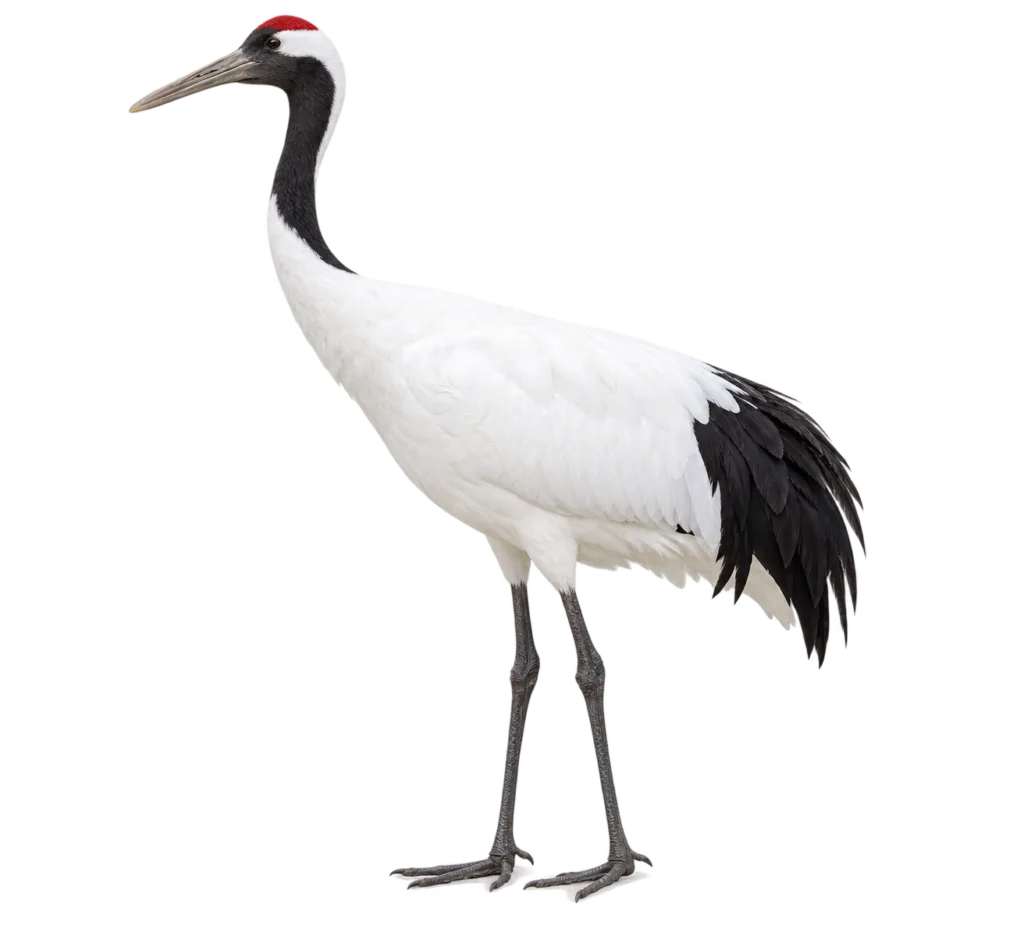
Size at a glance
How big is a Red-crowned Crane?
Compare
Compare Red-crowned Crane with another bird
Search by common or scientific name.
Morphology
Detailed measurements
Taxonomy
Classification
The Red-crowned Crane (Grus japonensis) combines exceptional height with a broad wingspan and a relatively heavy build for a crane. Adults are commonly described as standing about 158 cm (5 ft 2 in) tall, with a wingspan of roughly 220–250 cm (7 ft 3 in–8 ft 2 in). Those headline figures describe different parts of the bird, however, and they should not be treated as interchangeable measurements.
How Large Is a Red-Crowned Crane?
Published institutional profiles usually place adult body mass around 7–10 kg (15–22 lb), while individual birds can fall outside a simple typical range. The species is often described as the heaviest crane on average, even though the tallest cranes can exceed it in standing height.
Height, body length, wing length, and wingspan measure different things
A standing height near 158 cm describes the vertical bird. Total body length is measured along the body, while a scientific wing-length measurement is taken on one folded wing. Wingspan is the distance across both fully extended wings. A folded-wing value near 600 mm is therefore not evidence of a 600 mm wingspan.
The crane’s long neck and legs add much of its apparent height. Its body is much shorter than the full upright silhouette suggests, which is why photographs can make the bird look taller or more slender depending on posture.
What Wild Hokkaido Measurements Show
A large morphometric study of wild Red-crowned Cranes from eastern Hokkaido measured body mass together with total body, wing, tarsus, tail, and exposed culmen lengths. The adult sample included 75 males and 86 females. The values below are the reported adult means, not species-wide limits.
| Measurement | Adult Male Mean | Adult Female Mean |
|---|---|---|
| Total body length | 1,365 mm (53.7 in) | 1,247 mm (49.1 in) |
| Wing length | 618 mm (24.3 in) | 589 mm (23.2 in) |
| Tarsus length | 296.1 mm (11.7 in) | 276.3 mm (10.9 in) |
| Tail length | 253.1 mm (10.0 in) | 238.9 mm (9.4 in) |
| Exposed culmen | 162.4 mm (6.4 in) | 151.3 mm (6.0 in) |
| Body mass | 8.14 kg (17.9 lb) | 7.32 kg (16.1 lb) |
These means come from wild Hokkaido birds in a long-running specimen dataset. They are useful for understanding sex-related size patterns, but they should not be turned into universal minimum or maximum values for every Red-crowned Crane population.
Male and Female Size Differences Are Mostly Structural
Adult males and females have essentially the same plumage pattern, so color is not a reliable way to separate the sexes. Size provides more information. In the Hokkaido dataset, males averaged larger than females in every measured parameter, including body length, folded-wing length, tarsus length, bill length, tail length, and body mass.
The difference is easiest to appreciate when known pairs stand close together. A male may look taller, heavier through the body, and slightly more substantial in the head and bill. There is still overlap between individuals, so a single field sighting does not provide the same certainty as measured birds.
The Black Rear of a Standing Bird Is Not a Black Tail
Adult Red-crowned Cranes are mainly white, but the neck and the secondary and tertiary flight feathers are black. The primary flight feathers are white. When the wings are folded, the long black tertiary feathers drape over the rear of the body and can make the bird appear to have a black tail.
The actual tail feathers are white. This distinction becomes much easier to see in flight, when the wings open and the black secondaries and tertials separate visually from the white primaries and body. The pattern is one of the most useful ways to understand the crane’s shape rather than judging it only from a standing profile.
Age Changes the Crown and Flight Feathers
The red crown that gives the species its English name is bare skin, not red feathers. In adults, the exposed crown is bright red. Yearling birds can retain darker feathering over part of the crown, and the exposed area may look duller. Juveniles have a brownish forehead rather than the fully developed adult crown.
Wing plumage changes at the same time. Juveniles and yearlings can show black tips on the primaries and upper primary coverts. By the adult stage, the primaries are white. Younger birds also carry a mixture of white, cinnamon-brown, tawny, and gray through the body, so their outline may already be crane-like before their plumage matches the sharp black-and-white adult pattern.
Bill and Leg Proportions Fit a Deep-Water Crane
The Red-crowned Crane has a long, pointed bill and long lower legs. In the Hokkaido adult sample, exposed culmen length averaged about 16.2 cm in males and 15.1 cm in females, while tarsus length averaged about 29.6 cm and 27.6 cm respectively.
The species regularly feeds in deeper water than most cranes, making these long leg and bill measurements especially relevant to its form. Head-and-bill proportions also contribute to the subtle size difference between males and females even though their adult colors are nearly identical.
Data
Measurement sources
- Data status
- Measured
- Size measurements
- AVONET — Tobias et al. (2022)
- Morphology source
- AVONET — Tobias et al. (2022)
- Morphology dataset
- AVONET v7 — BirdLife taxonomy
- Morphology dataset license
- CC BY 4.0
Full source links, dataset definitions, licensing details and measurement methodology are maintained on the Data Sources & Methodology page.