Bird size profile
Red-tailed Hawk
Buteo jamaicensis
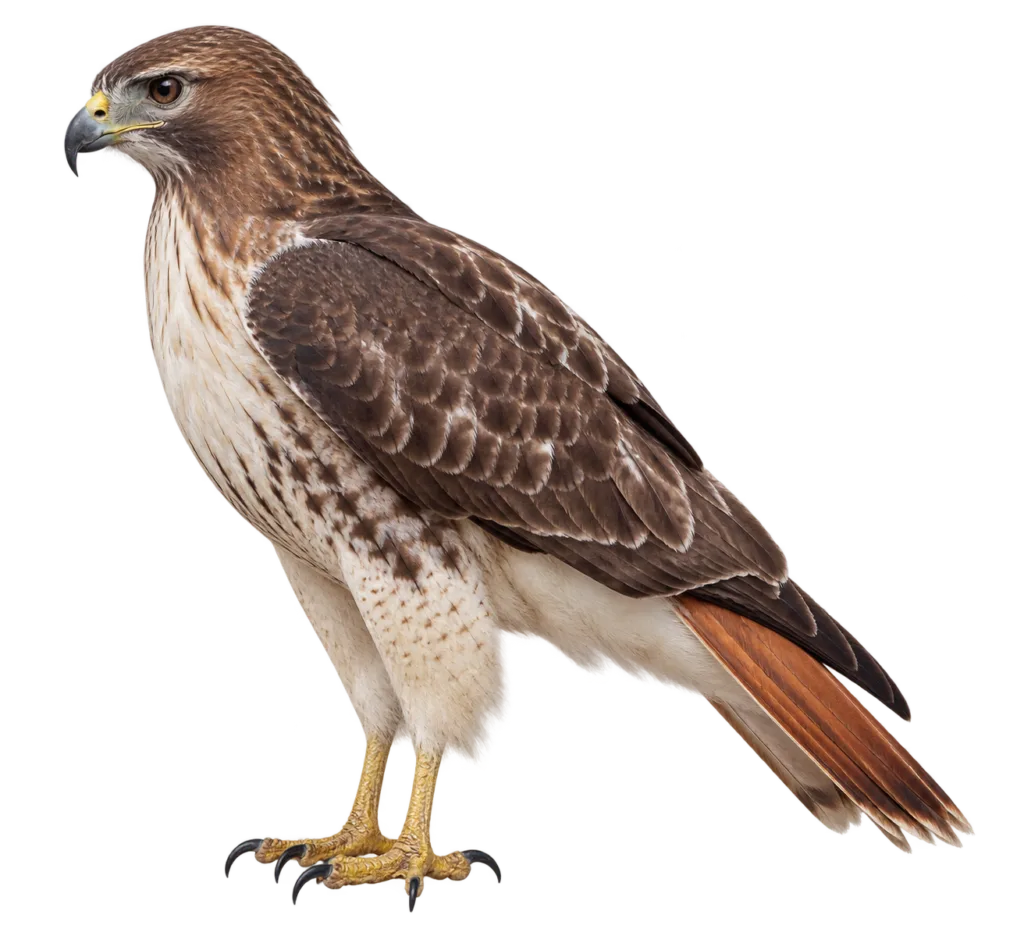
Size at a glance
How big is a Red-tailed Hawk?
True-scale visual
Red-tailed Hawk compared with a 175 cm person
When a transparent species asset and body-length data are available, BirdSize places the real bird asset and the fixed human reference on one mathematical centimetre scale.
Compare
Compare Red-tailed Hawk with another bird
Search by common or scientific name.
Morphology
Detailed measurements
Taxonomy
Classification
The Red-tailed Hawk (Buteo jamaicensis) has the heavy, broad-winged build expected of a large buteo, but its size is easier to understand when body length, mass, and wingspan are kept separate. Adult males commonly measure about 45–56 cm (17.7–22.1 in) long and weigh roughly 690–1,300 g (1.5–2.9 lb). Females extend the upper end of the range, reaching about 50–65 cm (19.7–25.6 in) and roughly 900–1,460 g (2.0–3.2 lb).
Its Wings Create Most of the Visual Scale
A perched Red-tailed Hawk can look compact. Once the wings open, its proportions change dramatically. The species has broad, rounded wings paired with a comparatively short, wide tail, producing the heavy buteo silhouette often seen circling over open ground.
The Cornell Lab gives a wingspan range of 114–133 cm (44.9–52.4 in), while some raptor references use a broader species range extending to about 141 cm (55.5 in). These figures should not be forced into one exact value. Samples, geographic populations, and measurement datasets are not always identical.
Bird length is normally measured from the tip of the bill to the tip of the tail. A 60 cm Red-tailed Hawk is therefore not a bird standing 60 cm tall. Posture, leg position, neck position, and tail angle all affect how tall a perched individual appears.
Females Are Larger, but the Sexes Still Overlap
Red-tailed Hawks show reverse sexual size dimorphism: females tend to be larger than males. The difference is especially noticeable in body mass and structural measurements, but there is enough overlap that an isolated bird cannot always be sexed reliably by apparent size.
A study of western Red-tailed Hawks illustrates the pattern. Adult females in the sample averaged about 1,266 g, compared with 923 g for adult males. Their average natural wing chords were about 415 mm and 381 mm, respectively. Females were also larger on average in measurements of the tail, tarsus, bill, and hallux.
Researchers can combine several measurements to estimate sex with much better accuracy than visual judgment alone. The most useful measurements can change with age and population, which is one reason a single body-weight cutoff is unreliable.
Body Mass and Wingspan Tell Different Stories
The bird’s wide flight profile can make it seem heavier than it is. Even a large female usually weighs only around one to one and a half kilograms. Much of the apparent size comes from long flight feathers spread across a broad wing surface rather than from a large, dense body.
This also explains why wingspan is more useful than weight for judging the space occupied by a soaring Red-tail. A bird weighing around a kilogram can stretch its wings well beyond a meter from tip to tip. When the wings are folded, that same individual becomes a much narrower shape dominated by the chest, folded wing feathers, and tail.
Young Hawks Can Look Slightly Different in Proportion
Age affects more than tail color. Juveniles have brown, barred tails instead of the familiar reddish tail of most adults, and structural measurements can also differ slightly between age classes.
In one western migration study, hatch-year Red-tailed Hawks averaged a 233 mm tail, compared with 220 mm among adults in the same dataset. The difference does not provide a universal field-age rule, but it helps explain why some young Red-tails can appear a little longer-tailed or less compact than mature birds.
Geography Adds Another Layer of Size Variation
Red-tailed Hawks occupy an unusually large geographic range, and not every regional population has identical proportions. Current work on the species continues to document differences among populations that have traditionally been described as subspecies.
The Alaska form commonly called alascensis, for example, averages smaller than adjacent mainland forms. At the other end of the pattern, the Fuertes Red-tailed Hawk, B. j. fuertesi, has been described as averaging larger and longer-winged than several other populations.
Regional variation is why a Red-tailed Hawk near one end of the published size range is not automatically unusually small or unusually large. Sex, age, geographic origin, and individual variation can all contribute to the measurements of a particular bird.
Data
Measurement sources
- Data status
- Measured
- Size measurements
- Cornell Lab of Ornithology – All About Birds
- Morphology source
- AVONET — Tobias et al. (2022)
- Morphology dataset
- AVONET v7 — BirdLife taxonomy
- Morphology dataset license
- CC BY 4.0
Full source links, dataset definitions, licensing details and measurement methodology are maintained on the Data Sources & Methodology page.