Bird size profile
Rhinoceros Hornbill
Buceros rhinoceros
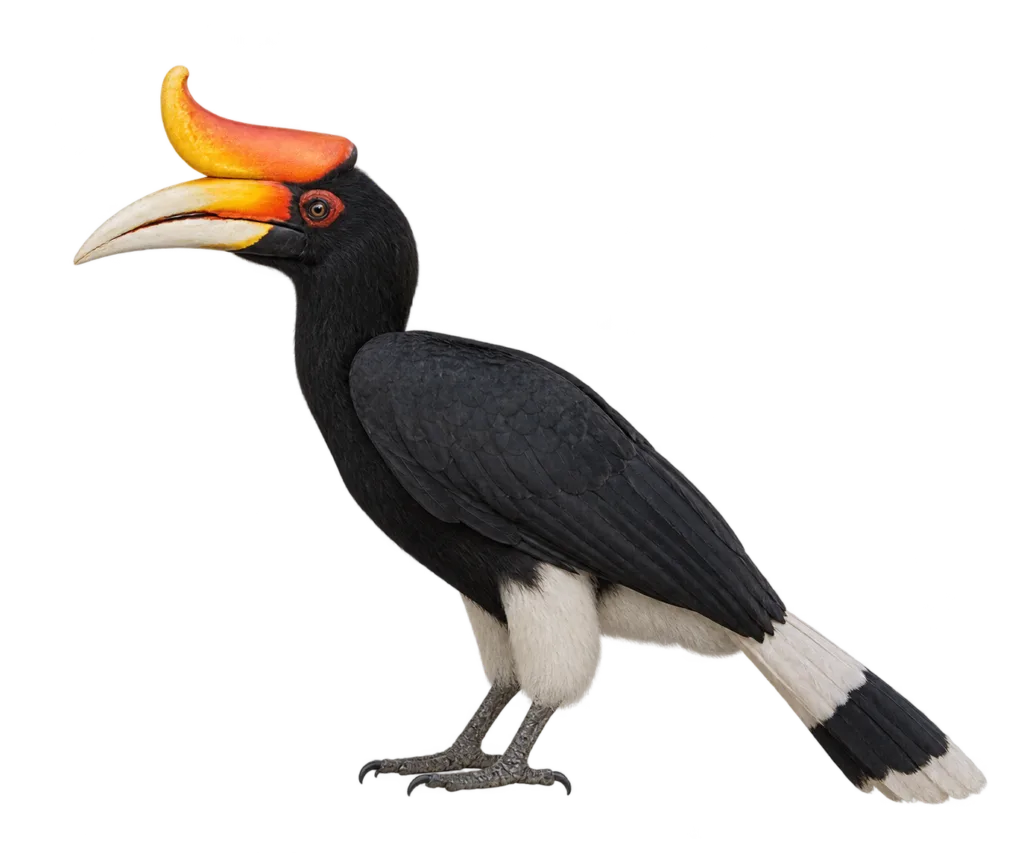
Size at a glance
How big is a Rhinoceros Hornbill?
Compare
Compare Rhinoceros Hornbill with another bird
Search by common or scientific name.
Morphology
Detailed measurements
Taxonomy
Classification
The Rhinoceros Hornbill, Buceros rhinoceros, is a very large Asian hornbill whose apparent size is shaped as much by its long bill and raised casque as by body length alone. Published measurements place adults close to the one-metre scale, while males are heavier and carry a more developed casque than females. The bird’s black body, white tail and upward-curving red-orange casque create a profile that looks even larger in side view.
How Large Is a Rhinoceros Hornbill?
One well-documented adult range is 99–125 cm (39–49 in) in total length. Other field references publish somewhat shorter ranges, so a single exact length should not be treated as universal. Differences can reflect the birds measured, geographic form and the way total length was recorded.
Body mass shows a clearer difference between the sexes. Recorded males weigh about 2,465–3,000 g (5.4–6.6 lb), while females are about 2,040–2,330 g (4.5–5.1 lb). The sexes overlap strongly in general body shape, but the male tends to look heavier through the head because of his larger bill and casque.
Wing Length Is Not Wingspan
Published specimen data give wing lengths of roughly 432–520 mm. This is a measurement from the wing joint to the tip of the longest primary under a defined measuring method. It should not be doubled or presented as the bird’s wingspan. A reliable species-wide wingspan range is not established by that measurement alone.
The Casque Changes the Bird’s Visible Proportions
The most distinctive structure is the large casque rising above the upper bill. In adults it forms an elongated, horn-like cylinder that curves upward, giving the head much greater vertical depth than the skull itself. Despite its imposing appearance, the casque is hollow rather than a solid mass.
Its colour also deserves some care. The bill and casque are naturally pale, but preening transfers coloured oil from the uropygial gland onto their surfaces. This produces much of the familiar yellow, orange and reddish staining. Colour intensity can therefore vary without indicating a difference in the underlying dimensions of the bill.
Adult males usually show a more developed casque with dark markings along its rear and sides. Females have a smaller casque and lack the same strong black pattern. This difference makes head size one of the most useful visual clues when two adults are seen together.
Male and Female Proportions
Rhinoceros Hornbills are sexually dimorphic without having radically different plumage. Both adults are predominantly black, with white thighs and vent and a white tail crossed by a broad black band. The main structural differences are concentrated around the head and overall mass.
Adult Male
2.47–3.00 kg
Usually heavier, with a larger casque, dark casque markings, red iris and dark skin around the eye.
Adult Female
2.04–2.33 kg
Usually lighter, with a smaller casque, pale whitish iris and reddish skin around the eye.
Eye colour is especially useful because it separates the sexes without relying on small differences in total length. A male’s red iris contrasts strongly with the dark orbital area, while an adult female typically has a pale bluish-white or white iris.
Three Geographic Forms Do Not Have Identical Profiles
Three subspecies are commonly recognised. B. r. rhinoceros occurs in southern Thailand, the Malay Peninsula and Sumatra, B. r. borneoensis occurs on Borneo, and B. r. silvestris occurs on Java.
The Bornean form is generally smaller and tends to have a shorter, broader casque with a more strongly recurved tip. The Javan form is noted for a broader black band across the white tail, while its casque tends to project forward more directly rather than showing the same strongly raised tip. Individual variation means that casque shape alone should not be treated as a precise measurement of subspecies identity.
These geographic differences also help explain why measurements taken from a limited set of birds may not represent every Rhinoceros Hornbill across its range. Sex, locality and specimen selection can all shift the values reported in different references.
Juveniles Have a Very Different Head Profile
Young Rhinoceros Hornbills already resemble adults in their basic black-and-white plumage, but the bill and casque reveal their age. Juveniles begin with a much less developed bill and essentially no adult-sized casque. The casque enlarges as the bird matures, gradually producing the high, curved head profile associated with adults.
Young birds also have pale bluish eyes regardless of sex. Adult sexual differences become clearer as the casque develops and the iris changes toward the mature male or female colour. For this reason, apparent casque size cannot be interpreted only as a male-versus-female difference unless the bird’s age is also considered.
Data
Measurement sources
- Data status
- Measured
- Size measurements
- AVONET — Tobias et al. (2022)
- Morphology source
- AVONET — Tobias et al. (2022)
- Morphology dataset
- AVONET v7 — BirdLife taxonomy
- Morphology dataset license
- CC BY 4.0
Full source links, dataset definitions, licensing details and measurement methodology are maintained on the Data Sources & Methodology page.