Bird size profile
Rock Pigeon
Columba livia
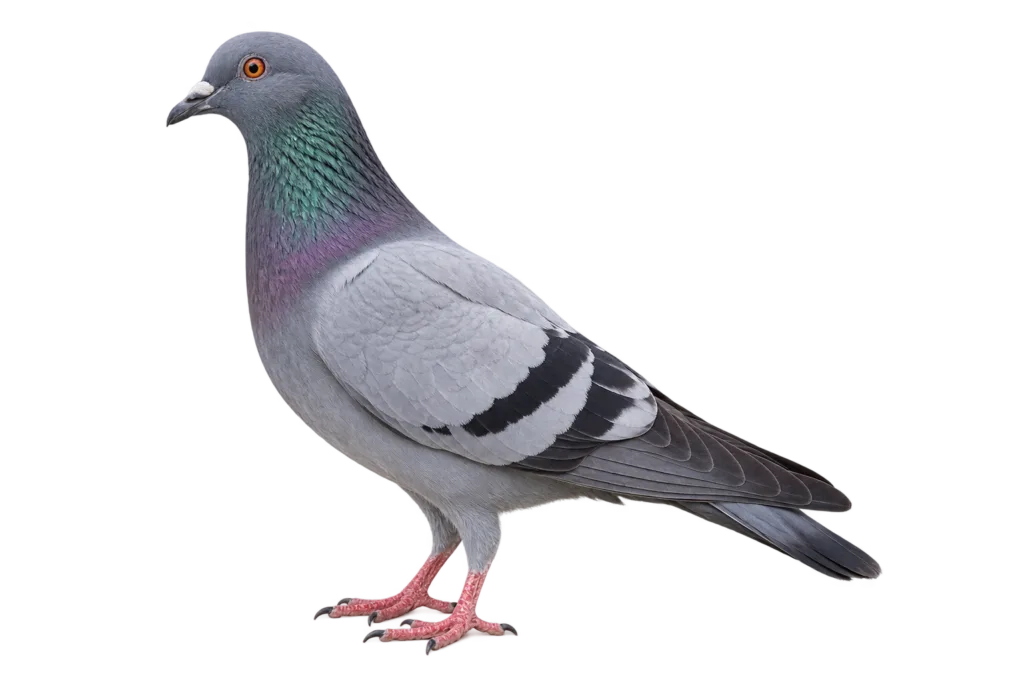
Size at a glance
How big is a Rock Pigeon?
True-scale visual
Rock Pigeon compared with a 175 cm person
When a transparent species asset and body-length data are available, BirdSize places the real bird asset and the fixed human reference on one mathematical centimetre scale.
Compare
Compare Rock Pigeon with another bird
Search by common or scientific name.
Morphology
Detailed measurements
Taxonomy
Classification
Rock Pigeons (Columba livia) have a compact, heavy-looking build that can make them seem larger than their actual length suggests. Adults typically combine a small head, short legs, a broad chest, pointed wings, and a fairly broad rounded tail. The familiar city pigeon belongs to the same species, although domestic ancestry has produced far more variation in plumage and, to a lesser extent, body form than is seen in wild-type birds.
A Compact Body With Long Flight Surfaces
Published measurements place most Rock Pigeons at roughly 30–36 cm (11.8–14.2 in) in total length, with a commonly cited body mass of about 265–380 g (9.3–13.4 oz). Wingspan figures around 50–67 cm (19.7–26.4 in) are also reported for the species.
Those numbers describe a bird that is moderately long but relatively full-bodied. The chest is deep, the neck is short, and much of the visible bulk sits around the breast and shoulder area. In profile, this gives a Rock Pigeon a denser outline than many similarly long doves.
The wings add another important part of the shape. They are broad near the body but taper toward pointed tips. When folded, much of their length is hidden along the sides of the bird. Once extended, they give the pigeon a much wider outline than its standing dimensions suggest.
A recorded wing length usually measures one folded wing, while wingspan measures the distance between the tips of both fully extended wings. The two measurements describe different dimensions and should not be substituted for one another.
Why Rock Pigeon Measurements Can Vary Between Sources
Rock Pigeon size is often presented as a range rather than a single standard value. Part of that variation is biological, and part comes from the way birds are sampled and measured.
For example, British Trust for Ornithology biometric records for adult Rock Doves give a mean folded wing length of 229.3 mm, based on 58 adults, with recorded values from 218 to 241 mm. The same dataset reports an adult mean body weight of 359.6 g. Its central body-weight range, based on the 5th and 95th percentiles of 57 birds, is 299–441 g.
These figures should not be treated as conflicting with broader species ranges from other references. A measurement taken from live birds in one monitored population answers a different question from a general range compiled for the species. Geographic origin, sex, condition, ancestry, and measurement method can all affect the figures that appear in a dataset.
Wild-Type Shape Versus Feral Pigeon Variation
The wild-type Rock Pigeon has a much more consistent appearance than many urban flocks suggest. The classic form is blue-gray, usually with two dark wing bars, a dark terminal tail band, and green or purple iridescence around the neck. The rump is pale in typical wild birds.
Feral populations can contain birds that are almost white, very dark, reddish, heavily checked, lightly patterned, or close to the ancestral blue-gray form. This color variation can make a flock appear morphologically diverse even when the birds share the same basic pigeon proportions.
Color is therefore a poor guide to body size. A black, white, red, or patterned Rock Pigeon is not automatically a different-sized type. The more dependable structural features are the compact torso, relatively small head, short legs, broad-based pointed wings, and wide tail.
Wild and Feral Birds Are Not Always Equivalent Samples
The name Rock Pigeon is widely used for Columba livia, but size data can come from birds with very different backgrounds. Truly wild Rock Doves still occur in parts of the species’ original range, while the pigeons occupying cities across much of the world largely represent feral populations with domestic ancestry.
Genetic work on surviving wild populations has shown that wild Rock Doves can remain distinguishable from sampled domestic and feral pigeons. Other populations show varying levels of mixing. This distinction matters when comparing measurements because a dataset based on wild coastal birds should not automatically be assumed to describe every feral city population with equal precision.
Domestic pigeon breeding has also produced forms that depart far more strongly from the ancestral body shape. Those specialized breeds should not be used as a general reference for the dimensions of an ordinary Rock Pigeon.
Male and Female Size Overlaps Strongly
Male and female Rock Pigeons look very similar, and there is extensive overlap in their dimensions. Research on geographic variation in wild Rock Doves has nevertheless found males to be larger on average across measured structural traits.
The difference is subtle enough that body size alone is not a dependable way to sex an individual pigeon. A relatively large female can exceed a relatively small male, and posture, feather condition, crop fullness, and viewing angle can change the apparent size of a bird.
Males can sometimes appear heavier through the neck and chest, particularly during display, but this is a visual tendency rather than a precise measurement rule.
Geography Adds Another Layer of Size Variation
Wild Rock Doves are not identical in size across their native range. Morphometric research using wing, tarsus, and bill measurements has found geographic variation among populations from Europe, North Africa, the Middle East, and South Asia.
Some populations in warmer southern parts of the range were smaller in the studied material, while several populations farther north or east averaged larger. The pattern was not uniform enough to reduce Rock Pigeon size to one simple regional rule.
This helps explain why a measurement from one locality should not automatically become a worldwide species standard. For a bird with a broad native range and an enormous feral distribution, naturally occurring population variation is expected.
The Proportions Behind the Familiar Pigeon Silhouette
The Rock Pigeon’s appearance depends as much on proportion as absolute size. Its small head makes the body look fuller. Short legs keep the torso close to the ground, while the breast projects forward when the bird stands upright. The bill is fairly short and slender relative to the mass of the head and body.
Feathers can alter that outline further. A relaxed pigeon may fluff its contour feathers and look rounder, especially in cool conditions. A bird holding its plumage tightly against the body looks narrower without any change in skeletal dimensions or actual body length.
Posture also changes apparent height. Rock Pigeons frequently alternate between a low, horizontal walking posture and a more upright stance. Photographs taken during these different positions can make two similarly sized birds appear noticeably different.
Flight Shows Dimensions That Are Hidden at Rest
A standing Rock Pigeon emphasizes body mass. A flying bird emphasizes wing area and span. Extending the wings exposes long flight feathers that are largely concealed while perched, creating a much broader overall profile.
The combination of a strong chest and pointed wings suits sustained, fast flight. The tail can spread beyond its resting width during maneuvering and braking, so its apparent shape also changes markedly between a perched bird and one in the air.
This is why length, folded wing length, wingspan, and body weight describe separate aspects of Rock Pigeon size. No single measurement captures the bird’s entire physical scale. Used together, they describe a medium-sized pigeon with a compact trunk, comparatively long flight surfaces, short supporting limbs, and enough natural variation that individual birds do not all fit one exact set of dimensions.
Data
Measurement sources
- Data status
- Measured
- Size measurements
- Cornell Lab of Ornithology – All About Birds
- Morphology source
- AVONET — Tobias et al. (2022)
- Morphology dataset
- AVONET v7 — BirdLife taxonomy
- Morphology dataset license
- CC BY 4.0
Full source links, dataset definitions, licensing details and measurement methodology are maintained on the Data Sources & Methodology page.