Bird size profile
Roseate Spoonbill
Platalea ajaja
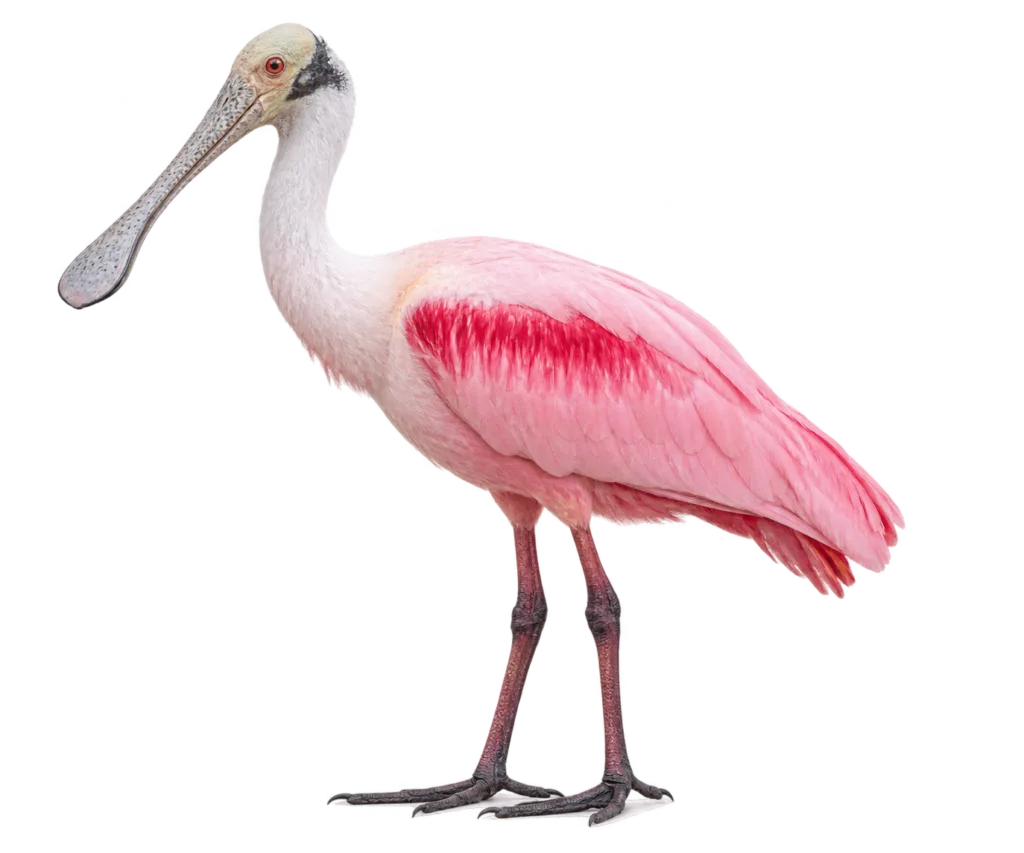
Size at a glance
How big is a Roseate Spoonbill?
Compare
Compare Roseate Spoonbill with another bird
Search by common or scientific name.
Morphology
Detailed measurements
Taxonomy
Classification
The Roseate Spoonbill (Platalea ajaja) is a large wading bird whose apparent size changes sharply with posture. Adults measure about 71–86 cm (27.9–33.9 in) in length, span roughly 120–130 cm (47.2–51.2 in) across the wings, and weigh about 1.2–1.8 kg (2.6–4.0 lb). Those numbers describe only part of its shape. Long legs, an extendable neck, a small head, and an unusually broad-tipped bill create proportions that can look very different while standing, feeding, or flying.
The Bill Has an Outsized Effect on Its Shape
A Roseate Spoonbill has a relatively small head followed by a long, flattened bill that widens toward the tip. Viewed from the side, this structure adds considerable visual length in front of the head. From above, the expanded tip is much more obvious and gives the species its characteristic spoon profile.
The bill is closely tied to the bird’s feeding posture. Spoonbills move it from side to side through shallow water while holding it partly open. As a result, the head and neck are often extended downward and forward, making a feeding bird appear longer and lower than one standing at rest.
Standing, Feeding, and Flying Produce Different Silhouettes
A resting Roseate Spoonbill may draw its neck into a curved position, reducing its apparent height and making the body look relatively substantial. When actively feeding, the body is commonly held nearly horizontal while the neck reaches toward the water. The same bird can therefore look surprisingly low despite its long legs.
Flight reveals a different set of proportions. The neck is extended rather than folded back, and the legs project behind the body. This creates a long end-to-end silhouette even though the central body remains fairly compact.
Broad Wings Contrast With a Short Tail
The 120–130 cm wingspan is one of the clearest indicators of the bird’s scale in flight. The wings are broad, long, and rounded, while the tail is comparatively short. This puts most of the flight silhouette into the wings themselves rather than into a long tail.
The relationship between wingspan and body length also explains why a flying spoonbill can appear much larger than the same bird standing in shallow water. A maximum reported body length of about 86 cm is notably shorter than the full span between the wingtips.
Body length and wingspan describe different axes of the bird. The 71–86 cm length range should not be treated as a substitute for standing height, and the 120–130 cm wingspan applies to fully extended wings rather than a folded-wing measurement.
The Juvenile Bill Reaches Its Familiar Shape Early
Young Roseate Spoonbills do not hatch with the fully developed spoon-shaped bill seen in adults. The bill begins to flatten at roughly nine days of age, becomes recognizably spoon-like at around 16 days, and is close to full size by about 39 days.
Other features take much longer to mature. Juveniles are paler than adults and have a fully feathered head, while mature birds develop the largely bare head that changes the outline around the eyes, crown, and bill base. Young birds can retain a feathered head for years before attaining adult breeding appearance.
This difference matters when judging proportions from photographs. A juvenile can already have the distinctive expanded bill while the feathered head still creates a rounder, softer profile than the bare-headed adult.
Published Size Ranges Cover Both Sexes
Widely used field measurements for the Roseate Spoonbill commonly present males and females together rather than giving separate standard size ranges. The published 71–86 cm length, 1.2–1.8 kg mass, and roughly 120–130 cm wingspan should therefore be read as species-level ranges.
A bird near the upper end of one measurement is not automatically male, and a bird near the lower end is not automatically female. Individual variation and the particular measurement being recorded can overlap, so photographs or isolated size estimates are not a dependable way to assign sex.
Data
Measurement sources
- Data status
- Measured
- Size measurements
- AVONET — Tobias et al. (2022)
- Morphology source
- AVONET — Tobias et al. (2022)
- Morphology dataset
- AVONET v7 — BirdLife taxonomy
- Morphology dataset license
- CC BY 4.0
Full source links, dataset definitions, licensing details and measurement methodology are maintained on the Data Sources & Methodology page.