Bird size profile
Ruby-throated Hummingbird
Archilochus colubris
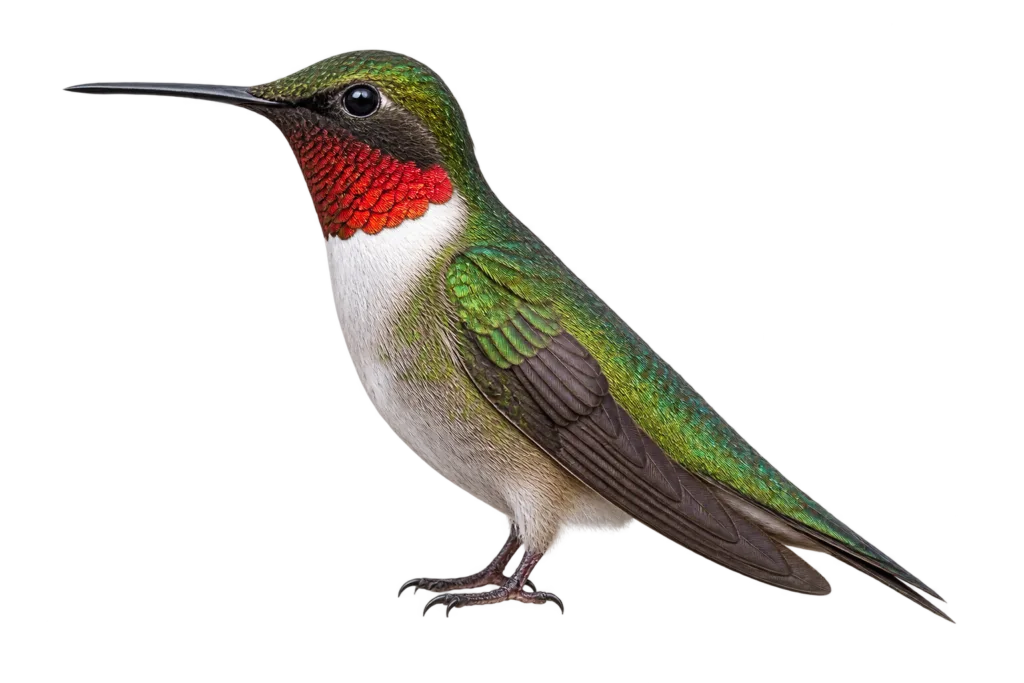
Size at a glance
How big is a Ruby-throated Hummingbird?
True-scale visual
Ruby-throated Hummingbird compared with a 175 cm person
When a transparent species asset and body-length data are available, BirdSize places the real bird asset and the fixed human reference on one mathematical centimetre scale.
Compare
Compare Ruby-throated Hummingbird with another bird
Search by common or scientific name.
Morphology
Detailed measurements
Taxonomy
Classification
The Ruby-throated Hummingbird (Archilochus colubris) is one of North America’s smallest birds, but a single size figure does not describe it very well. Published field measurements place adults at about 7–9 cm (2.8–3.5 in) in total length, with an 8–11 cm (3.1–4.3 in) wingspan and a broad body-mass range of roughly 2–6 g (0.1–0.2 oz). Sex, age, season, and stored migration fuel can all affect where an individual falls within those ranges.
Females Are the Larger Sex
Ruby-throated Hummingbirds show reversed sexual size dimorphism: adult females tend to be larger than adult males. The difference appears in more than body mass. Females generally have longer wings and longer bills as well.
Banding measurements make the difference easier to see than a distant view of a bird at a feeder. In a Texas dataset, adult males averaged a 38.2 mm wing chord and 15.9 mm exposed culmen, while adult females averaged 43.2 mm and 17.7 mm respectively. Mean mass in the same sample was 3.2 g for adult males and 3.5 g for adult females.
| Measurement | Adult Male | Adult Female |
|---|---|---|
| Average wing chord | 38.2 mm | 43.2 mm |
| Average exposed culmen | 15.9 mm | 17.7 mm |
| Average mass | 3.2 g | 3.5 g |
These figures describe birds from a particular banding sample rather than fixed limits for the species. Individual measurements overlap, so an unusually large male or small female cannot be identified reliably from size alone.
The Female Bill Differs in Shape as Well as Length
The bill is one of the more informative parts of Ruby-throated Hummingbird morphology. It is slender and close to straight at a casual glance, with a slight downward curve often visible in profile. Females generally have longer bills than males, but research on museum specimens shows that the difference is not simply a larger copy of the same shape.
A geometric study of adult Ruby-throated Hummingbirds found that female bills were longer and more curved, while male bills were comparatively shorter and stouter. The shape difference remained after researchers accounted for size, showing that male and female bill morphology follows somewhat different proportions.
Field measurements show the same length pattern. Typical exposed culmen measurements from long-term banding work have placed many adult males around 15–18 mm and females around 17–21 mm. There is overlap between those ranges, which is another reason bill length by itself is not a dependable field test for sex.
Wing Measurements Reveal Differences Hidden in Flight
A hovering Ruby-throated Hummingbird moves its wings too quickly for small structural differences to be obvious. In the hand, those differences become measurable. Adult males have shorter wings than adult females on average, and studies of North American hummingbird wing morphology also describe adult male wings as smaller and narrower than those of females and immature males.
The standard measurement used by bird banders is wing chord. It measures a folded or flattened wing from the wrist area to the tip of the longest primary feather. It is not the same measurement as wingspan, which describes the distance between the two extended wingtips.
A Ruby-throated Hummingbird may have an 8–11 cm wingspan while its individual wing chord measures only around 4 cm. The two figures describe different parts of the bird and should not be converted into one another.
Feather shape can also carry information that total size cannot. In Ruby-throated Hummingbirds, the sixth primary feather is more sharply tapered in males, while the corresponding feather in females is more rounded. Banders can use such feather characters together with age and measurements when plumage alone leaves the sex uncertain.
Tail Shape Separates Adult Males and Females
The tail changes the outline of the bird and provides one of the clearest adult sex differences. An adult male has a dark, distinctly forked tail. An adult female has a less deeply shaped tail with white on the tips of the outer tail feathers.
This distinction becomes less simple when young birds are involved. Juvenile males initially resemble females and may have little or no red in the throat. They can also show pale outer tail markings. During late summer and fall, a white-throated Ruby-throated Hummingbird is therefore not automatically an adult female.
Young males acquire the fully developed adult male throat pattern after their first-year plumage changes. Their wing proportions also change: measurements from banding work show that young males can have longer wing chords before their first complete molt than they do afterward as adults. Age can therefore affect comparisons that appear at first to be purely about sex.
Body Mass Can Change Far More Than Body Length
Length, bill size, and skeletal dimensions remain fairly stable once a bird is fully grown. Body mass is much more variable. A Ruby-throated Hummingbird weighed during the breeding season and the same bird weighed while preparing to migrate can produce very different numbers.
Typical breeding-season males in long-term banding records have often weighed roughly 2.8–3.5 g, with females averaging somewhat heavier. Before migration, hummingbirds feed heavily and store fat. Some individuals can increase their mass by tens of percent, pushing them well beyond ordinary breeding-season weights.
This seasonal change helps explain why broad species references can legitimately give weights reaching 5 or even 6 g while commonly encountered adults are often closer to 3–4 g. A high autumn mass does not mean the bird has become structurally larger; much of the change represents stored fuel.
- Females normally average heavier than males.
- Young and adult birds do not always have identical measurements.
- Body mass changes with feeding condition and time of day.
- Migrating birds can carry large fat reserves compared with breeding-season birds.
The Ruby Throat Changes With Light, Not With Size
The adult male’s throat patch, or gorget, is formed by iridescent feathers. Its ruby color depends strongly on the direction of incoming light and the viewing angle. A male can show a brilliant red throat in one position and an almost black throat moments later without any change in plumage.
This optical effect can alter the apparent proportions of the head and throat in photographs. The dark mask, throat, and surrounding shadows may make a male look heavier through the front of the body, even though adult males are generally the smaller sex. Females lack the complete ruby gorget and usually appear pale through the throat and underparts.
Both sexes are metallic green above and pale below. Their compact bodies, narrow bills, short legs, and pointed flight feathers create the familiar hummingbird profile, but the male’s color pattern can make the sex difference appear much greater than the actual difference in body dimensions.
Small Legs Belong to a Bird Built Primarily for Flight
The legs and feet of a Ruby-throated Hummingbird are extremely short relative to its body. The bird can grip a perch and can use its feet for scratching and preening, but it does not walk or hop across branches like a sparrow. Movement between feeding points is overwhelmingly accomplished by flight.
The wings beat at roughly 50 times per second during ordinary hovering, with Cornell reporting about 53 beats per second for the species. The combination of very low body mass and rapidly moving wings allows the bird to remain suspended near flowers, move sideways, reverse direction, and fly backward.
That flight-centered body plan also explains why photographs can be misleading when estimating size. A perched bird compresses its feathers and folds most of its wing surface against a body only a few centimeters long. In flight, the extended wings occupy a much wider area while the body itself remains exceptionally small.
How to Read Ruby-throated Hummingbird Size Numbers
The familiar 7–9 cm length, 8–11 cm wingspan, and 2–6 g mass ranges describe different aspects of the bird and should not be treated as interchangeable measures of overall size. Total length includes the bill and tail. Wingspan measures fully extended wings. Wing chord measures only one wing. Mass can change substantially without any change in skeletal dimensions.
Sex adds another layer. Adult females tend to be longer-billed, longer-winged, and heavier, while males have their own bill proportions, narrower adult wings, a forked dark tail, and the iridescent gorget. Age can temporarily blur several of those distinctions because juvenile males resemble females before obtaining full adult plumage.
For that reason, a Ruby-throated Hummingbird is described most accurately by a set of measurements and structural traits rather than one number. Length establishes its tiny scale, while wing, bill, tail, sex, age, and seasonal mass explain much of the variation seen among individual birds.
Data
Measurement sources
- Data status
- Measured
- Size measurements
- Cornell Lab of Ornithology – All About Birds
- Morphology source
- AVONET — Tobias et al. (2022)
- Morphology dataset
- AVONET v7 — BirdLife taxonomy
- Morphology dataset license
- CC BY 4.0
Full source links, dataset definitions, licensing details and measurement methodology are maintained on the Data Sources & Methodology page.