Bird size profile
Rufous Hummingbird
Selasphorus rufus
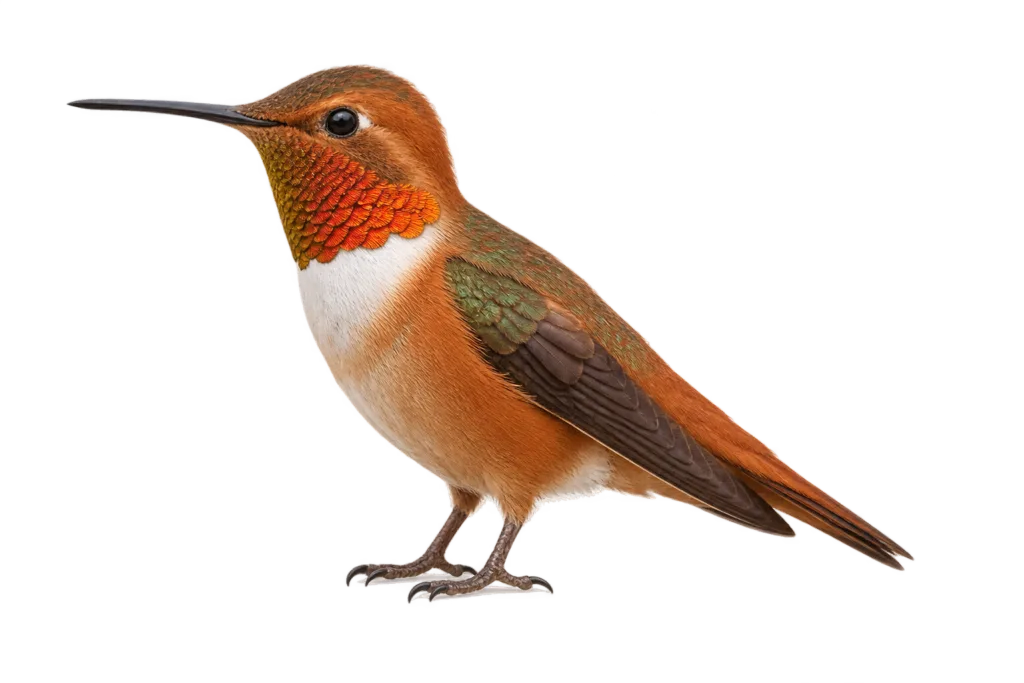
Size at a glance
How big is a Rufous Hummingbird?
Compare
Compare Rufous Hummingbird with another bird
Search by common or scientific name.
Morphology
Detailed measurements
Taxonomy
Classification
The Rufous Hummingbird (Selasphorus rufus) is a compact hummingbird whose total length is commonly reported at about 2.8–3.5 inches (7–9 cm). Typical reference values place body mass around 2–5 g (0.1–0.2 oz) and wingspan near 4.3 inches (11 cm). Those headline measurements describe the species well, but they hide an important feature of its build: adult males and females do not have exactly the same proportions.
A perched Rufous Hummingbird has a slender, nearly straight bill, short wings and a tail that projects beyond the folded wingtips. The folded tail narrows toward the end, giving the bird a compact but distinctly rear-extended outline. Sex, age and tail-feather structure add more variation than total body length alone suggests.
Male and Female Proportions Differ
Adult females tend to carry longer wings and a slightly longer bill, while adult males have a longer tail. This pattern can be seen in measurements from adult reference populations used in morphological research.
| Measurement | Adult Male | Adult Female |
|---|---|---|
| Folded wing chord | 39.7 ± 0.9 mm | 43.1 ± 1.3 mm |
| Tail length | 28.2 ± 1.0 mm | 26.0 ± 0.9 mm |
| Exposed culmen | 16.1 ± 0.6 mm | 16.6 ± 0.6 mm |
These figures come from measured adult reference populations rather than a universal range for every Rufous Hummingbird. They are most useful for showing the direction of the difference: females are longer-winged, while males carry proportionally more tail.
Folded wing chord is not the same measurement as wingspan. Wing chord measures one folded wing from the wrist region toward the tip, while wingspan measures the full distance from one extended wingtip to the other. The values should not be substituted for one another.
The Male’s Shorter Wings Change Its Shape
The difference in wing length is noticeable in detailed measurements. Adult male Rufous Hummingbirds have shorter wings than females, and hummingbird flight research has also found sex-related differences in wing form within this species.
This does not make the male look visibly small in the simple sense. Instead, it changes proportion. The male combines relatively short wings with a comparatively long tail. When perched, the wingtips remain clearly short of the tail tip. Adult male wings also tend to be more pointed than those of younger birds.
Females retain longer wings. Experimental work with female Rufous Hummingbirds has measured single-wing length around 47 mm in one small research sample, with an extended wingspan close to 109 mm. That result closely matches the roughly 11 cm wingspan used in general species references, although the two measurements were collected for different purposes and should not be treated as interchangeable datasets.
The Tail Accounts for Much of the Bird’s Distinctive Structure
Body length alone misses much of what makes a Rufous Hummingbird recognizable. The tail has unusually useful structural information.
Adult males normally have a rufous tail with dark tips. Their tail feathers are relatively broad, and the second rectrix has a characteristic notch near its tip. The shape becomes much easier to assess when the tail is spread than when it is folded. A folded tail instead appears narrow and tapered.
The adult female has a different tail pattern and proportion. Her tail is more rounded, with rufous near the bases of the feathers, a darker band and white tips on the outer feathers. Measurements from adult reference birds also show a shorter mean tail than in males despite the female’s longer wing chord.
Bill Length Is Small but Not Trivial
The Rufous Hummingbird has a thin, dark bill that is close to straight rather than strongly curved. Published species descriptions commonly place bill length around 15–19 mm, roughly 0.6–0.75 inches.
That is only a fraction of the bird’s 7–9 cm total length, yet the bill makes a noticeable contribution to the head profile. Measurements of adult birds also tend to give females a somewhat longer bill than males. The difference may amount to only fractions of a millimeter or a little more depending on the sample and measurement method, so a single bird should not be sexed from apparent bill length alone.
The measurement itself also needs a definition. Ornithological studies often report the exposed culmen, a defined measurement along the upper bill, rather than an informal estimate of the entire visible beak. Different published bill values can therefore reflect both real biological variation and differences in how specimens were measured.
Plumage Can Alter the Impression of Size
Adult males are visually dominated by rufous-orange plumage and an iridescent orange-red gorget. The white breast creates a sharp break between the throat and the rufous lower body. Most males have extensive rufous across the back, although some adult males carry much more green than expected.
Females are greener above and paler below, with rufous along the flanks and within the tail. The throat is usually pale with greenish or bronze spotting and may contain a small patch of iridescent orange-red feathers. Immature males can look much like females while adult plumage is developing.
These color differences can change how broad or compact the bird appears without changing its actual skeletal dimensions. A bright adult male may look heavier through the body because the rufous flanks create a continuous block of color, while the green-and-white pattern of a female breaks the same general body area into smaller visual regions.
Why Different Size Figures Appear in References
Published descriptions do not always give identical numbers for Rufous Hummingbirds. General identification references commonly use a total length of 7–9 cm and a mass of 2–5 g, while datasets based on captured or measured birds may report narrower averages or individual values outside a simplified field-guide range.
Several measurements are also easy to confuse. Total length includes the bill and tail. Tail length measures only part of that total. Folded wing chord describes one closed wing, whereas wingspan requires both wings to be extended. Bill measurements may refer to the exposed culmen rather than every visible part of the bill.
Sex and age add another layer. An adult male’s shorter wings and longer tail create different proportions from an adult female even when both fall within the same broad total-length category. Immature birds can have feather shapes closer to those of females before adult male wing and tail structure is fully developed.
Some Rufous Hummingbirds cannot be identified reliably from apparent body size or back color alone. Green-backed males occur, and females and immature birds can be especially difficult in areas where closely related hummingbirds occur. Tail-feather shape, age, sex and precise measurements can become more informative than total length.
A Tiny Bird With Strongly Sex-Specific Geometry
The Rufous Hummingbird’s broad 7–9 cm body-length range is only the outer scale of its morphology. Adult females tend toward longer wings and bills, while adult males combine shorter wings with a longer, more modified tail. Those differences affect the bird’s perched outline, flight surfaces and the proportions used for detailed identification.
The result is a species in which two birds of almost the same total length can be built somewhat differently. For Rufous Hummingbirds, measurements such as wing chord, tail length and exposed culmen reveal more about shape than total body length by itself.
Data
Measurement sources
- Data status
- Measured
- Size measurements
- AVONET — Tobias et al. (2022)
- Morphology source
- AVONET — Tobias et al. (2022)
- Morphology dataset
- AVONET v7 — BirdLife taxonomy
- Morphology dataset license
- CC BY 4.0
Full source links, dataset definitions, licensing details and measurement methodology are maintained on the Data Sources & Methodology page.