Bird size profile
Sandhill Crane
Antigone canadensis
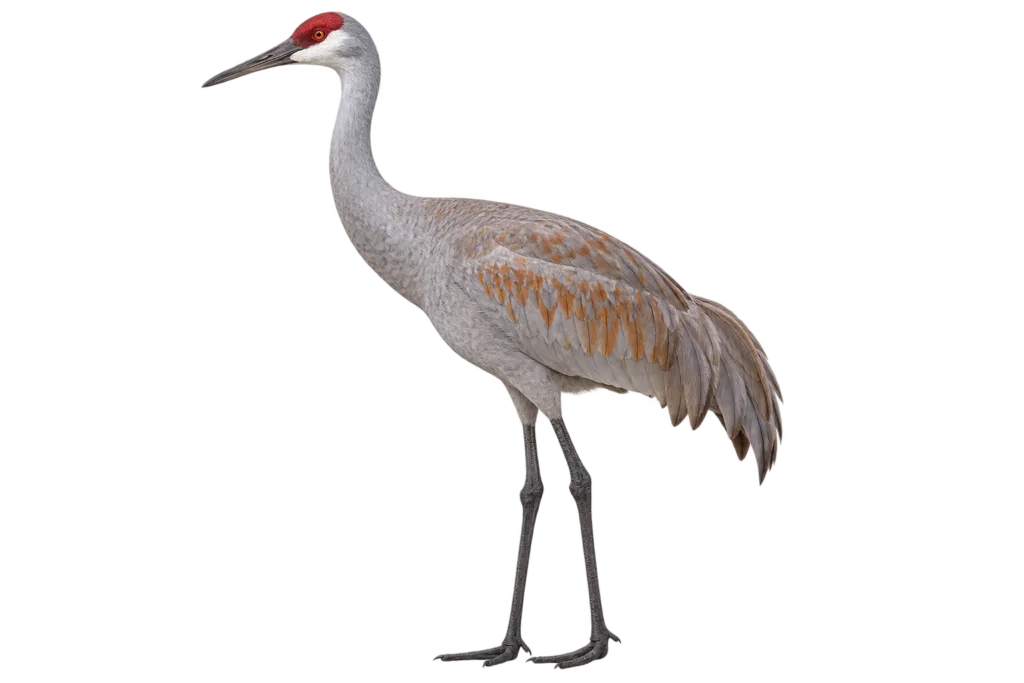
Size at a glance
How big is a Sandhill Crane?
True-scale visual
Sandhill Crane compared with a 175 cm person
When a transparent species asset and body-length data are available, BirdSize places the real bird asset and the fixed human reference on one mathematical centimetre scale.
Compare
Compare Sandhill Crane with another bird
Search by common or scientific name.
Morphology
Detailed measurements
Taxonomy
Classification
Sandhill Crane size is better described as a range than as one fixed measurement. Across the species, adults are roughly 80–120 cm (2.6–3.9 ft) tall, while published weight ranges extend from about 3 to 6.5 kg (6.5–14 lb). A wingspan near 2 m (6.6 ft) is a useful general reference, but population, sex, and the type of measurement all affect the number attached to an individual bird.
Sandhill Crane Size Is Not One Fixed Number
A commonly cited body length for a Sandhill Crane is about 120 cm (47 in), while wingspan is often listed near 200 cm (79 in). Standing-height references usually cover a wider range. These figures can appear inconsistent until the measurements are separated by what they actually describe.
Standing height describes the bird vertically from the ground toward the top of the head. Body length describes its head-to-tail dimension. A crane can have similar numerical values for both without those measurements representing the same part of its body.
Posture also changes how tall a Sandhill Crane appears. An alert bird can hold its long neck nearly upright, while a feeding bird lowers and extends the neck forward. Photographs therefore provide a poor basis for assigning an exact standing height unless scale and posture are known.
The Species Has a Real Small-to-Large Size Gradient
Part of the unusually broad measurement range comes from geographic variation. Lesser Sandhill Cranes occupy the small end of the spectrum, while Greater Sandhill Cranes are the largest form. Other populations fall between those ends rather than fitting into one uniform body size.
This variation affects more than weight. Bill dimensions, wing measurements, leg dimensions, and other body measurements also change across populations. Morphometric studies have found that Lesser and Greater Sandhill Cranes can be separated more reliably when several measurements are considered together. Intermediate-sized birds make classification from one apparent dimension much less dependable.
That is why a measurement taken from a large Greater Sandhill Crane should not automatically be treated as typical for an Arctic-breeding Lesser Sandhill Crane. Both belong within the Sandhill Crane size spectrum, but they occupy different parts of it.
Males Tend to Be Larger, but the Sexes Look Alike
Adult males and females share the same basic plumage and body shape. Males are generally somewhat larger, adding another layer of overlap to published measurements. Within a breeding pair, the larger bird may be the male, but apparent height alone is not a dependable way to determine sex.
Population differences can be greater than the visual difference between the sexes. A smaller male from one part of the species’ range may therefore be outweighed or outsized by a female from a larger-bodied population.
Long Legs and Neck Create the Tall Profile
The Sandhill Crane’s apparent size is strongly shaped by proportion. Much of its standing height comes from long legs and an elongated neck rather than an unusually deep torso. The body itself is heavy and rounded through the chest, then narrows sharply into the neck.
The head is comparatively small. A straight, pointed bill projects well beyond it, extending the bird’s profile without adding much visual bulk. When the neck is fully raised, this combination produces the narrow, vertical outline associated with a standing crane.
The proportions change while feeding. The neck can reach downward and forward while the legs keep the body well above the ground or shallow water. As a result, two photographs of the same adult can suggest very different heights even though its physical dimensions have not changed.
Folded Wings Hide Much of the Crane’s Scale
A standing Sandhill Crane does not reveal the full scale of its wings. Once opened, the wings commonly span close to 2 m, and some published ranges extend from roughly 1.7 to 2.0 m. The wings are broad rather than narrow, giving the bird a much larger horizontal profile in flight or during an open-wing display.
With the wings folded, long drooping inner wing feathers cover the short tail and create the rounded, bustle-like shape at the rear of the body. That outline can easily be mistaken for a large tail, but much of what is visible is folded wing plumage.
Flight also changes the apparent proportions. Sandhill Cranes extend the neck forward and trail the long legs behind the body. The resulting silhouette is far longer than the compact central body alone would suggest, while the broad wings reveal the dimension that is least obvious when the bird is standing.
Plumage Can Change the Impression of Size
Adult Sandhill Cranes are mainly gray, with pale facial areas and exposed red skin on the crown. Some adults develop a strong rusty or brown wash after working iron-rich mud into their feathers while preening. The staining can cover enough of the plumage to make birds from different places look less alike than their body structure suggests.
Juveniles are naturally browner and lack the fully developed adult head pattern. Color is therefore more useful for interpreting age and plumage condition than for judging body size. A rusty-looking crane is not necessarily a smaller Sandhill Crane form, and a clean gray bird is not necessarily a larger one.
The most useful size reading comes from combining the bird’s proportions with geographic context and, when available, actual measurements. The long-legged frame, narrow neck, broad folded wings, and compact tail remain recognizable even where body dimensions overlap between populations.
Data
Measurement sources
- Data status
- Measured
- Size measurements
- Cornell Lab of Ornithology – All About Birds
- Morphology source
- AVONET — Tobias et al. (2022)
- Morphology dataset
- AVONET v7 — BirdLife taxonomy
- Morphology dataset license
- CC BY 4.0
Full source links, dataset definitions, licensing details and measurement methodology are maintained on the Data Sources & Methodology page.