Bird size profile
Scarlet Ibis
Eudocimus ruber
Size at a glance
How big is a Scarlet Ibis?
Compare
Compare Scarlet Ibis with another bird
Search by common or scientific name.
Morphology
Detailed measurements
Taxonomy
Classification
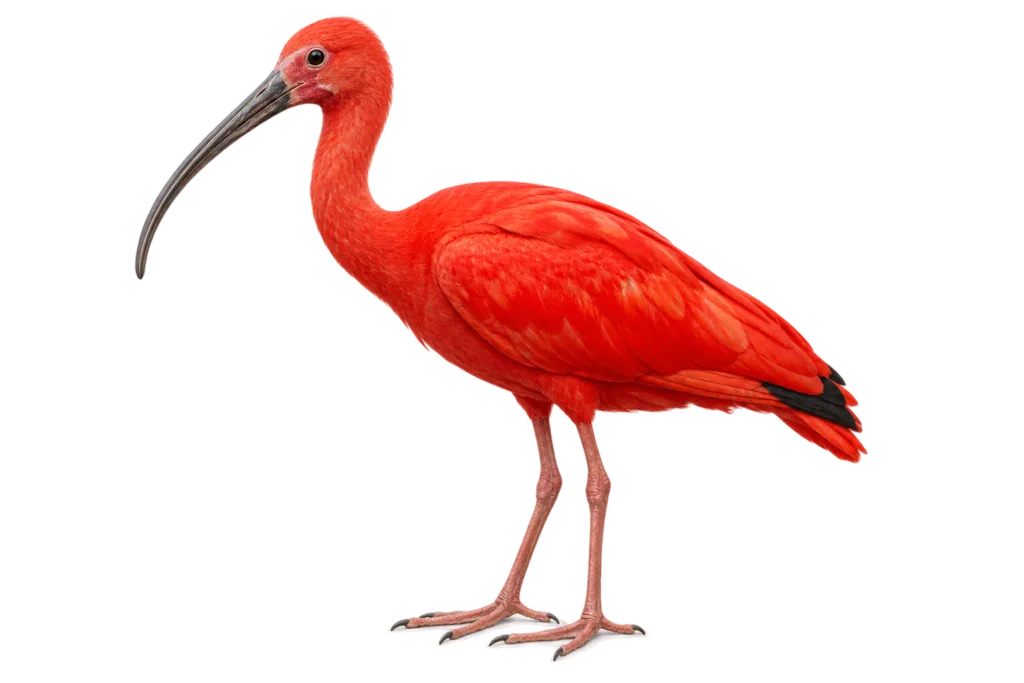
The Scarlet Ibis, Eudocimus ruber, has a slender body stretched visually by a long neck, long legs, and an unusually extended, down-curved bill. That shape matters when reading its measurements: total length, standing height, wing measurements, and wingspan describe different parts of the bird and should not be treated as interchangeable.
How Large Is a Scarlet Ibis?
Adult Scarlet Ibises are generally about 56–71 cm (22–28 in) in total length. Published body masses vary among datasets and individuals, but adults commonly fall roughly within the 0.5–0.9 kg (1.1–2.0 lb) range.
The bird can look larger than its mass suggests. Much of its visible length comes from the neck and bill rather than a deep or bulky torso. When standing upright, the long legs add still more apparent height without adding much body volume.
A Caution About Published Wingspans
Scarlet Ibis wingspan figures are unusually inconsistent across public references. Several datasets place the span near 94–105 cm (37–41 in), with values around one metre also reported elsewhere. Other sources list figures near 52–56 cm as “wingspan.” Those much smaller numbers should not be mixed uncritically with the broader span measurements, since measurement labels and methods are not consistent across sources.
This distinction is especially important on a bird with long flight feathers and a narrow body. A measurement from a folded wing, a single wing, or another linear wing dimension is not equivalent to the distance from one fully extended wingtip to the other.
The Bill Accounts for an Unusually Large Share of Its Profile
The Scarlet Ibis has a narrow bill that curves downward along much of its length. It is not simply an identifying feature. The bill changes the proportions of the entire head-and-body profile, adding substantial length ahead of a relatively small skull.
Research on Eudocimus ibises has found a clear sex difference in this structure. Male Scarlet Ibises tend to be larger overall, but the difference in the bill is stronger than body size alone would predict. One study of Scarlet and American White Ibises found male bills to be about 22% longer on average than female bills, with only part of that difference explained by the males’ larger bodies.
Color is therefore a poor way to separate adult males from females. Structural measurements, especially bill dimensions together with overall body size, are more informative.
A Long-Limbed Bird Built Around a Compact Trunk
The body between the shoulders and hips is comparatively compact. Long legs extend below it, while the neck can be held in a deep curve when resting or stretched well forward in flight. This creates very different silhouettes depending on posture.
The legs end in elongated toes suited to moving over shallow, soft substrates. The feet have some webbing, but the overall foot remains very different from the broad paddle of a strongly swimming-adapted waterbird. The Scarlet Ibis can wade and probe while still retaining feet suited to perching in trees.
In flight, the neck is extended rather than folded back against the body. The bill projects ahead of it, producing a long front profile, while the legs trail behind. A flying bird can therefore appear much longer than the compact central body alone would suggest.
The Black Wing Tips Reveal the Flight-Feather Structure
An adult is dominated by red plumage, but the outer primary feathers have dark blue-black tips. These dark areas can be relatively unobtrusive on a standing bird with its wings folded. Once the wings open, their position at the outer flight feathers becomes much clearer.
The contrast is useful because it separates coloration from structure. The black area does not form a large dark wing panel across the whole wing; it is concentrated toward the ends of the outer primaries. The rest of the adult plumage remains red to scarlet, including most of the wings.
Juveniles Change in Both Color and Proportion
A young Scarlet Ibis does not begin life with the adult’s proportions and scarlet appearance fully developed. Juveniles are initially dark gray-brown to brown, often with paler underparts. Red feathers appear progressively as the bird matures.
The bill changes as well. Young birds begin with a shorter, straighter bill. Growth lengthens it and produces the pronounced downward curve associated with the adult. This means that age affects the apparent shape of the head even before plumage is considered.
Sources differ slightly on the timing of full adult coloration, but the transition takes well beyond the first few months. Scarlet plumage develops through successive feather replacement, with near-adult coloration generally reached during the following one to two years rather than immediately after fledging.
Reading the Adult Silhouette
Because these structures contribute differently to each measurement, a Scarlet Ibis described as roughly 60 cm long should not be pictured as a solid 60 cm body. A large portion of that line is created by its elongated bill, neck, and tailward profile. Its relatively modest mass and narrow trunk explain why the bird can appear tall and long without looking heavy.
Data
Measurement sources
- Data status
- Measured
- Size measurements
- AVONET — Tobias et al. (2022)
- Morphology source
- AVONET — Tobias et al. (2022)
- Morphology dataset
- AVONET v7 — BirdLife taxonomy
- Morphology dataset license
- CC BY 4.0
Full source links, dataset definitions, licensing details and measurement methodology are maintained on the Data Sources & Methodology page.