Bird size profile
Shoebill
Balaeniceps rex
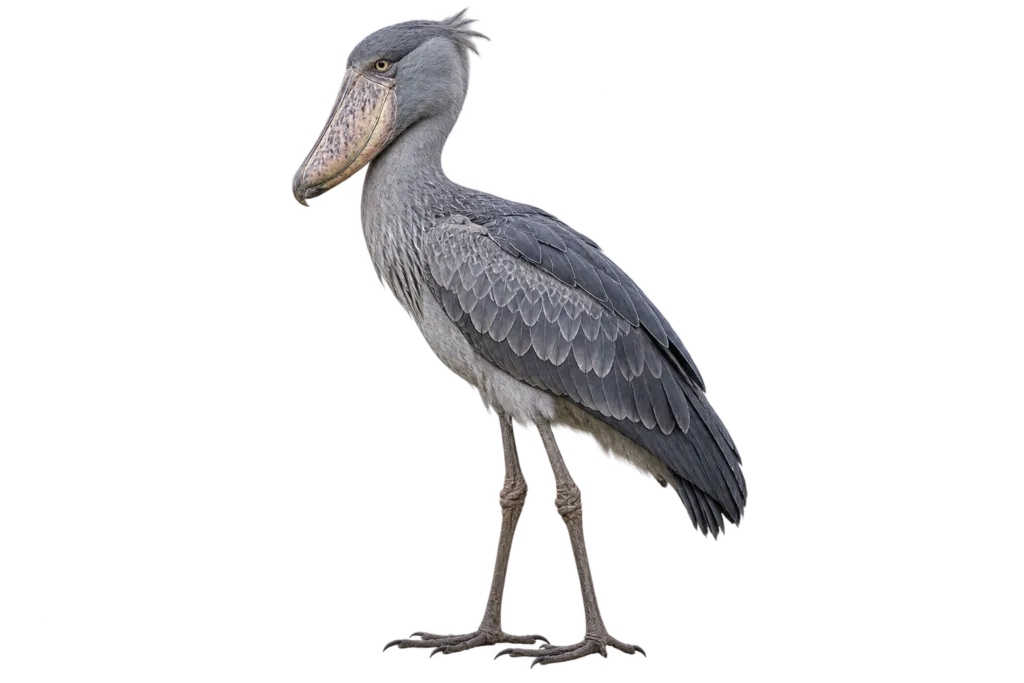
Size at a glance
How big is a Shoebill?
Compare
Compare Shoebill with another bird
Search by common or scientific name.
Morphology
Detailed measurements
Taxonomy
Classification
The Shoebill, Balaeniceps rex, combines a tall stance with an unusually broad head, a massive bill, long toes and wings that extend far beyond its standing outline. Adult body length is commonly reported around 100–140 cm (39–55 in), while standing birds are often about 110–140 cm (43–55 in) tall. The wingspan reaches roughly 230–260 cm (7.5–8.5 ft).
Standing Height and Body Length Measure Different Things
A Shoebill can look taller than expected because much of its visible height comes from its long legs and upright posture. Standing height is measured vertically, while body length follows a different axis from the bill toward the tail. Those measurements can therefore overlap numerically without describing the same part of the bird.
A reported height of 120 cm does not mean the bird has a 120 cm torso. The legs, neck position and head all contribute to standing height. Likewise, a body-length measurement includes the unusually large bill, which adds noticeably to the Shoebill’s front-to-back length.
Posture also changes the apparent size. A resting or hunting Shoebill may draw its neck inward and lower its head, making the body look compact. The same bird standing fully upright has a much taller outline.
The Bill Dominates the Head’s Proportions
The bill is the feature that most strongly changes the Shoebill’s proportions. It is not simply long. It is also deep and very broad, giving the head far more visual mass than the narrow bills found on many other long-legged waterbirds.
Zoo measurements describe the bill as more than 19 cm (7.5 in) long and nearly as wide. The upper mandible is strongly built and ends in a curved hook. Sharp cutting edges run along the mandibles.
This broad construction explains why side and front views of the same bird can look very different. From the side, bill length is most obvious. From the front, its width becomes much clearer. The large bill is attached to a correspondingly large head and a relatively thick neck rather than a very slender, elongated neck.
Its Wingspan Is Far Greater Than Its Standing Width
With the wings folded, the Shoebill has a fairly narrow vertical silhouette. Opening the wings changes that scale completely. A span of about 2.3–2.6 m (7.5–8.5 ft) can be close to twice the bird’s standing height.
The wings are broad rather than narrow and pointed. Morphological data compiled from AVONET specimens record flattened wing lengths around 620–664 mm in the sampled birds. Wing length and wingspan should not be treated as interchangeable measurements: wing length measures one folded wing from the carpal area toward the longest primary, while wingspan measures the full distance from one wingtip to the other.
In flight, the Shoebill retracts its neck and carries the head closer to the body. This shifts its outline away from the tall, long-necked shape seen when it stands upright in a wetland.
Large Feet Spread Beneath Long, Unwebbed Toes
The legs are long and dark, but the feet are especially useful for understanding the bird’s scale. The toes are extremely long and are not joined by webbing. When spread, they create a broad contact area beneath a body that otherwise appears top-heavy because of the large head and bill.
This foot shape suits the floating and waterlogged vegetation used by Shoebills while feeding. Instead of concentrating the bird’s weight onto a small foot, the widely separated toes distribute contact across a larger area. The toes also give the bird a wider base when it moves over unstable vegetation.
The result is a distinctive set of proportions: long legs below the body, very wide feet at ground level, and a large head above a comparatively compact trunk.
Male and Female Shoebills Have Similar Overall Form
Adult males and females have much the same grey plumage and basic body shape, so sex is not reliably identified from colour alone. Size provides more separation. Males tend to be larger and are reported to have longer bills than females.
Body mass also shows this tendency. Published reference values place average males around 5.6 kg (12 lb) and average females around 4.9–5.0 kg (about 11 lb). These are averages rather than fixed limits, so an individual bird’s mass by itself does not establish sex.
The difference is easier to understand as a shift in overall scale rather than a different body plan. Both sexes retain the same broad bill, large head, long legs, spreading toes and broad wings.
Young Shoebills Reach a Large Body Mass Before Leaving the Nest
Shoebill chicks begin life without the fully developed proportions of an adult. Their bill is initially much smaller relative to the head, while juveniles develop darker grey plumage with a brownish cast before taking on the cleaner blue-grey appearance of adults.
Field research in Zambia’s Bangweulu Wetlands followed Shoebill chicks from only a few days old to more than 100 days of age. The measured chicks approached a fledging mass of about 5.7 kg (12.6 lb). That places a near-fledged chick within the body-mass range commonly associated with full-sized Shoebills even though plumage and other age-related features continue to distinguish it from an adult.
The study also illustrates why age matters when interpreting a Shoebill measurement. A large body mass does not automatically mean that every part of the bird has reached its final adult form.
Data
Measurement sources
- Data status
- Measured
- Size measurements
- AVONET — Tobias et al. (2022)
- Morphology source
- AVONET — Tobias et al. (2022)
- Morphology dataset
- AVONET v7 — BirdLife taxonomy
- Morphology dataset license
- CC BY 4.0
Full source links, dataset definitions, licensing details and measurement methodology are maintained on the Data Sources & Methodology page.