Bird size profile
Snow Goose
Anser caerulescens
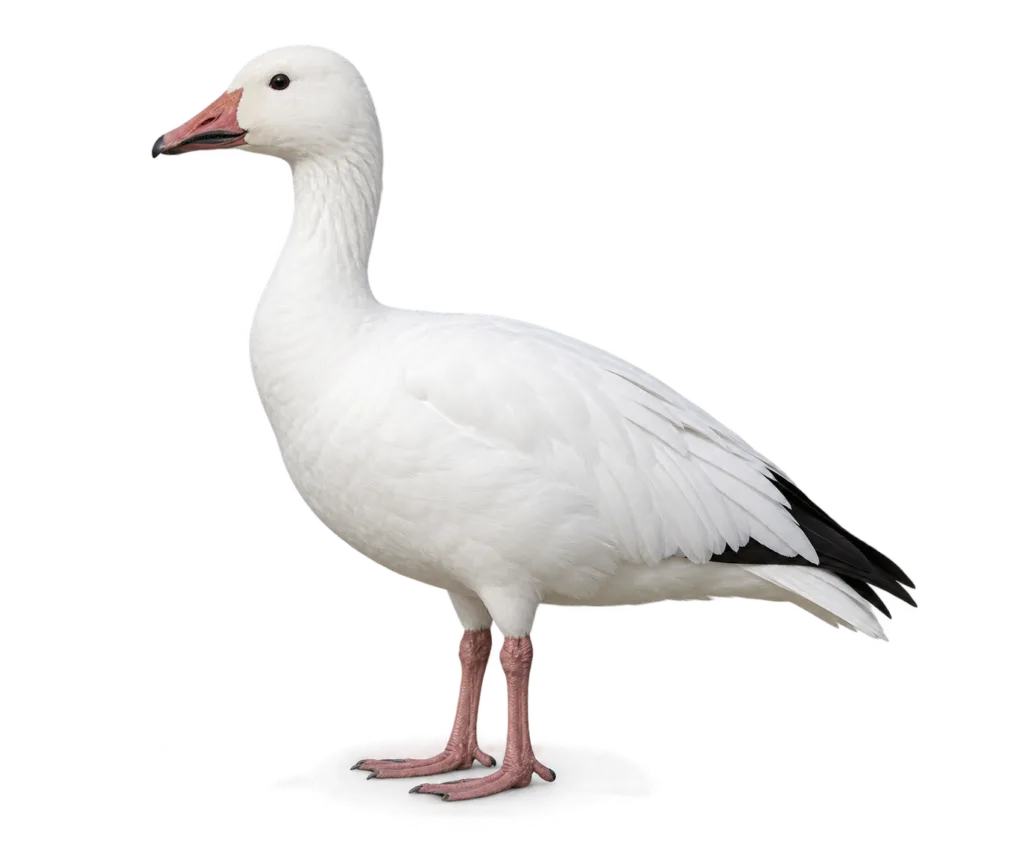
Size at a glance
How big is a Snow Goose?
Compare
Compare Snow Goose with another bird
Search by common or scientific name.
Morphology
Detailed measurements
Taxonomy
Classification
The Snow Goose (Anser caerulescens) is a medium-sized goose with more size variation than its uniform flock appearance may suggest. Adults commonly measure about 69–83 cm (27.2–32.7 in) in length and weigh roughly 1.6–3.3 kg (3.5–7.3 lb). A wingspan around 138 cm (54.3 in) is a useful general reference, but individual size depends on subspecies, sex, age, and population.
Why Snow Goose Size Varies So Much
The wide adult weight range is not simply normal variation among otherwise identical birds. Snow Geese occur as two recognized subspecies, and the larger-bodied form can noticeably raise the upper end of measurements reported for the species.
Greater and Lesser Snow Geese
The Greater Snow Goose (A. c. atlantica) is generally larger than the much more widespread Lesser Snow Goose (A. c. caerulescens). The difference involves more than body mass. Greater Snow Geese tend to have larger heads and longer bills as well.
Adult Greater males are commonly reported around 5.8–6.8 lb, while adult Greater females are about 5.1–5.7 lb. Lesser Snow Geese have broader overlap: reported adult males are roughly 4.2–6.2 lb and females about 3.8–6.4 lb. These overlapping values are an important reminder that body weight alone does not reliably identify the subspecies of an individual bird.
Measurements for “Snow Goose” may describe the whole species or a particular subspecies. A value from a Greater Snow Goose population should not be treated as the expected size of every Snow Goose.
Males Are Usually Slightly Larger
Snow Geese also show modest sexual size differences. Males are generally larger than females, although the sexes overlap heavily enough that size is not a dependable way to determine sex in the field.
Morphometric research on Lesser Snow Geese has found males to be only about 2–6% larger than females across different ages. The difference can be detected when many birds are measured, but it is much less obvious when looking at one male and one female in a flock.
White and Blue Snow Geese Are Not Different Size Types
The dramatic plumage difference between white and blue Snow Geese can make the two forms look like separate kinds of birds. They are color morphs of the same species rather than large and small forms.
Adult white-morph birds have mostly white plumage with black primary feathers. Blue-morph adults have a white head and a much darker gray-brown body. Despite that visual contrast, the color morph itself does not represent a different body-size class. White and blue birds share the same basic body proportions.
The distinction is also tied to subspecies distribution. Lesser Snow Geese occur in both white and blue forms, whereas the Greater Snow Goose is represented by the white form. As a result, a flock’s mixture of plumage colors should not be read as a simple indicator of the birds’ measurements.
Body Shape Matters Alongside the Numbers
A Snow Goose has a fairly long, thick neck and a substantial bill. These proportions give it a more elongated head-and-neck profile than a compact goose of similar general body mass might show.
Bill dimensions can be particularly useful when studying variation within Snow Geese. Measurements of the culmen, the upper ridge of the bill, overlap between the Greater and Lesser forms but tend to be longer in Greater Snow Geese. Because the two subspecies overlap in some measurements, researchers may combine bill, head, sex, and other information rather than relying on one dimension.
Young Birds Have Not Yet Reached Full Adult Size
Juvenile Snow Geese can be slightly smaller than adults during fall and early winter. The difference is most noticeable when young birds remain beside their parents in family groups, where direct size relationships are easier to judge.
Plumage changes can make age differences look stronger than the actual structural difference. Young white-morph Snow Geese have gray-brown areas on the head, neck, and wings instead of the clean white appearance of adults. Young blue-morph birds are much darker overall. Their bills and legs are also duller than those of mature birds.
As juveniles complete growth, these early differences become less useful for judging body size. Adult measurements therefore should not be applied rigidly to recently fledged or first-autumn birds.
Weight Is More Variable Than Structural Size
Body mass can change without an equivalent change in skeletal dimensions. Feeding conditions, seasonal energy stores, age, sex, and stage of the annual cycle can all affect how heavy a Snow Goose is when measured.
Length, head dimensions, bill length, and other structural measurements describe the bird’s physical frame more directly. Weight describes both that frame and the condition of the bird at a particular time. This helps explain why published weight ranges overlap substantially even where average structural size differs between groups.
For a Snow Goose near the middle of the species range, a single weight value therefore gives only part of the size picture. Its subspecies, sex, age, and structural proportions provide the context needed to interpret that number.
Data
Measurement sources
- Data status
- Measured
- Size measurements
- AVONET — Tobias et al. (2022)
- Morphology source
- AVONET — Tobias et al. (2022)
- Morphology dataset
- AVONET v7 — BirdLife taxonomy
- Morphology dataset license
- CC BY 4.0
Full source links, dataset definitions, licensing details and measurement methodology are maintained on the Data Sources & Methodology page.