Bird size profile
Snowy Albatross
Diomedea exulans
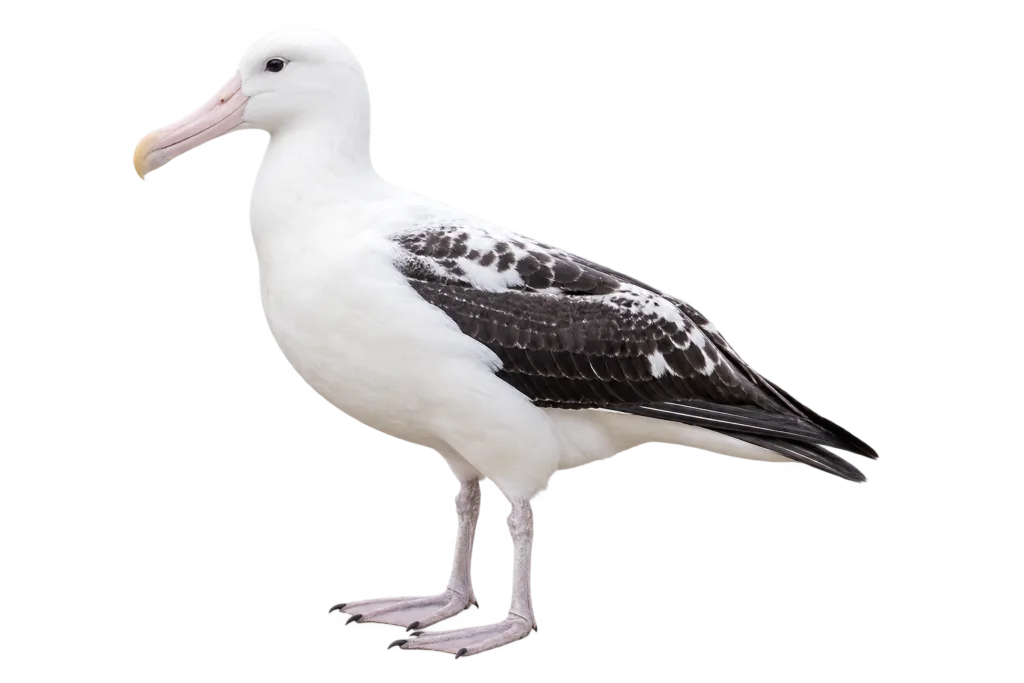
Size at a glance
How big is a Snowy Albatross?
Compare
Compare Snowy Albatross with another bird
Search by common or scientific name.
Morphology
Detailed measurements
Taxonomy
Classification
The Snowy Albatross (Diomedea exulans), long known as the Wandering Albatross, is built around an unusual proportion: a large but fairly compact body carried between exceptionally long, narrow wings. Adult body length is about 120 cm (47 in), while the fully spread wings extend to roughly 3 m (9.8 ft) and can exceed that figure in large individuals. Its apparent size therefore changes sharply depending on whether the bird is standing, sitting on the sea, or seen with its wings fully open.
The Three-Metre Wingspan Defines Its Scale
Body length alone gives an incomplete picture of this species. A Snowy Albatross measuring around 1.2 m from bill to tail becomes a bird about two and a half times as wide when the wings are extended. Much of its visual scale comes from that horizontal spread rather than from a deep or bulky body.
The wings are also narrow relative to their length. This produces the high-aspect-ratio shape associated with long-distance gliding. The outer wing tapers gradually, while the inner wing provides a broader connection to the body. Seen in flight, the result is a long, almost blade-like outline rather than the broad-winged profile of a bird designed for frequent powered flapping.
Wingspan is the straight tip-to-tip distance across both fully extended wings. It should not be confused with the length of one wing, wing chord, or total body length.
Males and Females Are Not the Same Size
Snowy Albatrosses show clear sexual size dimorphism. Detailed measurements of adults from the Crozet Archipelago found males heavier and larger across most measured body dimensions. The difference was strongest in body mass: adult males in the study averaged 9.44 kg (20.8 lb), compared with 7.84 kg (17.3 lb) for females.
The wingspan difference was smaller but still measurable. Males averaged 311 cm (10 ft 2 in), while females averaged 299 cm (9 ft 10 in). This means a female can have a wingspan close to three metres while carrying considerably less body mass.
| Adult Measurement | Male Mean | Female Mean |
|---|---|---|
| Body mass | 9.44 kg | 7.84 kg |
| Wingspan | 311 cm | 299 cm |
| Culmen length | 169.6 mm | 164.2 mm |
| Tarsus length | 128.3 mm | 121.1 mm |
These figures are study means rather than fixed dimensions for every individual. They are useful because they show how the sexes differ proportionally: male Snowy Albatrosses are not simply heavier versions of females. Their bills, legs and wings also tend to be longer.
Extra Body Mass Changes How the Wings Work
The male’s greater wingspan does not completely offset his greater mass. In the Crozet measurements, male wings had about 6.8% more surface area than female wings, but males were about 20.4% heavier. Their average wing loading was therefore higher.
Wing loading describes how much weight the wing area has to support. Adult males in the study averaged 148 N/m², compared with 132 N/m² in females. The difference matters because two birds with similarly shaped wings can experience different flight demands when one carries more mass over each unit of wing area.
The overall wing proportions remain remarkably similar between the sexes. Measured aspect ratio averaged 15.5 in males and 15.3 in females. In practical terms, both retain the same basic long-and-narrow albatross wing design even though males operate it with a heavier body.
The Bill Adds More Length Than the Head Suggests
The Snowy Albatross has a very large, elongated bill that contributes noticeably to its body profile. Adult culmen measurements from the Crozet sample averaged about 170 mm in males and 164 mm in females. The bill is therefore roughly 16–17 cm long along its upper ridge in those birds.
Its size is easier to appreciate from a side view, where the head itself looks relatively small beside the long bill. This can make the front half of the bird appear more elongated than body length alone suggests. The bill is also deep and strongly hooked at the tip, so its visual effect comes from both length and volume.
Plumage Age Can Distort Size Impressions
Young Snowy Albatrosses are much darker than old adults. Juveniles can be largely chocolate brown, while mature birds progressively acquire more white. Adult males can eventually become exceptionally white apart from dark areas near the wing tips and trailing edges.
That change in contrast can alter how the outline appears at sea. A pale mature bird against dark water may make its wings and body boundaries easier to see, while the darker plumage of a younger bird can produce a more compact visual impression. Plumage is therefore a poor substitute for actual measurement when judging body size.
The common name also reflects a modern taxonomic distinction rather than a separate white plumage form. Snowy Albatross is now used for Diomedea exulans, the species historically called the Wandering Albatross in many field guides and scientific publications.
Why Standing Birds Look Smaller Than Flying Birds
On land, the wings are folded tightly along the sides and much of their length disappears from view. Attention shifts to the long bill, thick body, large feet and roughly 1.2 m body length. The same bird in full flight presents nearly three metres of continuous wing from tip to tip.
This difference in geometry explains why photographs of a standing Snowy Albatross can understate its true dimensions. Its most extreme measurement is not vertical height or body length but lateral span. The species reaches its characteristic scale only when both wings are fully extended.
Data
Measurement sources
- Data status
- Measured
- Size measurements
- AVONET — Tobias et al. (2022)
- Morphology source
- AVONET — Tobias et al. (2022)
- Morphology dataset
- AVONET v7 — BirdLife taxonomy
- Morphology dataset license
- CC BY 4.0
Full source links, dataset definitions, licensing details and measurement methodology are maintained on the Data Sources & Methodology page.