Bird size profile
Snowy Egret
Egretta thula
Size at a glance
How big is a Snowy Egret?
Compare
Compare Snowy Egret with another bird
Search by common or scientific name.
Morphology
Detailed measurements
Taxonomy
Classification
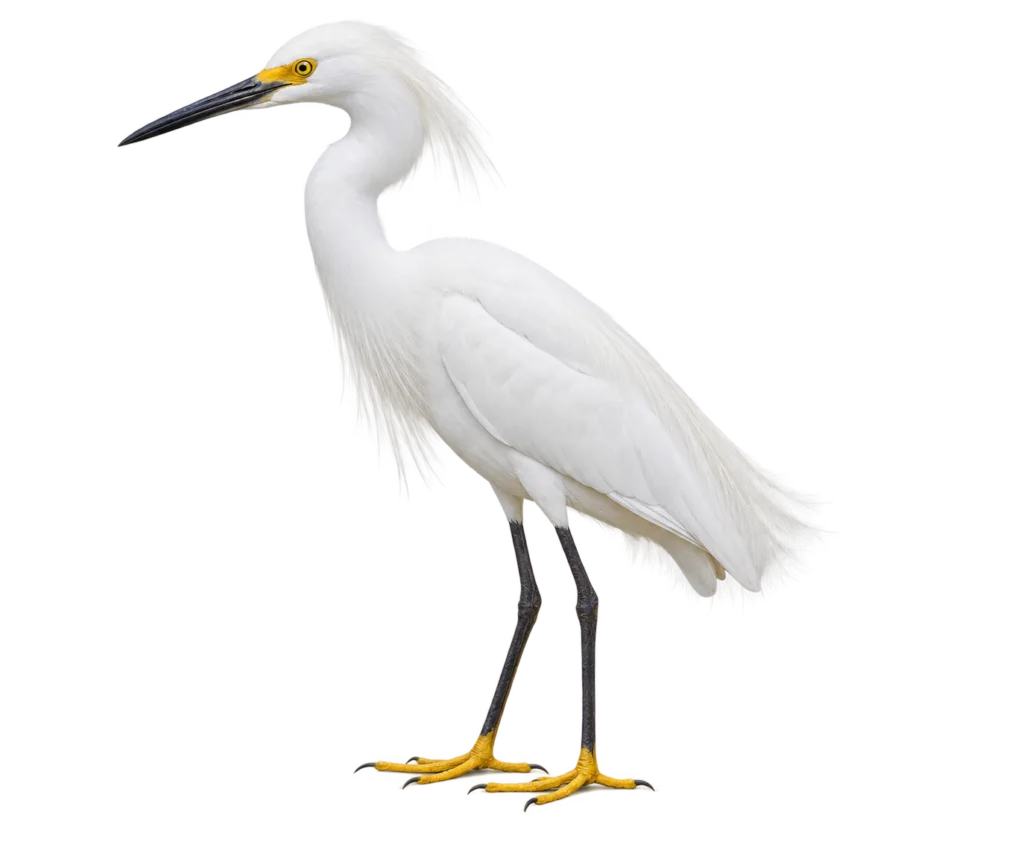
The Snowy Egret (Egretta thula) is a slim, medium-sized heron whose long neck and legs make it look larger than its body mass suggests. Adults are generally 56–66 cm (22.1–26.0 in) long, with a wingspan close to 100 cm (39.4 in). A commonly reported adult weight is about 370 g (13.1 oz), although some field references extend the upper end to roughly 420 g.
How Large Is a Snowy Egret?
Body length does not mean standing height. The usual 56–66 cm measurement describes the bird from bill to tail in a standard body-length measurement. A Snowy Egret can appear much taller when its neck is extended because a large share of its visible outline comes from the neck and legs rather than a bulky torso.
The wings tell a similar story. A span of about one metre is broad compared with the bird’s relatively low mass. In flight, the neck folds back against the body while the long legs project beyond the short tail. This produces a much more compact body profile than the same bird shows while standing with its neck extended.
Wing Length and Wingspan Are Different Measurements
Specimen datasets may give a single-wing measurement of roughly 219–279 mm. This is a wing measurement taken from the folded or flattened wing, not the full distance between both wingtips. It should not be substituted for the Snowy Egret’s roughly one-metre wingspan.
A Light Body on Long, Narrow Proportions
The Snowy Egret’s shape is dominated by narrow structures. The neck is long and thin, the head is relatively small, and the bill is straight and slender. Its legs are also long and fine rather than heavy. Together, these proportions create a tall-looking bird without much body mass.
The bill is usually black in adults and forms a clean extension of the narrow head. The neck can be drawn into a deep curve while resting or foraging, then extended rapidly. Because the torso remains fairly compact, changes in neck posture can alter the apparent size of the bird considerably.
The Yellow Feet Are Part of the Bird’s Proportions
Adult Snowy Egrets normally combine black legs with yellow feet. The contrast is especially noticeable because the legs themselves are so narrow. The feet can therefore appear unusually prominent even though they represent only a small part of the bird’s total length.
The feet are not simply a static color feature. Outside peak breeding condition they may look yellow to greenish-yellow. During breeding, they can become richer orange-yellow and at times reddish-orange. The bare skin between the eye and bill also changes, shifting from yellow toward pinkish or reddish tones in breeding condition.
These color changes do not alter the bird’s physical dimensions, but they can change how the legs and head are perceived in the field. Bright feet draw attention to the lower end of an otherwise dark leg, while stronger facial color makes the narrow head and bill more visually distinct.
Breeding Plumes Change the Outline Without Changing Body Size
A breeding adult develops long, fine white plumes on the head, neck, breast, and back. Some of the back plumes curve outward beyond the normal contour feathers. The result is a softer and more expanded outline, especially around the rear of the body.
This can make a breeding bird seem fuller than a nonbreeding bird of the same skeletal size. The effect comes from feather structure rather than an increase in body dimensions. When the plumes are raised during display, the difference becomes even more obvious.
Outside breeding condition, the outline is cleaner. The white body remains, but without the extended ornamental feathers the bird’s narrow neck, small head, compact torso, and long legs become more visually dominant.
Young Snowy Egrets Have Softer Leg and Bill Contrasts
Immature birds already have the white body shape associated with the species, but their bare-part colors are less sharply defined. The legs can be dull greenish or yellow-green rather than the strong black of a typical adult. Yellow-green may extend upward from the feet along the rear of the lower leg.
The bill can also look paler, particularly near its base, before darkening with age. Young birds lack the elaborate breeding plumes of mature adults. Their basic proportions are therefore recognizable before the high-contrast adult pattern is fully developed.
Because age changes color more noticeably than basic body form, the slim bill, narrow head, long neck, and fine legs remain useful structural features when the familiar black-leg and yellow-foot pattern is not yet fully expressed.
Male and Female Size Differences Are Hard to See
Male and female Snowy Egrets have essentially the same plumage. Males average slightly larger in published accounts, but the size ranges overlap enough that an isolated bird cannot be reliably sexed from apparent size alone.
Geographic variation also exists. Birds traditionally assigned to Egretta thula brewsteri in western North America, especially around Baja California, have been described as somewhat larger and heavier-billed. Measurements overlap with other populations, however, so the difference is not a simple large-versus-small division across the species’ range.
For ordinary size interpretation, the broad adult figures remain more useful: roughly 56–66 cm in body length, around a metre across the wings, and a body mass measured in only a few hundred grams. The Snowy Egret’s distinctive appearance comes less from sheer size than from how that light body is distributed across a long neck, narrow bill, extended wings, and very long legs.
Data
Measurement sources
- Data status
- Measured
- Size measurements
- AVONET — Tobias et al. (2022)
- Morphology source
- AVONET — Tobias et al. (2022)
- Morphology dataset
- AVONET v7 — BirdLife taxonomy
- Morphology dataset license
- CC BY 4.0
Full source links, dataset definitions, licensing details and measurement methodology are maintained on the Data Sources & Methodology page.