Bird size profile
Southern Brown Kiwi
Apteryx australis
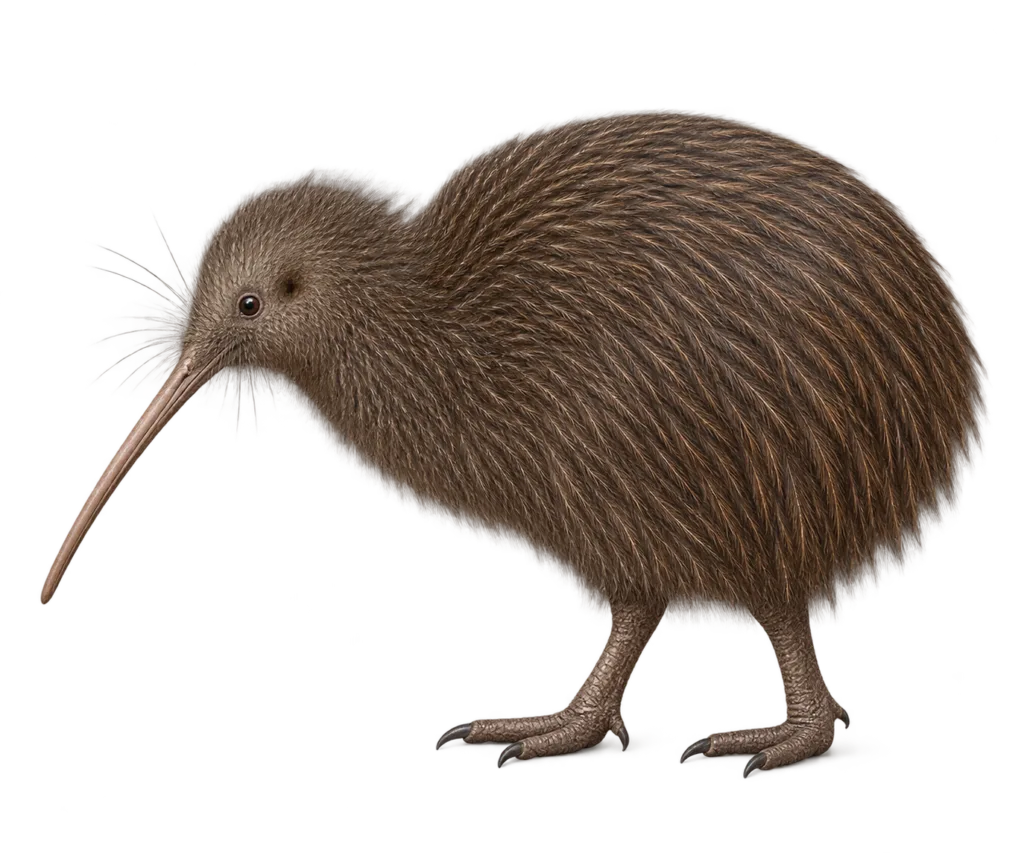
Size at a glance
How big is a Southern Brown Kiwi?
Compare
Compare Southern Brown Kiwi with another bird
Search by common or scientific name.
Morphology
Detailed measurements
Taxonomy
Classification
The southern brown kiwi, or tokoeka (Apteryx australis), has a low, rounded body, short powerful legs and a long bill that accounts for much of its visible length. A commonly published identification length is about 45 cm, but body mass varies strongly with sex and also differs among the geographically separated forms of tokoeka. Adult females are usually both heavier and longer-billed than adult males.
A Heavy Body on a Low Frame
Tokoeka do not have the upright outline associated with many similarly heavy birds. The body is carried fairly low, the neck narrows toward a small head, and the bill projects far beyond the face. The result is a long-looking bird whose mass is concentrated in a compact trunk rather than spread across long legs, a long neck or a large tail.
New Zealand Birds Online gives a representative weight of about 2.4 kg for males and 3.1 kg for females. These figures are more useful when read as sex-specific reference values rather than as fixed weights for every southern brown kiwi. Individual condition, locality and the particular tokoeka population can all shift the number.
A 45 cm identification length should not be treated as a standing height. Tokoeka have short legs and a long projecting bill, while much of their weight sits in the rounded body. Two birds with fairly similar visible length can therefore differ noticeably in mass.
Females Show the Stronger Dimensions
Sexual size differences are especially clear in the bill. Females are not simply heavier versions of males; their bills can be much longer as well. Measurements from adult Rakiura tokoeka at Mason Bay on Stewart Island/Rakiura show this pattern in the same population.
| Adult Measurement | Female Mean | Male Mean |
|---|---|---|
| Bill length | 142.7 mm | 105.1 mm |
| Tarsus length | 96.5 mm | 91.5 mm |
| Body mass | 3,264 g | 2,657 g |
The bill difference is much greater than the difference in tarsus length. This gives adult females a visibly longer facial profile even before body mass is considered. In the Mason Bay sample, female bills averaged more than 14 cm, while male bills averaged a little over 10 cm.
The mass figures from that research should not be turned into universal species averages. The study dealt with one Rakiura population, and body mass was recorded during a limited part of the year. The measurements are most useful for showing the shape and scale of the male–female difference within Rakiura tokoeka.
Southern Brown Kiwi Size Changes Across Its Range
Tokoeka are not identical in build throughout their southern New Zealand range. Rakiura birds from Stewart Island are particularly large. Fiordland tokoeka are also large-bodied, while the geographically isolated Haast form is smaller.
This geographic variation matters when a measurement is labelled only as “southern brown kiwi.” A value taken from a large Rakiura adult should not automatically be treated as the expected measurement for a Haast bird. Sex adds another layer of variation, so a female from a large-bodied population can sit well above a male from a smaller-bodied population without either bird being unusual.
The Bill Adds Length but Also Works as a Sensory Organ
The tokoeka bill is long, narrow and gently down-curved. Its shape makes it one of the most visually dominant parts of the bird and helps explain why overall length alone gives an incomplete impression of body bulk.
Kiwi have their nostril openings close to the tip of the bill rather than near its base. The bill tip also contains dense sensory structures associated with touch. Anatomical studies of kiwi have found mechanoreceptors within pits near the tip, allowing the bill to respond to mechanical information from the substrate while the bird probes through soil and litter.
This means bill length is not merely a convenient morphometric measurement. A female’s longer bill changes both her proportions and the reach of the main structure used during probing. The bill is paired with long bristles around its base, while the eyes remain small relative to the head.
Soft Feathers Hide an Unusual Flightless Body
The apparent size of a southern brown kiwi is also shaped by its plumage. Its feathers have a loose, hair-like structure rather than the tightly linked surface typical of flight feathers. They form a shaggy outer layer that can make the trunk look broader and less sharply outlined.
Colour varies from rufous brown to darker brown, usually with darker lengthwise streaking. The feather tips are soft. Beneath this covering are extremely reduced wings that are largely hidden from view, and there is no visible external tail to extend the rear of the silhouette.
The legs provide the opposite impression. They are short but strongly built, with sturdy feet and claws supporting a bird that spends its life walking, running, digging and probing at ground level. Because there is little visible wing or tail structure, the combination of rounded trunk, muscular legs and elongated bill defines most of the tokoeka’s external proportions.
Those proportions also explain why mass, bill length and body length should be kept as separate measurements. A long bill can add greatly to linear size without adding much bulk, while the trunk and legs carry most of the bird’s mass.
Data
Measurement sources
- Data status
- Measured
- Size measurements
- AVONET — Tobias et al. (2022)
- Morphology source
- AVONET — Tobias et al. (2022)
- Morphology dataset
- AVONET v7 — BirdLife taxonomy
- Morphology dataset license
- CC BY 4.0
Full source links, dataset definitions, licensing details and measurement methodology are maintained on the Data Sources & Methodology page.