Bird size profile
Southern Cassowary
Casuarius casuarius
Size at a glance
How big is a Southern Cassowary?
Compare
Compare Southern Cassowary with another bird
Search by common or scientific name.
Morphology
Detailed measurements
Taxonomy
Classification
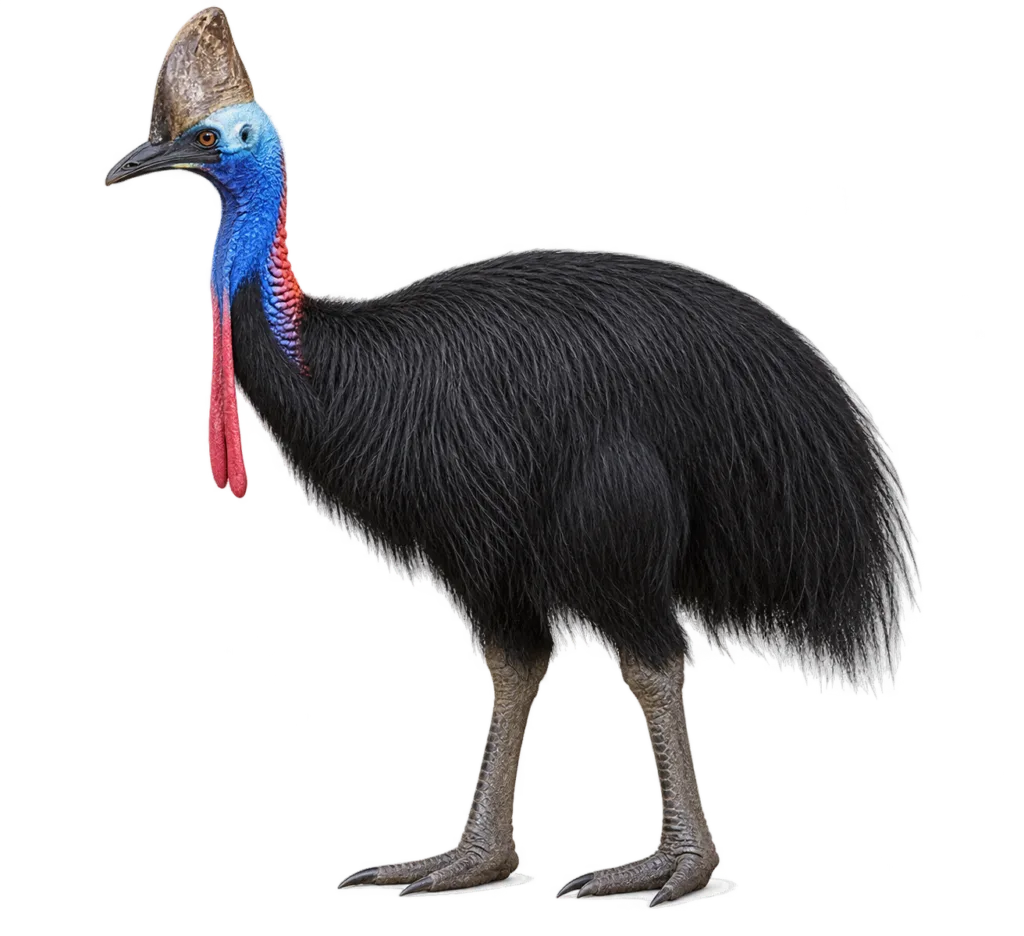
The Southern Cassowary (Casuarius casuarius) is a very large, heavy-bodied flightless bird whose standing height comes from a combination of long legs, an upright neck and a tall cranial casque. Adults can reach about 1.5–2.0 m (4.9–6.6 ft) in standing height, while body mass differs strongly between the sexes. Females are the larger and heavier birds.
How Large Does a Southern Cassowary Get?
Published size figures need to be read carefully because height, body mass and individual structural measurements describe different parts of the bird. A standing-height range of about 150–200 cm is reported for the species. This is vertical stature rather than a head-to-tail body length measurement.
The upper weight figures come from Australian Southern Cassowaries and should not be treated as the expected mass of every adult across the species’ entire range. Individual condition, sex, age and population all affect body mass. Research using mean adult measurements also shows the same basic pattern: females carry substantially more mass than males.
For a bird with long legs, a long neck and a projecting casque, standing height describes a different dimension from conventional body length. Converting a reported height into an assumed head-to-tail length would create a measurement that was never actually taken.
Females Are Noticeably Larger Than Males
Southern Cassowaries show reverse sexual size dimorphism: the female is larger. One analysis of published mean body masses used approximately 45.8 kg for females and 31.7 kg for males. Work on adult birds has likewise described females as roughly 30% heavier in body mass than fully grown males.
The difference is visible in overall build as well as on a scale. Females tend to look deeper and more massive through the trunk, and museum descriptions also note that they are generally larger, more brightly coloured and may carry a taller casque. Size alone, however, should not be used as an exact field measurement of sex because individual adults vary.
Casque shape is especially poor as a simple male-versus-female marker. A geometric study of more than 100 adult Southern Cassowaries found no clear sex-specific separation in casque shape despite the strong difference in overall body size.
The Casque Adds More Than Height
The casque is a tall structure rising above the skull, so it contributes directly to the bird’s apparent stature. It is not simply a solid horn sitting on top of the head. Anatomical imaging has shown a complex structure involving several cranial bones, including the nasals, lacrimals and frontals, together with midline elements. A relatively thin keratinous covering forms the external surface.
This matters when interpreting photographs or comparing individual cassowaries. Two adults with similar body size can have visibly different casque outlines. The structure may lean slightly away from the midline, and the degree and direction of that asymmetry vary between birds.
A study of adult Casuarius casuarius found that casque asymmetry was common. In a sample of 111 casques, 77.5% deviated toward the right, 20.7% toward the left and only 1.8% showed no deviation from the midline. This makes an individual casque profile a variable feature rather than a fixed geometric shape shared by every adult.
The casque also changes during growth. Chicks hatch without the tall adult structure. Bony casque development begins after hatching, with primary growth starting at roughly six weeks of age and continuing toward maturity. Enlargement appears to continue more slowly in adults. An immature bird therefore cannot be scaled into an adult simply by using its current casque height.
What Does the Casque Do?
No single proposed function explains every aspect of the casque. One experimentally supported role is heat exchange. Thermal imaging of live cassowaries showed that the casque can alter surface heat loss as ambient temperature changes. The distal bill and legs also showed temperature-responsive heat exchange, while the feathered body remained much more insulated.
This thermal role fits the bird’s anatomy: a large, dark-feathered body retains heat, while less insulated structures can release it. The casque may have additional functions, but its exact biological roles are still being studied.
Long Legs Support a Heavy, Upright Body
The Southern Cassowary’s silhouette is dominated by its pelvic limbs. The legs are long, thick and heavily muscled, supporting a body mass that can exceed 50 kg in large adults. Unlike the small wings, the hind limbs are major load-bearing structures.
Each foot has three toes. The inner toe carries an elongated, dagger-shaped claw that can reach about 120 mm (4.7 in). That figure describes the specialised claw rather than general toe length, so it should not be used as a proxy for foot size.
Measurements from a small field study of adult Australian cassowaries also illustrate the sex difference in the lower limb. Mean metatarsus length was about 388 mm in females and 350 mm in males in the sampled birds. These are study-specific measurements, not universal minimum and maximum values, but they show that the female’s larger mass is accompanied by larger supporting limb dimensions.
Reduced Wings Make the Body Profile Unusual
The wings are tiny relative to the mass of the bird. Rather than forming the broad folded-wing outline seen on many birds, they remain largely hidden against the body. Modified quills project from the reduced wing area, while the main body is covered in coarse, black feathers often described as hair-like in appearance.
Southern Cassowaries also lack a conventional feathered tail. As a result, the rear body profile is rounded and compact instead of tapering into long tail feathers. The visual impression of size therefore comes mostly from the deep trunk, long legs, extended neck and casque.
Age Changes Both Colour and Proportions
A young Southern Cassowary does not look like a scaled-down adult. Newly hatched chicks have strongly striped plumage and no developed adult casque. Juveniles become browner as they grow, while the head and neck remain less brightly coloured than in mature birds.
The adult body plan develops gradually. The legs lengthen, overall body mass rises, the plumage darkens and the casque expands above the skull. Because these features mature at different rates, estimating age from one external measurement alone is unreliable.
Adult males and females eventually become similar in their basic structural layout—long legs, reduced wings, black body plumage, a bare colourful neck and a prominent casque—but they do not converge on the same body mass. The larger female remains the heavier-bodied sex, making sexual size dimorphism one of the clearest features of Southern Cassowary morphology.
Data
Measurement sources
- Data status
- Measured
- Size measurements
- AVONET — Tobias et al. (2022)
- Morphology source
- AVONET — Tobias et al. (2022)
- Morphology dataset
- AVONET v7 — BirdLife taxonomy
- Morphology dataset license
- CC BY 4.0
Full source links, dataset definitions, licensing details and measurement methodology are maintained on the Data Sources & Methodology page.