Bird size profile
Southern Royal Albatross
Diomedea epomophora
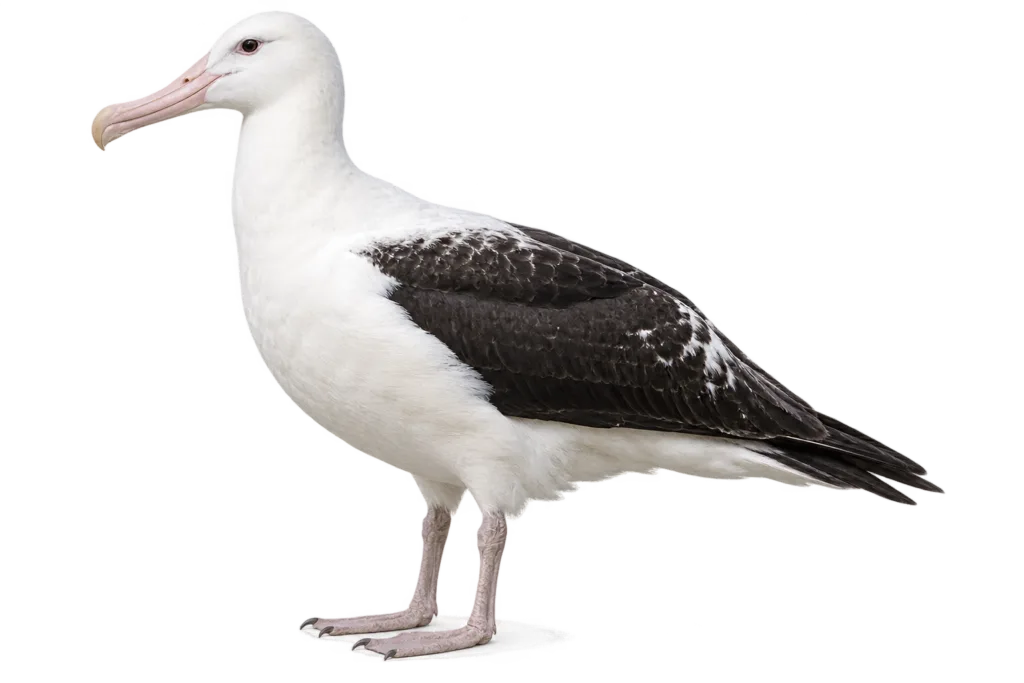
Size at a glance
How big is a Southern Royal Albatross?
Compare
Compare Southern Royal Albatross with another bird
Search by common or scientific name.
Morphology
Detailed measurements
Taxonomy
Classification
The Southern Royal Albatross (Diomedea epomophora) combines a body about 1.2 metres long with wings that span more than 3 metres. That contrast matters when judging its scale: the bird is large and heavy-bodied, but most of its visual size in flight comes from exceptionally long wings rather than from body length alone.
A Three-Metre Wing System on a 1.2-Metre Bird
A Southern Royal Albatross typically weighs around the scale expected of the largest living albatrosses, with adult measurements commonly falling near 9 kg. Yet mass does not explain its appearance as well as wing geometry does. The body is full and deep, while the wings extend far beyond it as long, relatively narrow surfaces. The tail is much shorter and gently wedge-shaped.
This creates two very different impressions of the same bird. On land or sitting on the sea, the folded wings conceal much of its true span and the large bill and substantial torso become more prominent. With the wings fully spread, body length becomes a much smaller part of the overall silhouette.
Wing Measurement Is Not Wingspan
Morphometric records may list a wing measurement of roughly 65–71 cm. That is a single-wing measurement taken from the bird and is not the full tip-to-tip wingspan. It should not be doubled to create a substitute wingspan figure. Full spread wings exceed 3 metres.
Male and Female Measurements Do Not Fall Into One Size Range
Males tend to be larger than females, although the two sexes overlap in some measurements. The difference is therefore better understood from several dimensions together rather than from body weight alone.
| Measurement | Male | Female |
|---|---|---|
| Wing | 674–707 mm | 647–686 mm |
| Tail | 211–224 mm | 196–210 mm |
| Bill, tip to skull | 179–188 mm | 163–177 mm |
| Tarsus | 134–138 mm | 123–126 mm |
| Weight | 8.2–9.5 kg | 6.6–9.1 kg |
The overlap is especially clear in wing measurement and weight. A large female can fall within part of the male range, so neither measurement alone provides a clean boundary between the sexes. Bill, tail and leg measurements in the same dataset also show the generally larger structure of males.
The Bill Adds to the Heavy Front Profile
The bill is not a minor feature on a Southern Royal Albatross. It is long, deep and strongly built, with a pale pink tone, a creamy tip and a dark cutting edge along the upper mandible. Its size gives the head a substantial profile that matches the bird’s broad chest and heavy body.
That front-heavy appearance can make a resting bird seem more compact than its measurements suggest. The tail contributes relatively little length compared with the enormous extension supplied by the wings. In side view, the result is a large body, a prominent bill and a fairly short rear profile; in flight, the same bird becomes dominated by its wing span.
Wing Colour Changes With Age, but Wing Scale Does Not
Young Southern Royal Albatrosses have darker upperwings than mature birds. Their white body plumage can also carry dark flecking on the back, flanks, crown and tail. As the bird matures, white develops along the leading portion of the inner upperwing, and this whitening is often more extensive in males.
The changing pattern can alter how broad or dark the wings appear at a distance, but it should not be treated as a structural size change. A dark-winged younger bird still has the long-winged proportions of the species. Adult plumage simply exposes more pale feathering across parts of that large wing surface.
Body Form
Large, deep-bodied and substantial rather than slim through the torso.
Wing Form
Extremely long relative to the body, producing a spread of more than 3 metres.
Tail Form
Short compared with the wings and gently wedge-shaped.
Bill Form
Large and robust, with a pale bill surface and a distinctive dark cutting edge.
Data
Measurement sources
- Data status
- Measured
- Size measurements
- AVONET — Tobias et al. (2022)
- Morphology source
- AVONET — Tobias et al. (2022)
- Morphology dataset
- AVONET v7 — BirdLife taxonomy
- Morphology dataset license
- CC BY 4.0
Full source links, dataset definitions, licensing details and measurement methodology are maintained on the Data Sources & Methodology page.