Bird size profile
Spix’s Macaw
Cyanopsitta spixii
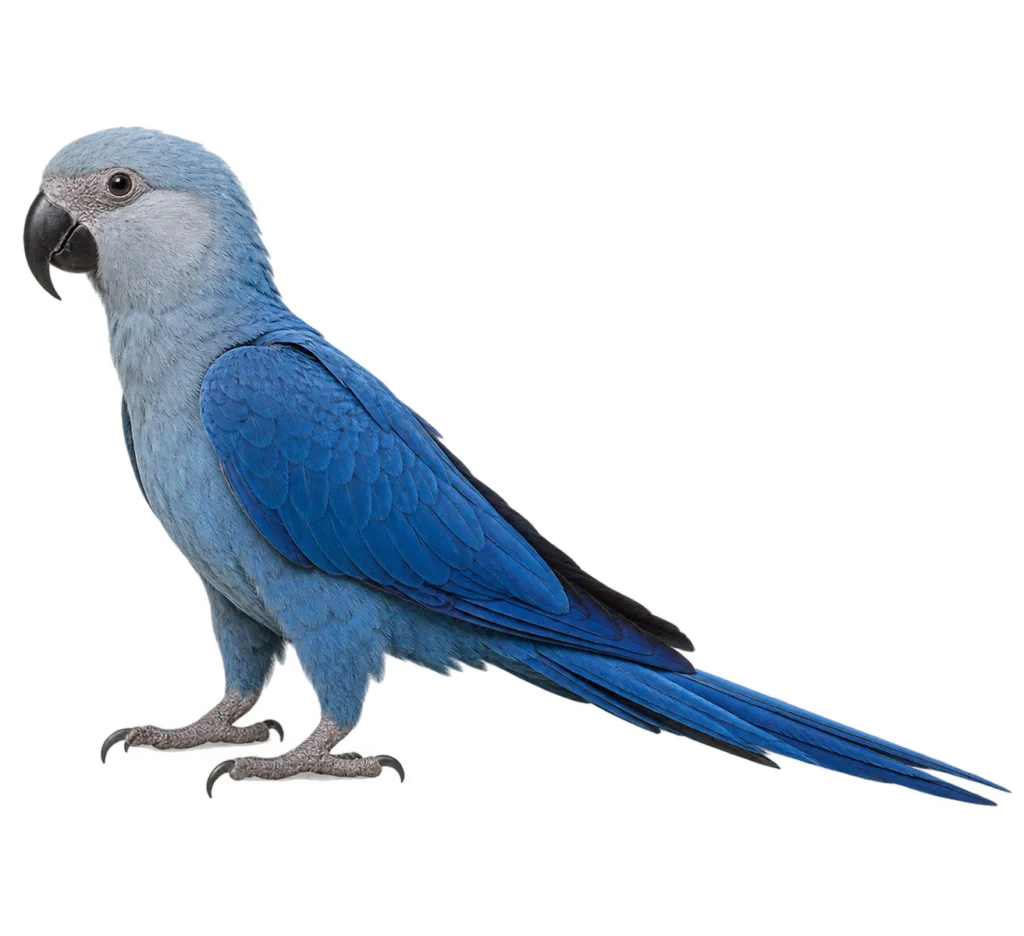
Size at a glance
How big is a Spix’s Macaw?
Compare
Compare Spix’s Macaw with another bird
Search by common or scientific name.
Morphology
Detailed measurements
Taxonomy
Classification
Spix’s Macaw (Cyanopsitta spixii) is a compact, long-tailed macaw whose total length can give a misleading impression of its body size. Adults are generally listed at about 55–57 cm (21.7–22.4 in) in total length, but much of that measurement comes from the elongated tail rather than a large, heavy body.
Total Length Is Dominated by the Tail
The species has the classic long-tailed outline of a macaw, but on a relatively light frame. Historical museum material recorded a tail of about 13.5 inches, or roughly 34 cm, while modern feather data include central tail feathers measuring about 355 mm. These measurements help explain why a bird only a few hundred grams in mass can still approach 57 cm from the bill to the end of the tail.
This also makes total length a poor stand-alone indicator of bulk. A perched Spix’s Macaw looks slender through the chest and body, with the narrow body continuing into a long, tapered tail. The head is relatively compact and has been described as somewhat square in outline. The combination of a small body, long wings and long tail gives the species a much lighter-looking profile than the total-length figure alone suggests.
Published wingspan figures are unusually inconsistent. Some secondary references give values near 1.2 m, while other sources publish much smaller figures. These should not be treated as interchangeable with measured wing length. Standardized wing measurements provide a firmer basis for describing the bird’s proportions.
Measured Wings Show a Long-Winged Bird
Modern feather datasets give a flattened wing length of about 261–289 mm from 18 measured records. A nineteenth-century British Museum description recorded an adult male wing at about 11 inches, approximately 279 mm, which falls comfortably inside that modern range.
Wing length is not the same measurement as wingspan. It is taken on one folded or prepared wing, usually from the carpal joint to the tip of the longest primary under a defined measurement method. It is therefore useful for comparing specimen proportions without relying on uncertain published span estimates.
The wings themselves are long and fairly narrow. Together with the extended tail, they create an elongated silhouette in flight rather than the broad, heavy outline that might be expected from the word “macaw.” The flight feathers are darker than much of the body plumage, adding definition to the wing when it is spread.
Body Mass Varies Across Published Records
Spix’s Macaw weight data do not form one perfectly consistent range. An ICMBio conservation account reported 270–360 g in captivity, while a zoological database lists 296–400 g. The World Parrot Trust gives 360 g as a representative weight. These figures come from different collections and reporting methods, so combining them into a single artificial “official” range would hide the variation in the underlying records.
Body mass can also change with age, condition, feeding and reproductive state. For this species, the useful interpretation is that an adult is a relatively light macaw, usually weighing only a few hundred grams despite its long head-to-tail measurement.
That distinction matters when visualizing size. Length describes the bird’s extended outline; mass describes the amount of body tissue carried within that outline. Spix’s Macaw has a particularly strong separation between those two impressions because its tail contributes so much to its apparent size.
The Blue Plumage Is Not Uniform
An adult is not a single shade of blue. The head and neck are muted grey-blue, with the forehead and ear-coverts appearing greyer. The underparts are generally paler blue, while the back, upper wings and long tail are deeper and more vivid blue. Darker flight and tail feathers become more apparent from below.
The bare facial area is another useful structural feature. Adults have exposed skin around the eye and lores, breaking up the feathered surface of the head. The bill is dark and strongly curved, but proportionally compact for a macaw. Adult irises are pale yellow to yellowish, contrasting with the grey-blue head and darker facial skin.
The feet are grey to dark grey and have the opposing-toe arrangement typical of parrots: two toes point forward and two backward. This foot structure is suited to gripping branches and manipulating food rather than adding much to the bird’s visible height when perched.
Young Birds Have Different Proportions
Juveniles resemble adults closely enough that body color alone is not always the clearest age clue. Their tails are shorter, so young birds can look noticeably more compact even before subtle plumage details are considered. The iris is brown rather than the pale yellow of an adult, and immature birds show lighter or horn-colored areas on the upper mandible.
As the tail reaches adult length, the bird develops the stretched proportions associated with mature Spix’s Macaws. This age-related change is important when interpreting photographs or measurements because a juvenile’s shorter overall length does not necessarily indicate an unusually small adult-sized individual.
Males and Females Are Very Similar Externally
Spix’s Macaws show little obvious external sexual dimorphism. Adult males and females share the same general plumage pattern and structural features, and sex cannot be reliably assigned from blue coloration alone. Historical descriptions characterize the female as somewhat smaller, but the difference is subtle rather than a clear visual division between two body forms.
For size records, this means individual measurements should not automatically be interpreted as male or female values unless the sex of the measured bird was actually known. The species’ small surviving population history also means that published measurements draw heavily on captive birds, preserved specimens and managed populations rather than a broad sample of wild adults.
Data
Measurement sources
- Data status
- Measured
- Size measurements
- AVONET — Tobias et al. (2022)
- Morphology source
- AVONET — Tobias et al. (2022)
- Morphology dataset
- AVONET v7 — BirdLife taxonomy
- Morphology dataset license
- CC BY 4.0
Full source links, dataset definitions, licensing details and measurement methodology are maintained on the Data Sources & Methodology page.