Bird size profile
Steller’s Sea-Eagle
Haliaeetus pelagicus
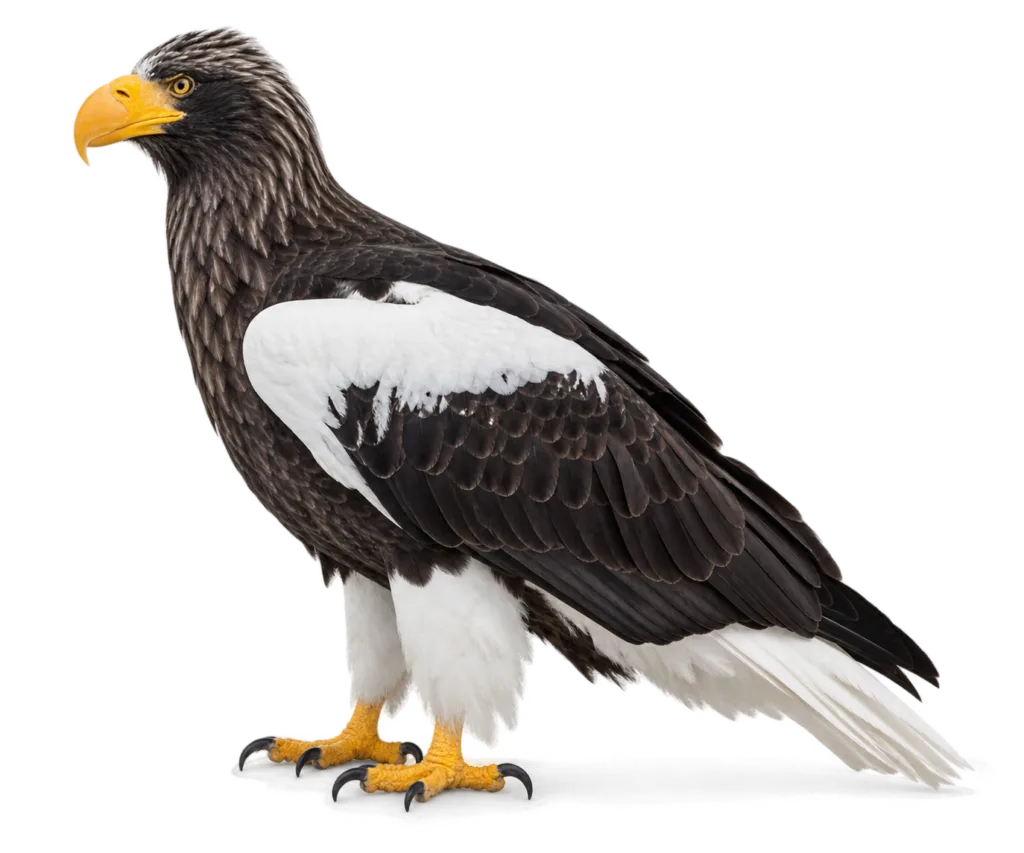
Size at a glance
How big is a Steller’s Sea-Eagle?
Compare
Compare Steller’s Sea-Eagle with another bird
Search by common or scientific name.
Morphology
Detailed measurements
Taxonomy
Classification
Steller’s Sea-Eagle (Haliaeetus pelagicus) is a very large, heavy-bodied sea eagle. Adults are roughly 85–105 cm (33.5–41.3 in) long, while published wingspan figures commonly fall between about 1.95 and 2.50 m (6 ft 5 in–8 ft 2 in). Body mass shows a clear sex difference, with females usually substantially heavier than males.
How Large Is a Steller’s Sea-Eagle?
Length alone does not fully convey the size of this eagle. Much of its visual bulk comes from a deep body, broad wings, a large head and an unusually massive bill. Even when perched with the wings folded, an adult has a thick, powerful outline rather than the narrower profile seen in many raptors.
Published measurements do not always use identical samples, so the upper and lower limits can differ slightly between references. Values near 2.5 m should be treated as the upper end of the reported wingspan range rather than the expected span of every adult.
Females Carry More of the Mass
Steller’s Sea-Eagles show female-biased size dimorphism. The sexes have similar adult plumage, but females tend to be larger overall and can be much heavier.
The ranges overlap because body mass is not fixed. Age, season, feeding condition and the population or sample being measured can all affect recorded weights. Some published datasets also use slightly narrower sex-specific ranges.
Body length follows the same general pattern. Males tend to occupy the shorter end of the species range, while large adult females can approach or exceed one metre from bill to tail.
The Bill Adds to the Eagle’s Heavy Profile
The bill is one of the most distinctive parts of the species’ proportions. It is deep, strongly hooked and conspicuously large relative to the head. In adults, the bright yellow-orange bill contrasts sharply with the dark head and makes the front of the bird appear especially substantial.
This feature matters when judging apparent size from photographs. A Steller’s Sea-Eagle can look unusually massive even when there is no reliable scale object nearby because the head, bill, neck and body all have broad proportions.
The legs and feet are similarly powerful. Thick yellow toes end in large dark talons, while the feathered thighs contribute additional bulk to the lower body when the bird is perched.
Broad Wings Create a Distinctive Flight Shape
With the wings fully open, the bird’s proportions change from compact and heavy to exceptionally broad. The wings are long but also wide through much of their length, producing the broad, paddle-like appearance associated with the species in flight.
Adult plumage makes these proportions easier to read. Large white shoulder areas interrupt the dark wings, while the white tail provides a clear rear boundary to the body. Immature birds lack the same clean adult pattern, but their large bill, broad wings and heavy build remain useful indicators of structure.
Length, Wingspan and Weight Describe Different Parts of Its Size
A single figure cannot represent the full scale of a Steller’s Sea-Eagle. Body length measures the bird from the front of the head or bill region to the tail, depending on the measurement convention. Wingspan measures the distance between the extended wingtips. Body mass reflects weight rather than linear size.
These measurements should not be substituted for one another. A 100 cm body length does not imply a particular wingspan, and wingspan cannot be used to calculate body mass reliably. Sex also affects the interpretation: two adults with similar plumage may differ noticeably in mass even when their linear dimensions appear relatively close.
For photographs and field observations, posture introduces another source of variation. A crouched bird can look shorter and rounder, while an alert bird with the neck extended appears taller and slimmer. Flight images can also distort span when one wing points toward or away from the camera. Direct measurements are therefore more useful for size reference than apparent proportions in a single photograph.
Data
Measurement sources
- Data status
- Measured
- Size measurements
- AVONET — Tobias et al. (2022)
- Morphology source
- AVONET — Tobias et al. (2022)
- Morphology dataset
- AVONET v7 — BirdLife taxonomy
- Morphology dataset license
- CC BY 4.0
Full source links, dataset definitions, licensing details and measurement methodology are maintained on the Data Sources & Methodology page.