Bird size profile
Strigops habroptila
Strigops habroptila
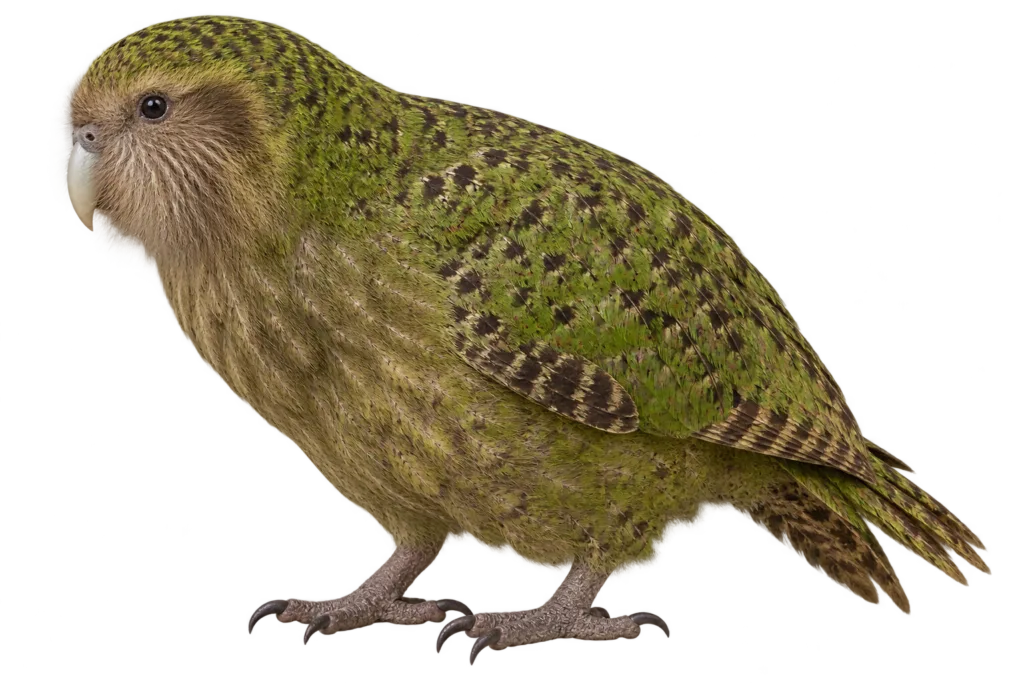
Size at a glance
How big is a Strigops habroptila?
Compare
Compare Strigops habroptila with another bird
Search by common or scientific name.
Morphology
Detailed measurements
Taxonomy
Classification
Strigops habroptila, the kākāpō, combines the length of a large parrot with an unusually heavy, compact body. Adults are about 58–64 cm long, yet body mass can reach several kilograms. The difference matters: the kākāpō is known as the heaviest living parrot because of its mass, not because it has the greatest total length.
The spelling Strigops habroptila remains widely encountered in scientific databases and older references. Current Birds New Zealand and New Zealand Birds Online usage is Strigops habroptilus, following treatment of the genus name Strigops as masculine. Both names refer to the kākāpō.
Why a 58–64 cm Kākāpō Carries So Much Mass
A standard adult length of 58–64 cm includes the body and tail. That measurement alone does not convey how bulky the bird is. Adult males are generally reported at 2–4 kg, while females are usually about 1–2.5 kg. The upper end of the male range places the species well beyond other living parrots in body mass.
The kākāpō has a deep trunk, broad pelvic region and dense-looking body profile. Its relatively short wings do not extend the outline in the way long functional wings do in flying birds. The result is a parrot that can look almost oval from the front and heavily built from the side.
Total length can also be misleading when comparing large parrots. Species with long tails may exceed a kākāpō in measured length while carrying far less body mass. In the kākāpō, much more of the apparent size comes from the body itself.
Male and Female Size Differs Most Clearly in Weight
Sexual size dimorphism is unusually strong for a parrot. Adult males are markedly heavier than adult females, although the sexes have broadly similar plumage and the same general body plan. The difference is therefore much easier to see in overall bulk than in colour.
A study using adult kākāpō handled during the 2019 breeding season recorded 20 males at 1.9–3.1 kg, with a mean of 2.7 kg, and 12 females at 1.4–1.9 kg, with a mean of 1.6 kg. These values describe that research sample rather than the full possible mass range of the species.
Body mass is not fixed throughout an adult bird’s life or even throughout a year. Kākāpō undergo seasonal changes in condition, and both sexes can gain weight before breeding activity. Males may build reserves before spending long periods displaying, while female condition is closely tied to reproduction. A single measured weight therefore gives a less stable picture of size than skeletal dimensions or total length.
The sex difference should not be applied mechanically to every external measurement. Historical measurement samples show that females can overlap males in wing and tail dimensions even while weighing much less. The strongest and most dependable visible distinction is the heavier build of the male.
Flightlessness Is Built Into the Wings and Chest
The kākāpō does not simply have normal parrot wings attached to an unusually heavy body. Anatomical studies show a set of changes associated with the loss of powered flight. Relative to body size, it has the smallest wings of any living parrot.
Its flight feathers are shorter and more rounded than those of flying parrots. Their two sides are less unequal in shape, and the outer parts of the feathers have fewer of the interlocking structures that help make a flight feather into a stiff aerodynamic surface.
The changes continue beneath the feathers. The sternum has only a low, reduced keel rather than the large keel needed to anchor powerful flight muscles. The main pectoral muscles used to drive the wing in flight are also greatly reduced.
The wings are still functional structures. Kākāpō use them while balancing, climbing and making controlled descents from elevated positions. They can flap while dropping from a tree, but the wing and chest anatomy cannot produce sustained powered flight.
The Skeleton Shifts Support Toward the Pelvis and Legs
Flightlessness also changed the proportions of the rest of the skeleton. Anatomical comparisons have found a relatively large pelvic region alongside reduced dimensions in parts of the pectoral skeleton. This gives the body a different structural emphasis from that of a parrot whose anatomy is dominated by flight.
The limb proportions are unusual as well. The femur is relatively long, while the lower leg includes a comparatively short tarsometatarsus. Within the wing, the elements nearer the body are proportionally longer and the more distant elements are shortened. These proportions are part of the same anatomical pattern seen in the reduced wing as a whole.
Strong feet remain especially useful because a kākāpō is not confined to the ground. Like other parrots, it has two toes directed forward and two backward, giving it a firm grip. It can climb trunks and branches and may forage well above the forest floor. The hooked bill can also be used as an extra point of support during climbing.
Soft Feathers Add to the Rounded Appearance
The plumage reinforces the bird’s broad, soft outline. The upperparts are mainly moss green with irregular yellow and dark markings, while the underparts tend to be more yellow-green. Unlike the firm flight surfaces of a strong-flying parrot, much of the kākāpō’s plumage has a soft texture.
The head is equally distinctive. Pale brownish feathers radiate around the eyes and bill to form the facial disc responsible for the traditional name “owl-parrot.” The resemblance is mainly one of shape: the kākāpō remains a parrot, with a large curved bill and parrot-like feet beneath the unusual facial feathering.
Adult males and females share this basic colour pattern, so body proportions are more useful than plumage for judging sex. Females are generally lighter and less bulky, while large adult males can develop a notably broad body and head. The combination of a heavy trunk, reduced wings, large feet, soft plumage and rounded facial disc gives Strigops habroptila a silhouette unlike that of any flying parrot.
Data
Measurement sources
- Data status
- Measured
- Size measurements
- AVONET — Tobias et al. (2022)
- Morphology source
- AVONET — Tobias et al. (2022)
- Morphology dataset
- AVONET v7 — BirdLife taxonomy
- Morphology dataset license
- CC BY 4.0
Full source links, dataset definitions, licensing details and measurement methodology are maintained on the Data Sources & Methodology page.