Bird size profile
Sulphur-crested Cockatoo
Cacatua galerita
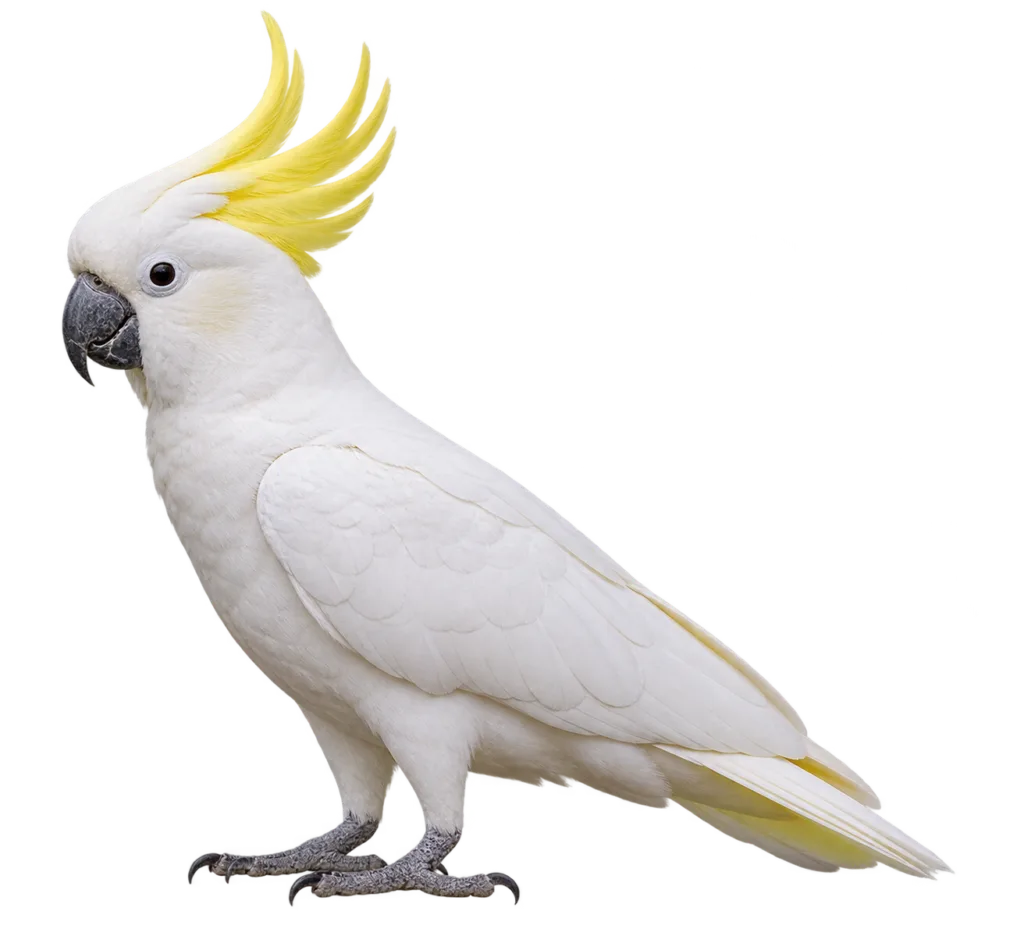
Size at a glance
How big is a Sulphur-crested Cockatoo?
Compare
Compare Sulphur-crested Cockatoo with another bird
Search by common or scientific name.
Morphology
Detailed measurements
Taxonomy
Classification
The Sulphur-crested Cockatoo (Cacatua galerita) is a large, heavy-bodied white cockatoo whose apparent size comes from more than body mass alone. Adults are commonly listed at about 45–50 cm (17.7–19.7 in) in total length, but the long tail, powerful bill and tall yellow crest all shape how large the bird looks. Field and banding measurements also show that weight and structural dimensions vary more than a single species average suggests.
How Large Is a Sulphur-crested Cockatoo?
A 45–50 cm total length places the species among the larger familiar cockatoos. That figure should not be read as body height. Much of the measured length extends through the head-to-tail axis, and the tail accounts for a substantial part of the silhouette.
Body mass is also variable. Broad reference figures often place adults around 700–950 g, while Australian banding data include birds outside that span. In the eastern and south-eastern Australian nominate form, recorded masses extend from roughly 502 g to 1,020 g across males and females. A bird near 800 g is therefore useful as a general reference point, not a fixed species weight.
Total length is strongly affected by tail length, while mass reflects body bulk and condition. Two cockatoos of similar total length can differ noticeably in weight, and a heavier bird is not necessarily longer.
The Crest Is a Large Part of the Head Profile
The sulphur-yellow crest is not a small decorative tuft. Australian banding measurements for the nominate form record crest lengths of about 108–144 mm (4.3–5.7 in). When folded, the crest follows the crown and nape. When raised, it greatly changes the visible height and outline of the head, while the crest itself remains a separate measurement from total body length.
The bill is another major structural feature. Recorded bill lengths in Australian birds are commonly around 35–48 mm. It is deep, strongly curved and dark grey to black, giving the head a heavier appearance than the clean white plumage alone might suggest. The eye is surrounded by bare pale skin, while pale yellow also appears beneath the wings and tail.
Measured Wing, Tail, Bill and Crest Ranges
Measurements from Australian banding references show how much the dimensions of individual birds can overlap. The ranges below are for the nominate form, Cacatua galerita galerita, found across eastern and south-eastern Australia.
| Measurement | Male Range | Female Range |
|---|---|---|
| Wing | 302–391 mm | 310–385 mm |
| Tail | 161–218 mm | 151–199 mm |
| Bill | 38.0–48.0 mm | 34.7–47.0 mm |
| Crest | 109–144 mm | 108–130 mm |
| Body mass | 560–1,020 g | 502–980 g |
The overlap is more informative than the small differences between the endpoints. A female can have a longer wing than some males, and many males and females fall within the same bill, tail and weight ranges. Measurements may show population-level tendencies, but they do not provide a clean size boundary between the sexes.
Males and Females Are Similar in Body Size
Adult males average slightly larger in several published morphometric datasets, especially in wing, tail and bill measurements. The difference is modest, and the ranges overlap too much for body size to be a dependable visual sexing method.
Adult iris colour is more useful at close range. Males usually have very dark brown to blackish irides. Females more often show reddish-brown, burgundy or red tones, although some females can have darker eyes. Young birds can also have brownish irides, so eye colour works best when age is considered rather than treated as an absolute rule.
Plumage does not provide a strong male-versus-female distinction. Both sexes are predominantly white with the same yellow crest and pale yellow areas beneath the wings and tail.
Size Changes Across the Species’ Range
The species is not identical in size across Australia and New Guinea. Australian banding references separate the eastern and south-eastern nominate population from the northern Australian form C. g. fitzroyi, and their measurement ranges are not the same. Other regional forms described from New Guinea and nearby islands are also often treated as smaller than the large nominate birds.
For northern Australian fitzroyi, published wing measurements span about 323–340 mm in sampled males and 310–344 mm in females. Tail and bill ranges also overlap strongly between the sexes. Mass samples are smaller, so they should not be used to create a precise regional average.
Geographic form, sex, age, sample size and measurement method can all affect the reported number. Museum skins may also differ slightly from measurements taken on live birds because preserved specimens can shrink. A species-wide value is best treated as a reference range rather than an exact template for every individual.
What Makes the Bird Look So Large in the Field?
The impression of size comes from proportions as much as raw length. The head is broad, the bill is deep, the chest is substantial, and the tail extends well behind the body. Measured crest feathers in Australian birds can exceed 10 cm, so an erected crest changes the head outline sharply. In flight, the white body and wings also expose pale yellow on the underwing and undertail, making the bird’s outline easy to read even before fine details are visible.
Juveniles are already close to the adult structural plan. Their plumage may show faint greyish marks, and the tips of the primary feathers can be more pointed before the post-juvenile moult. By late in the first year, plumage becomes much harder to separate from that of adults on general appearance alone.
Data
Measurement sources
- Data status
- Measured
- Size measurements
- AVONET — Tobias et al. (2022)
- Morphology source
- AVONET — Tobias et al. (2022)
- Morphology dataset
- AVONET v7 — BirdLife taxonomy
- Morphology dataset license
- CC BY 4.0
Full source links, dataset definitions, licensing details and measurement methodology are maintained on the Data Sources & Methodology page.