Bird size profile
Toco Toucan
Ramphastos toco
Size at a glance
How big is a Toco Toucan?
Compare
Compare Toco Toucan with another bird
Search by common or scientific name.
Morphology
Detailed measurements
Taxonomy
Classification
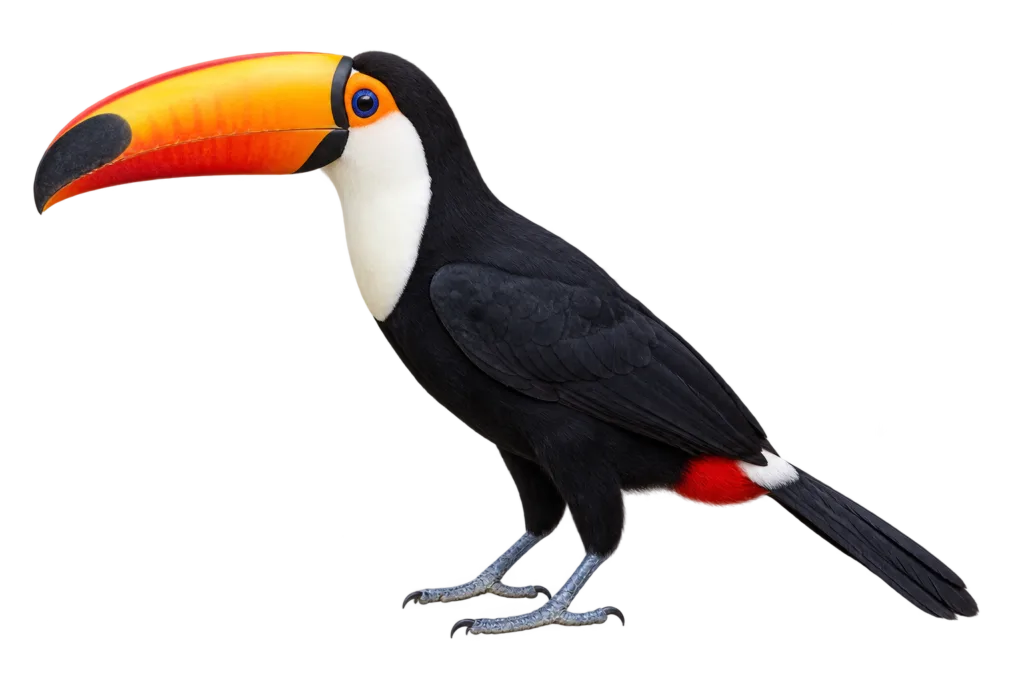
The Toco Toucan (Ramphastos toco) is the largest member of the toucan family, but much of its apparent size comes from one feature: the bill. Adults are generally reported in the mid-50s to mid-60s centimeters in total length, while published body masses commonly fall between about 500 and 860 g. Those numbers describe a bird whose silhouette looks much more front-heavy than its actual mass distribution.
How Large Is a Toco Toucan?
Bird length is normally measured from the tip of the bill to the end of the tail. This matters more for the Toco Toucan than for many birds because the bill contributes such a large share of the measurement. Published adult-length ranges differ slightly among institutional references, extending from roughly 55 cm to about 66 cm (21.7–26.0 in).
| Measurement | Adult Reference | How to Read It |
|---|---|---|
| Total length | About 55–66 cm (21.7–26.0 in) | Includes the bill, body, and tail rather than measuring the torso alone. |
| Body mass | About 500–860 g (1.1–1.9 lb) | Varies with sex, individual size, condition, and the population or sample measured. |
| Bill length | Roughly 19–20 cm (7.5–7.9 in) | The bill alone accounts for a large part of the bird’s total visible length. |
| Wing chord | 212–261 mm (8.3–10.3 in) | A folded-wing measurement from the wrist area to the longest primary, not wingspan. |
A Toco Toucan near 60 cm long therefore should not be pictured as a 60 cm-long compact-bodied bird. Its actual body is much shorter than the headline measurement suggests because the long bill projects far beyond the head.
The Bill Creates the Toco Toucan’s Unusual Proportions
The bill can approach one-third of the bird’s total length. In side profile, it occupies so much visual space that it can make the rest of the bird appear smaller or make the entire bird seem heavier than it is.
Its internal construction explains why that extreme proportion is possible. Studies of Toco Toucan bills describe a thin outer covering built from keratin over a lightweight internal network of bony, foam-like material. The bill is therefore not a solid block of bone. Its internal architecture adds support while keeping mass low.
Materials studies have produced somewhat different estimates for bill mass, ranging from about one-fortieth to one-twentieth of total body mass. The estimates vary, but they agree on the important physical point: the bill weighs far less than its size suggests.
This distinction is useful in size comparisons. A photograph dominated by the bill can make a Toco Toucan look bulky, yet an adult weighing around half a kilogram to under a kilogram remains relatively light for a bird with such a long profile.
Wing Length and Wingspan Are Not the Same Measurement
Toco Toucan wing data can be confusing because different sources use different terms. A morphological dataset compiled through AVONET reports a wing length of 212–261 mm from a sample of ten birds. That figure is a wing chord: a measurement of one folded wing from the carpal joint to the tip of the longest primary feather.
It cannot be doubled and presented as wingspan. A true wingspan is measured across both extended wings, and the relationship between wing chord and spread wingspan is not a simple two-to-one conversion.
Published wingspan figures for the Toco Toucan are also less consistent across general reference pages than its total length and mass. For precise comparison work, a wing value should therefore be labeled according to the measurement actually reported rather than treating every number associated with the wings as wingspan.
Adult Males and Females Are Similar but Not Identical in Size
Adult males and females have the same basic black, white, orange, and red color pattern, so sex is not reliably indicated by obvious plumage differences. Size measurements provide more information.
A study using 51 cytogenetically sexed Toco Toucans found that several bill measurements helped distinguish males from females, including dimensions along the upper and lower bill. Males also tend to average larger than females.
These are statistical differences rather than an easy visual rule. Individual measurements overlap, so a slightly longer-looking bill does not by itself prove that a bird is male. This is especially important when comparing photographs taken at different angles, where perspective can strongly change the apparent bill length.
Young Toucans Have Different Proportions
A juvenile should not be used as a direct size model for a fully developed adult. Young Toco Toucans have shorter, less developed bills and duller coloration. As the bird matures, the bill becomes longer and the adult color pattern becomes more pronounced.
The change in bill size also alters the bird’s apparent proportions. An immature bird can look noticeably more compact even when the body itself is already approaching adult dimensions. Age therefore matters when photographs or specimens are used for visual scale comparisons.
Why an Oversized Bill Works
The bill is more than an extension that makes the bird look longer. Its reach allows a toucan to grasp food without moving its whole body onto every supporting branch, and its low-mass construction limits the weight carried in front of the head.
It also functions as a controllable surface for heat exchange. Thermal imaging experiments with Toco Toucans showed that blood flow to the bill can change rapidly. When more warm blood enters its vascular tissues, the large exposed surface can release body heat; when blood flow is reduced, heat loss through the bill falls.
That combination of large surface area, low mass, and adjustable blood flow helps explain one of the Toco Toucan’s defining size traits. The bill adds a remarkable amount of visible length without adding anything close to the mass that a similarly sized solid structure would require.
Data
Measurement sources
- Data status
- Measured
- Size measurements
- AVONET — Tobias et al. (2022)
- Morphology source
- AVONET — Tobias et al. (2022)
- Morphology dataset
- AVONET v7 — BirdLife taxonomy
- Morphology dataset license
- CC BY 4.0
Full source links, dataset definitions, licensing details and measurement methodology are maintained on the Data Sources & Methodology page.