Bird size profile
Trumpeter Swan
Cygnus buccinator
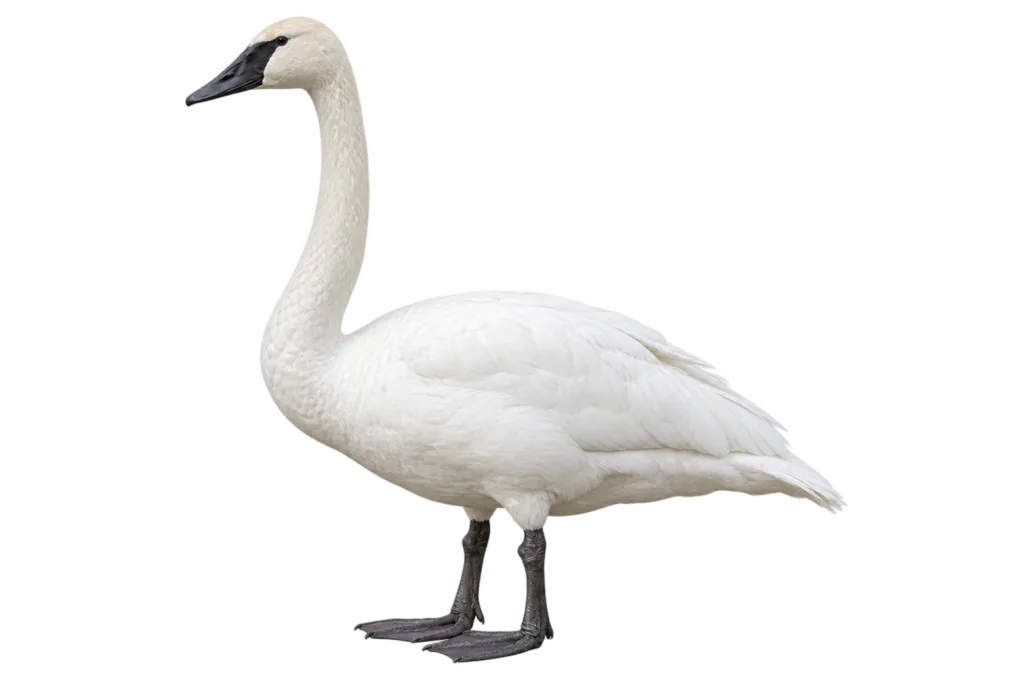
Size at a glance
How big is a Trumpeter Swan?
Compare
Compare Trumpeter Swan with another bird
Search by common or scientific name.
Morphology
Detailed measurements
Taxonomy
Classification
The Trumpeter Swan (Cygnus buccinator) combines exceptional body mass with a long neck, broad wings, and a heavy, streamlined body. Adults are among the largest flying waterfowl, yet their size is distributed across a shape built for swimming, reaching underwater vegetation, and powerful flight rather than upright height alone.
A Swan Built Around Mass and Reach
Adult Trumpeter Swans typically measure about 138–158 cm (54.3–62.2 in) in body length. A commonly reported wingspan is about 203 cm (80 in), while body mass can range from roughly 7.7 to 12.7 kg (17 to 28 lb). These figures place the species at the upper end of North American waterfowl size.
Length does not fully convey how large a Trumpeter Swan appears. The torso is deep and heavy, the neck adds a long forward reach, and the wings must support a body far heavier than that of most birds seen on inland lakes and wetlands. When swimming, much of that mass sits low in the water, so the bird can look less bulky than it does when standing or beginning a takeoff.
Males Carry More Body Mass Than Females
Male and female Trumpeter Swans have the same adult plumage, so sex is not reliably determined by color. Size provides a better clue, although individual overlap prevents it from being a certain field mark.
The male, traditionally called a cob, is generally heavier and can look slightly larger than the female, or pen. The difference becomes easier to notice when a bonded pair is close together, but body posture, distance, age, and perspective can make visual estimates unreliable.
The mass difference is more useful than expecting a dramatic difference in shape. Both sexes retain the same basic proportions: a heavy body, long neck, large black bill, broad wings, and large webbed feet.
The Head and Neck Create a Distinctive Profile
The Trumpeter Swan’s head has a fairly angular, wedge-like profile. Its large black bill slopes from the forehead, while black facial skin extends toward the eye. This creates the appearance of the eye and bill being connected within one dark facial area. A narrow reddish line may be visible along the lower edge of the bill at close range.
The long neck is especially important to the bird’s proportions. Trumpeter Swans normally carry it fairly straight while swimming and extend it fully in flight. The neck also increases feeding reach, allowing the bird to reach submerged plant material while its body remains at the surface.
Young Trumpeter Swans Change Shape and Color as They Mature
Cygnets do not begin life with the clean white appearance of adults. Young birds are gray to gray-brown, and older juveniles may show a mixture of dusky feathers and developing white plumage. The bill can also show pinkish coloration through the center rather than the uniformly dark appearance expected in an adult.
Much of the adult-sized body develops before the bird has fully acquired adult plumage. This matters when judging size in the field: a large gray bird may already approach adult dimensions even though its plumage still makes its age obvious.
White feathers become dominant as the bird matures, with young Trumpeter Swans becoming white during the period leading into their second summer. Some younger birds can retain traces of gray on the head and neck while the rest of the body already appears much more adult-like.
Large Wings Do Not Mean an Effortless Takeoff
A wingspan near two meters gives the Trumpeter Swan plenty of lifting surface, but the wings must move a very heavy bird. Takeoff therefore begins with a running acceleration across the water. The feet strike the surface repeatedly while the wings build enough lift for the body to become airborne.
Published wingspan figures are not identical across references. Some field datasets give a value close to 203 cm (80 in), while other management and identification materials describe broader spans extending beyond seven feet and sometimes much farther in large males. These figures should not be treated as measurements of one universal adult size. They reflect different samples and different ways of reporting typical values, ranges, and exceptional birds.
A single wingspan figure is useful as a reference point, but Trumpeter Swans vary by sex and individual size. Measurements from separate datasets may also use different sample sizes and reporting methods, so apparently conflicting figures do not necessarily describe different forms of the species.
Once airborne, the same proportions become easier to read. The neck is held fully extended, the heavy body follows behind it, and the broad wings provide the surface area needed to support one of the heaviest regularly flying birds in North America.
Data
Measurement sources
- Data status
- Measured
- Size measurements
- AVONET — Tobias et al. (2022)
- Morphology source
- AVONET — Tobias et al. (2022)
- Morphology dataset
- AVONET v7 — BirdLife taxonomy
- Morphology dataset license
- CC BY 4.0
Full source links, dataset definitions, licensing details and measurement methodology are maintained on the Data Sources & Methodology page.