Bird size profile
Turkey Vulture
Cathartes aura
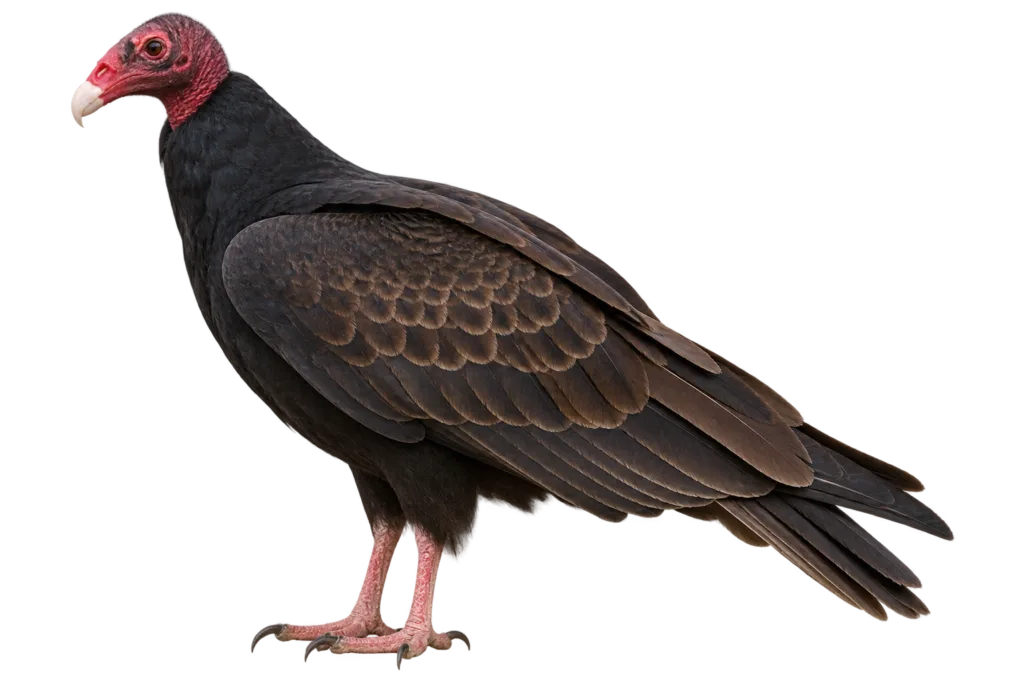
Size at a glance
How big is a Turkey Vulture?
True-scale visual
Turkey Vulture compared with a 175 cm person
When a transparent species asset and body-length data are available, BirdSize places the real bird asset and the fixed human reference on one mathematical centimetre scale.
Compare
Compare Turkey Vulture with another bird
Search by common or scientific name.
Morphology
Detailed measurements
Taxonomy
Classification
The Turkey Vulture (Cathartes aura) is a large soaring bird whose apparent size comes largely from its wings. Adults are commonly measured at about 64–81 cm (25–32 in) in body length, while published wingspans fall around 1.6–1.8 m (5.2–5.9 ft). The body itself is comparatively lean, with a small head and a long tail extending behind a broad wing plan.
Why the Wings Make the Bird Look So Large
A Turkey Vulture spreads a great deal of wing relative to the bulk of its body. Published North American references place body mass around 2 kg (4.4 lb), while broader datasets commonly span roughly 1.6–2.4 kg (3.5–5.3 lb). Those figures can vary with population and the birds included in a sample, so a single weight should not be treated as the size of every adult.
The wings are long and broad, with separated outer primary feathers forming the familiar fingered tips of a soaring bird. The tail is also fairly long. Together, these features create an elongated outline rather than the compact, heavy-bodied profile that the wingspan alone might suggest.
Turkey Vultures occur across a vast part of the Americas, and measurements have been collected from different populations and sample sizes. Research comparing populations has found noticeable variation in body mass and some wing measurements. A range is therefore more informative than treating one published figure as universal.
The Raised-Wing Posture Changes the Silhouette
Wing posture is one of the most useful ways to understand the Turkey Vulture’s proportions in flight. During soaring, the wings are normally held above horizontal in a shallow dihedral, creating a V-shaped profile when the bird is viewed from the front.
The bird also tends to rock gently from side to side while soaring. This movement is closely tied to a wing form suited to using rising and turbulent air. Turkey Vultures can remain aloft for long periods with relatively little flapping, including while moving at lower altitudes.
Seen from below, most of the body and the forward part of the wing appear dark, while the flight feathers are much paler. This produces a broad two-toned underside. Because the pale area extends through much of the flight-feather portion of the wing, it also makes the full span and long feather structure easier to read in good light.
A Small Head Alters the Bird’s Proportions
The head looks notably small beside the wings and torso. It is largely featherless, reducing the visual bulk that a fully feathered head and neck would create. Adults develop red bare skin on the head and usually show a pale bill, while young Turkey Vultures have a darker grayish head and darker bill.
This age-related color change is much more obvious at close range than it is in a distant soaring bird. Juveniles already share the long-winged form, raised-wing posture, long tail, and two-toned underwing that define the species’ larger outline. Head color therefore changes during maturation without fundamentally changing the flight silhouette.
The dark body can also be misleading. Turkey Vultures often appear nearly black at a distance, but close views show plumage that is more accurately described as dark brown. The contrast between this body color, the pale flight feathers below, and the bare head separates several different visual parts of the bird rather than creating one uniformly dark shape.
Male and Female Size Overlaps Heavily
Sex is not a dependable way to predict the size of a Turkey Vulture in the field. Males and females are similar in external appearance, and research using sexed birds has found extensive overlap in body weight, wingspan, wing area, and overall wing proportions.
That makes separate male and female size estimates less useful here than they are for birds with strong sexual size differences. Individual condition, population, and the measurement dataset can create more visible variation than sex alone.
The result is a bird whose proportions remain remarkably recognizable across adults: a relatively light body beneath long wings, a small head at the front, a long tail behind, and a soaring posture that displays almost the entire span for long periods without repeated wingbeats.
Data
Measurement sources
- Data status
- Measured
- Size measurements
- Cornell Lab of Ornithology – All About Birds
- Morphology source
- AVONET — Tobias et al. (2022)
- Morphology dataset
- AVONET v7 — BirdLife taxonomy
- Morphology dataset license
- CC BY 4.0
Full source links, dataset definitions, licensing details and measurement methodology are maintained on the Data Sources & Methodology page.