Bird size profile
Western Barn Owl
Tyto alba
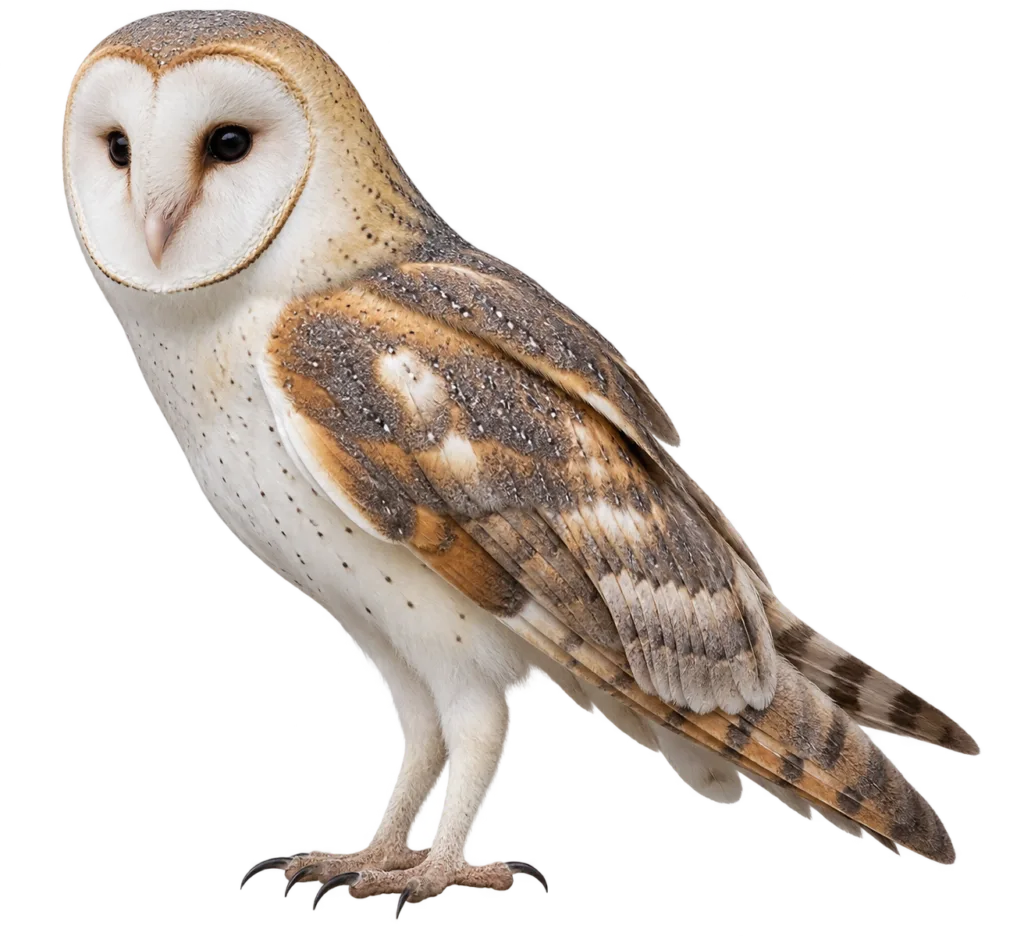
Size at a glance
How big is a Western Barn Owl?
Compare
Compare Western Barn Owl with another bird
Search by common or scientific name.
Morphology
Detailed measurements
Taxonomy
Classification
The Western Barn Owl, Tyto alba, is a medium-sized owl with proportions that make its size change noticeably with posture. An adult is commonly about 33–39 cm long, while the opened wings span roughly 80–95 cm. The body itself is slender and fairly light, so a perched bird can look much smaller than the same owl crossing an open field with its long wings fully extended.
A Slender Body Behind a Broad Wingspan
Body length alone does not capture the Western Barn Owl’s shape well. The species combines a rounded head, relatively narrow body, long legs, long rounded wings and a short tail. With the wings folded, much of its flight surface disappears into a compact outline along the back and sides.
That changes immediately in flight. An 80–95 cm wingspan is more than twice the bird’s head-to-tail length, giving the owl a broad profile without requiring a heavy body. The pale underparts can also make the open wings visually prominent, especially when the bird is viewed against darker ground.
A published head-to-tail length of 33–39 cm should not be treated as the owl’s vertical height while perched. Posture, leg position, neck position and feather compression all alter how tall an individual appears. Body length and standing height describe different physical dimensions.
Western Barn Owls Are Light for Their Apparent Size
The spread wings can give the impression of a fairly large owl, but body mass is modest. Data from live Barn Owls measured in Britain illustrate this well. Adult birds in that dataset averaged about 337 g, although individual mass varied around that figure.
Sex also affects weight more clearly than it affects wing length. Female adults in the British measurements averaged about 354 g, compared with about 312 g for males. Their average measured wing lengths, however, were almost identical.
| Adult Group | Mean Body Mass | Mean Wing Length |
|---|---|---|
| Female | 354.3 g | 292.2 mm |
| Male | 311.5 g | 292.3 mm |
This is an important distinction when comparing male and female Western Barn Owls. A female may carry noticeably more mass without having visibly longer wings. Weight therefore provides evidence of sex-related size difference that may not be obvious from the bird’s external outline.
Size Is Not Identical Across the Species’ Range
Tyto alba occurs across Europe, Africa and parts of western Asia, including several island populations. Those populations do not all share exactly the same dimensions. Geographic variation is especially clear in wing measurements.
A large comparative study of barn owls recorded mean wing lengths of roughly 284 mm in European T. a. alba and T. a. guttata. The Canary Islands form T. a. gracilirostris averaged about 250 mm, while the Madeira form T. a. schmitzi was intermediate at roughly 270–274 mm.
The difference is large enough to matter in visual comparisons. A Western Barn Owl from one population should not automatically be treated as physically identical to an individual from another part of the range simply because both carry the same species name.
Species-wide measurements may combine different populations, while local bird-monitoring programs often report measurements from a much narrower geographic area. Sample composition, sex and subspecies can therefore produce different but still valid figures.
The Barn Owl Taxonomic Split Changes Size Comparisons
The name Western Barn Owl has become more important as bird checklists have separated the former broad Barn Owl complex. Current major taxonomic treatments recognize Tyto alba as the Western Barn Owl, distinct from the Eastern Barn Owl Tyto javanica and American Barn Owl Tyto furcata.
This matters when checking older measurement references. Sources written when all of these populations were grouped under Tyto alba may include birds from Asia, Australasia or the Americas in ranges presented simply as “Barn Owl” measurements. Those figures are not always suitable for a modern Western Barn Owl size profile.
North American measurements deserve particular care. Birds formerly listed there as Tyto alba are now placed with the American Barn Owl in taxonomies that use the split. Very large measurements from an older North American Barn Owl source should therefore not automatically expand the size range assigned to the Western Barn Owl.
What Makes the Owl Look Large in Flight
The impression of size comes mainly from wing area rather than a bulky torso. Western Barn Owls have long, rounded wings adapted to slow flight over open ground. Their short tail contributes relatively little to the total head-to-tail measurement, while the wings extend far beyond the body when opened.
The legs add another visual cue. They are relatively long and can become conspicuous when the owl is landing or reaching downward, even though they are much less obvious in a normal perched pose.
For a true-to-scale side-profile comparison, the most useful measurement depends on the pose. A perched or standing Western Barn Owl should be scaled from a verified body dimension appropriate to that pose rather than from wingspan. An owl shown with its wings fully extended requires the wingspan measurement instead. Mixing those dimensions would make the bird appear artificially large or small.
Data
Measurement sources
- Data status
- Measured
- Size measurements
- AVONET — Tobias et al. (2022)
- Morphology source
- AVONET — Tobias et al. (2022)
- Morphology dataset
- AVONET v7 — BirdLife taxonomy
- Morphology dataset license
- CC BY 4.0
Full source links, dataset definitions, licensing details and measurement methodology are maintained on the Data Sources & Methodology page.