Bird size profile
White Stork
Ciconia ciconia
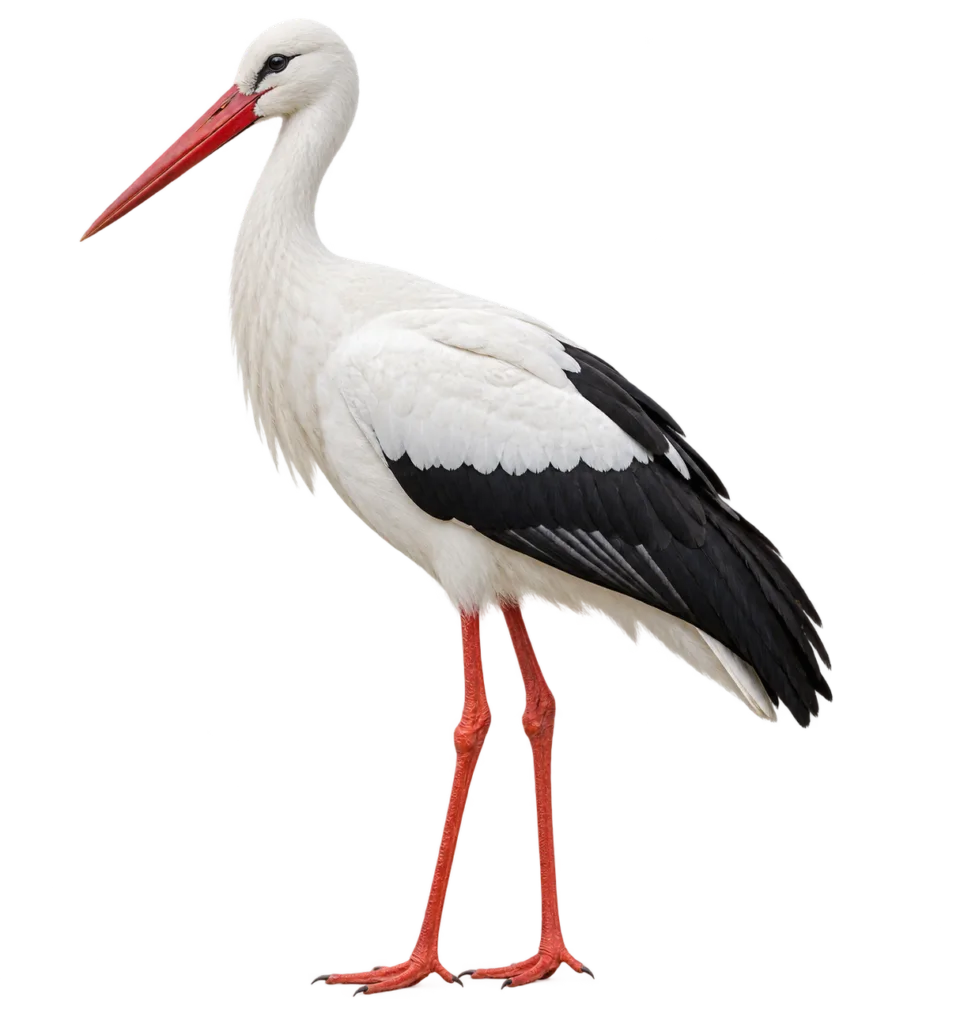
Size at a glance
How big is a White Stork?
Compare
Compare White Stork with another bird
Search by common or scientific name.
Morphology
Detailed measurements
Taxonomy
Classification
The White Stork (Ciconia ciconia) is a large, long-limbed bird whose apparent size comes as much from its proportions as from body mass. Adults combine a long neck, tall legs, an elongated bill and broad wings, creating a much larger visual profile than their weight alone might suggest.
How Large Is a White Stork?
Adult White Storks commonly stand about 100–115 cm tall. Their wings can span roughly 155–165 cm from tip to tip. Body mass varies with sex and individual condition, but many adults weigh around 3 kg, with a wider documented range extending from a little over 2 kg to more than 4 kg.
The bird’s height is distributed across several unusually elongated structures. Long tarsi raise the body well above the ground, while the neck and bill extend the profile farther still. The torso itself is much less massive than the full standing silhouette might imply.
Wingspan measures the distance between the two fully extended wingtips. Wing chord measures one folded wing from the wrist area to the tip of the longest primary feather. A White Stork can therefore have a wingspan well above 1.5 metres while its measured wing chord is only about 55–58 cm.
Male and Female White Storks Differ More in Size Than in Appearance
Male and female White Storks have essentially the same adult plumage, so sex is not reliably identified from color pattern alone. Measurements tell a different story. Males tend to be larger across several parts of the body.
A 2024 study of 103 adult White Storks measured 51 females and 52 males. The differences appeared across the bill, legs, wings and body mass rather than in one isolated feature.
| Measurement | Female Mean | Male Mean | Male–Female Difference |
|---|---|---|---|
| Culmen length | 155.2 mm | 169.7 mm | 8.5% |
| Tarsus length | 208.4 mm | 225.5 mm | 7.6% |
| Tail length | 228.1 mm | 238.8 mm | 4.5% |
| Wing chord | 551.8 mm | 584.5 mm | 5.6% |
| Body mass | 3,076.5 g | 3,566.3 g | 13.7% |
These values describe the adult birds measured in that study. They are population measurements with natural individual overlap, not fixed dimensions for every White Stork.
Body mass produced the largest average difference in the dataset, while tail length showed a smaller gap. The pattern helps explain why a male may look somewhat heavier or longer-bodied beside a female even though both birds carry the same familiar black-and-white plumage.
The Bill Shows Size Dimorphism Without a Reliable Male or Female Shape
The long, pointed bill is one of the most useful structures for studying White Stork morphology. Culmen length—the straight measurement along the upper bill—averaged about 14.5 mm longer in males than females in the 2024 adult dataset.
More recent geometric work has examined whether the bill also has a consistently different shape between the sexes. A 2025 study using 45 White Storks found that males had larger bills, particularly when size was assessed from the lateral view. Bill shape itself, however, did not separate males and females reliably.
This distinction matters in field identification. A bird with a large bill may be more likely to be male within a measured population, but bill shape alone is not a dependable visual sex marker. Individual variation creates too much overlap.
Why the Wings Look So Large Relative to the Body
White Storks are built for extensive soaring and gliding. Their broad wings provide a large lifting surface without requiring an equally heavy body. During migration they regularly use rising columns of warm air, gaining altitude in thermals before gliding onward.
This flight style gives wingspan a different role from simple body length. The long wings are part of an energy-saving flight system, while the narrow body, long neck and trailing legs keep the bird’s airborne outline elongated rather than bulky.
Adult and Young White Storks Do Not Have the Same Head and Leg Colors
Body proportions develop early enough for young White Storks to resemble adults in general structure, but age changes the appearance of the exposed parts. Mature birds have the familiar red to orange-red bill and legs. Young birds begin with much darker bills and duller, grayish or yellow-gray legs.
The black flight feathers against an otherwise white body already create the basic White Stork pattern, but the red bill and legs make the adult appearance more distinctive. Because adult males and females share this coloration, these features are useful for recognizing maturity rather than determining sex.
Bill growth can also continue after the first-year stage. Earlier repeated measurements of young White Storks recorded additional culmen growth as the birds matured, reinforcing why age must be considered when bill length is used as a morphological measurement.
What the Measurements Reveal About the Bird’s Shape
Several measurements tend to increase together in White Storks. Birds with longer bills also tend to have longer tarsi and longer wings, so a large individual is usually larger across more than one structure rather than possessing only one oversized feature.
The combination produces the characteristic White Stork build: long-legged, long-billed, relatively light for its apparent height, and equipped with wings much wider than its standing body. Male and female measurements overlap, but males occupy the larger end of that structural range more often, while plumage remains nearly identical between the sexes.
Data
Measurement sources
- Data status
- Measured
- Size measurements
- AVONET — Tobias et al. (2022)
- Morphology source
- AVONET — Tobias et al. (2022)
- Morphology dataset
- AVONET v7 — BirdLife taxonomy
- Morphology dataset license
- CC BY 4.0
Full source links, dataset definitions, licensing details and measurement methodology are maintained on the Data Sources & Methodology page.