Bird size profile
White-tailed Eagle
Haliaeetus albicilla
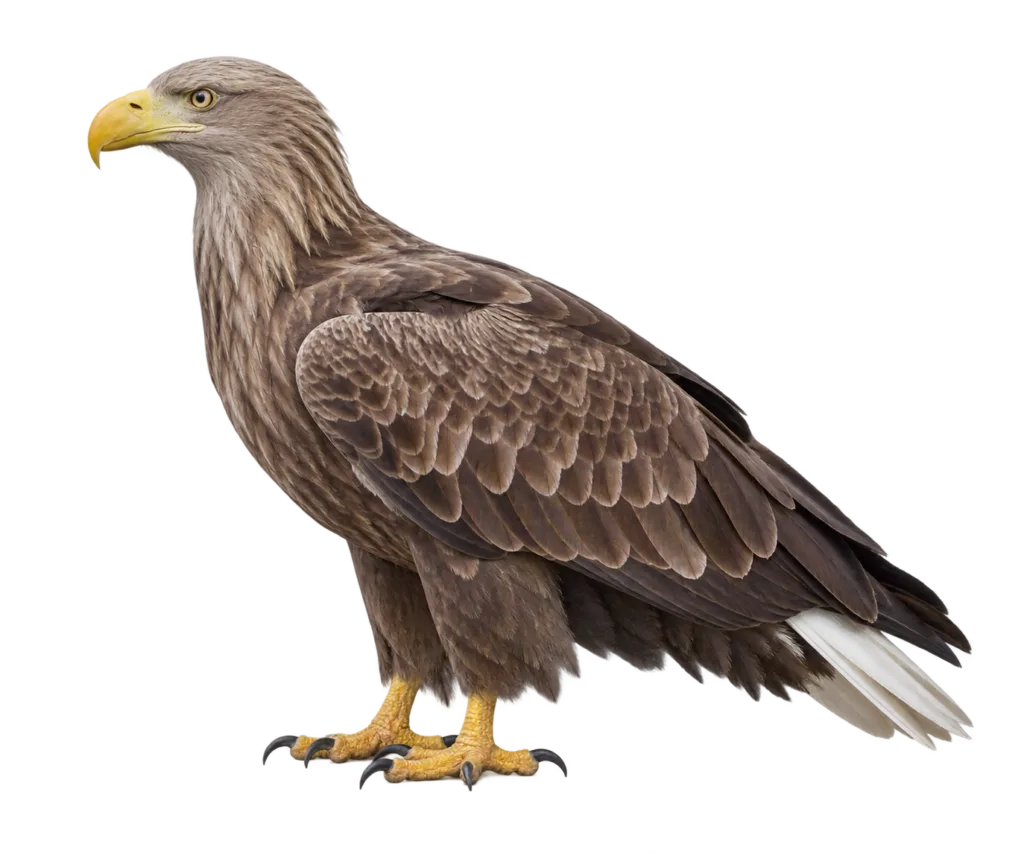
Size at a glance
How big is a White-tailed Eagle?
Compare
Compare White-tailed Eagle with another bird
Search by common or scientific name.
Morphology
Detailed measurements
Taxonomy
Classification
The White-tailed Eagle Haliaeetus albicilla is a heavy, broad-winged sea eagle whose size is expressed most clearly in its wingspan and body mass. Adults are typically about 70–90 cm long, while the wings can span roughly 200–240 cm. The combination of a thick body, large head and bill, very broad wings, and relatively short tail gives the species a distinctive set of proportions.
Individual measurements vary with sex, geographic population, age, and physical condition. Females are generally heavier than males, although the ranges overlap enough that apparent size alone is not a dependable way to determine sex in the field.
A Wingspan Built Around Breadth
A wingspan reaching around 2.4 metres is only part of what makes a White-tailed Eagle look so large. The wings are also unusually broad from front to back. Their outer flight feathers spread into obvious finger-like tips, while the inner wing remains wide and substantial.
This produces the species’ characteristic broad, plank-like flight profile. During soaring flight, the wings are often held approximately level rather than strongly raised. Because so much wing area surrounds the body, the eagle can appear even larger in flight than its body length suggests.
A 200–240 cm wingspan describes the distance between the fully extended wingtips. It should not be confused with the length of one folded wing or with total body length.
Females Carry More Body Mass
White-tailed Eagles show the female-biased size pattern found in many birds of prey. Commonly reported adult ranges place males at approximately 3.5–5.0 kg and females at about 4.0–7.0 kg. Other datasets give slightly different limits, so these values are better treated as representative ranges than fixed boundaries.
The overlap matters. A heavy male can fall within the same weight range as a lighter female, and distant views make smaller differences in linear dimensions difficult to judge. Sex determination based only on whether one bird appears “large” or “small” is therefore unreliable unless two known adults can be assessed under suitable conditions.
Body mass can also vary without producing an equally obvious change in body length. Two eagles of similar length may differ noticeably in weight because skeletal size, muscle mass, body condition, and sex do not vary in exactly the same way.
Body Length Does Not Fully Describe Its Scale
The usual length range of roughly 70–90 cm runs from the tip of the bill to the end of the tail. That measurement is useful, but it does not capture the feature that dominates the eagle’s appearance: the relationship between a relatively compact body and exceptionally broad wings.
The tail is comparatively short and graduated, so it occupies less of the bird’s total silhouette than it does in many long-tailed raptors. The head projects strongly in front of the wings, helped by a deep, heavy bill. Together, the broad wings, projecting head, and short-looking tail produce a very different visual balance from a slender raptor of similar body length.
When perched, the same proportions are expressed differently. Folded wings conceal most of the wingspan, leaving the thick torso, substantial legs, large feet, and oversized bill to carry much of the impression of size.
Age Changes the Appearance More Than the Overall Scale
Young White-tailed Eagles can already be physically large, so a dark-looking bird should not automatically be interpreted as a smaller individual. Age is more clearly reflected in plumage and bare-part coloration than in a simple large-versus-small distinction.
Adults have the white tail that gives the species its English name, along with a paler head and a yellowish bill. Immature birds are darker overall, with a dark bill and a brown tail carrying varying amounts of pale or white patterning. The fully white adult tail develops gradually over several years.
This age-related change can also alter how the bird’s proportions appear at a distance. A bright white adult tail stands out sharply and makes its shape easier to see, while the darker tail of an immature blends more readily into the body and wings.
Why Field Size Estimates Can Be Misleading
White-tailed Eagles are often seen soaring high above the ground, crossing open water, or passing at considerable distance. With no nearby object of known size, judging absolute measurements from such a view is difficult. Perspective can also make a banked bird look narrower or shorten the apparent span of one wing.
Proportions are usually more informative than trying to estimate an exact wingspan by eye. The combination of very broad wings, spread outer primaries, a relatively short tail, a strongly projecting head, and a heavy bill remains visible across a wider range of viewing distances than small differences in centimetres.
Data
Measurement sources
- Data status
- Measured
- Size measurements
- AVONET — Tobias et al. (2022)
- Morphology source
- AVONET — Tobias et al. (2022)
- Morphology dataset
- AVONET v7 — BirdLife taxonomy
- Morphology dataset license
- CC BY 4.0
Full source links, dataset definitions, licensing details and measurement methodology are maintained on the Data Sources & Methodology page.