Bird size profile
Whooper Swan
Cygnus cygnus
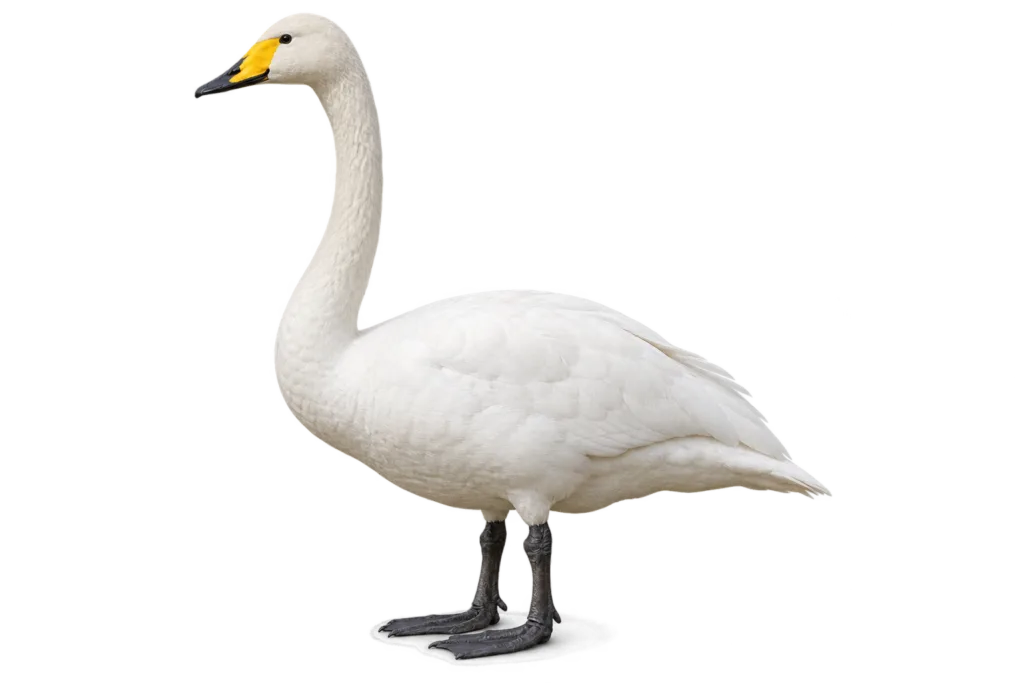
Size at a glance
How big is a Whooper Swan?
Compare
Compare Whooper Swan with another bird
Search by common or scientific name.
Morphology
Detailed measurements
Taxonomy
Classification
The Whooper Swan (Cygnus cygnus) is a large, long-necked swan with a body typically about 140–165 cm (55–65 in) long and a wingspan around 205–235 cm (81–93 in). Its size is only part of its appearance: a relatively straight neck, long wedge-shaped head profile, broad wings, and a yellow-and-black bill give the bird its characteristic proportions.
How Large Is a Whooper Swan?
The combination of a long neck and large body makes a Whooper Swan look tall when standing and elongated when swimming. The body itself is deep and substantial, but the relatively long neck can make the overall outline appear less compact than body mass alone might suggest.
Published weight figures vary more than length measurements. This is expected because body mass can change with stored fat, feeding conditions, season, and migration. Structural measurements such as wing length are less affected by short-term changes in condition.
Male and Female Size Is Similar but Not Identical
Male and female Whooper Swans have the same general plumage and body plan, so sex is not usually obvious from color. Males tend to be larger on average.
Those averages show a measurable size difference, but they are not reliable cutoffs for identifying the sex of a single bird. Individual measurements overlap. A relatively large female can approach the measurements of a smaller male, especially when body mass is used instead of a more stable skeletal or wing measurement.
Wing Length and Wingspan Describe Different Measurements
A Whooper Swan’s reported wingspan of roughly 205–235 cm measures the distance from one wingtip to the other when the wings are spread. Biometric studies may also report a single-wing measurement of around 60 cm. These numbers are not conflicting measurements.
A commonly reported biometric measurement is the maximum flattened wing chord. BTO data give an adult average of about 598.5 mm. This measures one wing and should not be doubled and treated as wingspan.
The difference matters because a living bird’s full span includes both wings and the width of the body between them. The method used for a flattened wing measurement is also different from measuring a bird with its wings naturally spread in flight.
The wings themselves are broad and long, with rounded outer profiles rather than narrow, sharply pointed tips. In flight, the extended neck projects well ahead of the body while the legs trail behind, producing a much longer overall silhouette than is apparent when the bird is resting on water.
The Bill Shapes the Whole Head Profile
The adult bill is long and predominantly yellow toward the base, with black toward the tip. The yellow commonly extends forward in a pointed wedge, often reaching beyond the nostril. This creates a long, sloping transition from forehead to bill and contributes to the Whooper Swan’s angular head profile.
The exact boundary between yellow and black varies among individuals. Bill pattern therefore adds variation within the species even though the basic yellow-and-black arrangement remains recognizable.
Adult Plumage Can Alter the Apparent Shape
Fully grown Whooper Swans are predominantly white. Against dark water, the white body can make the torso look especially broad, while the narrow neck creates a strong contrast in width between the body and head.
Some adults acquire rusty, orange, or brown staining on the head and upper neck after feeding in water or sediment rich in iron compounds. This staining changes the visible color of the feathers but does not represent a different body form or normal sex difference.
The tail is relatively short compared with the total length of the bird. Much of the apparent length of a swimming Whooper Swan comes from the neck and head rather than a long rear body section.
Young Whooper Swans Change Color Before Reaching the Adult Look
First-winter Whooper Swans are greyer than adults. Their bills initially show pale pinkish or whitish areas where mature birds develop yellow, making age-related color one of the most visible differences between young and fully adult birds.
The bill gradually develops the yellow-and-black adult coloration, while much of the grey juvenile plumage is replaced. Young birds may therefore have adult-like body proportions before their plumage and bill have completed the transition.
Size alone is not a dependable way to separate a well-grown juvenile from an adult. By the first winter, a young bird can already have the long neck, large body, and elongated head profile associated with the species while still retaining grey feathers and an immature bill.
Data
Measurement sources
- Data status
- Measured
- Size measurements
- AVONET — Tobias et al. (2022)
- Morphology source
- AVONET — Tobias et al. (2022)
- Morphology dataset
- AVONET v7 — BirdLife taxonomy
- Morphology dataset license
- CC BY 4.0
Full source links, dataset definitions, licensing details and measurement methodology are maintained on the Data Sources & Methodology page.