Bird size profile
Whooping Crane
Grus americana
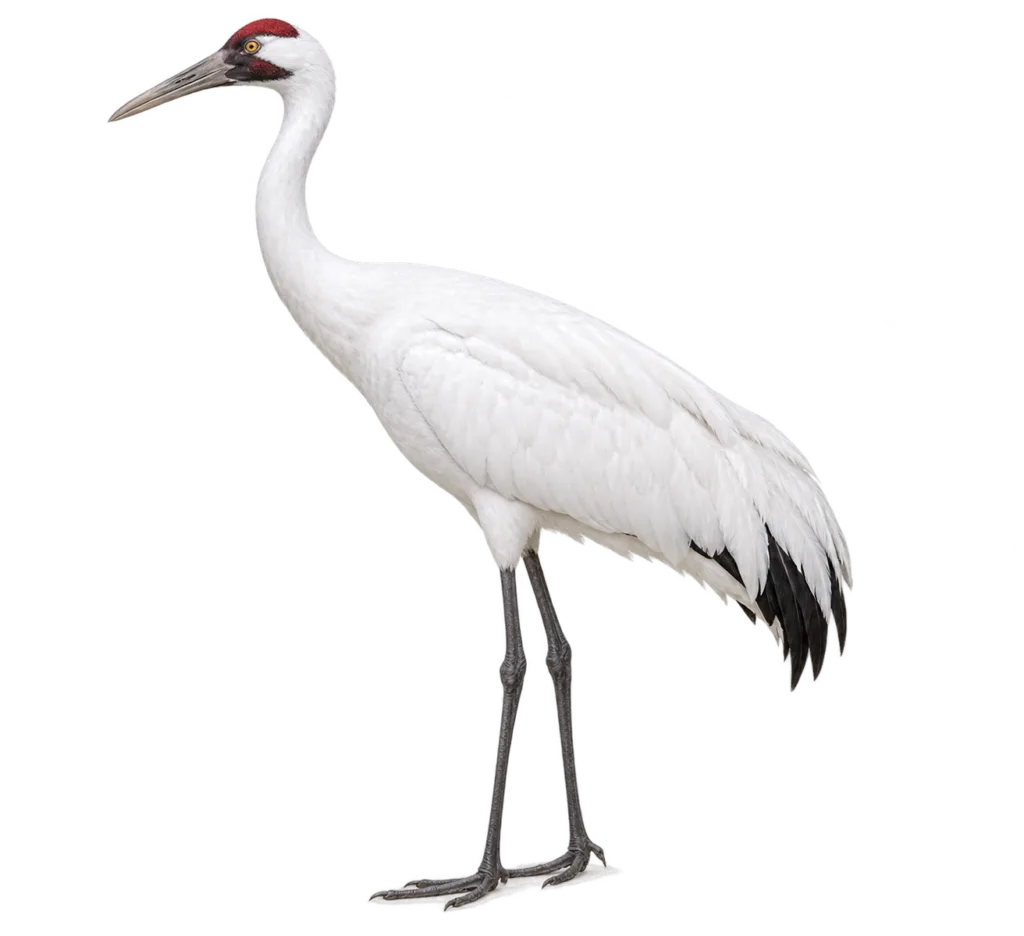
Size at a glance
How big is a Whooping Crane?
Compare
Compare Whooping Crane with another bird
Search by common or scientific name.
Morphology
Detailed measurements
Taxonomy
Classification
The Whooping Crane (Grus americana) is built around vertical reach. An erect adult stands about 1.5 meters (5 feet) tall, making it the tallest bird in North America, while typical body mass remains roughly 6.0–7.8 kilograms (13.2–17.2 pounds). Much of that height comes from exceptionally long legs and neck rather than a bulky body. The torso is comparatively slender, with a fuller feathered area toward the tail.
Standing Height and Body Length Are Different Measurements
Whooping Crane measurements can look confusing because published standing height and body length both fall close to 150 centimeters. They describe different dimensions.
Standing height is the vertical distance represented by an upright bird, including its long legs and raised neck. Body length is measured along the bird from the bill toward the tail. A crane can also lower, extend, or curve its neck, so its apparent height changes considerably with posture even though its body dimensions have not changed.
This distinction matters more in a crane than in a compact bird. The long neck can be held almost upright while the bird is alert, angled forward while feeding, or fully extended during flight. A five-foot standing figure therefore describes the bird in an erect posture rather than a fixed silhouette that is maintained all day.
The Wings Extend Far Beyond the Standing Profile
A detailed published measurement gives the Whooping Crane a wingspan of about 229 centimeters (90.2 inches). Other institutional descriptions round the span to about 2 meters or simply state that it exceeds 7 feet. Those figures represent different levels of rounding rather than a reason to combine them into a new average.
A value such as 229 centimeters is a more specific measurement, while “about 2 meters” is a simplified description. Keeping the original level of precision avoids turning rounded figures into false exactness.
The open wing also reveals a feature that is easy to miss when the bird is standing. The primary flight feathers are black. With the wings folded, these feathers are largely covered by the white outer wing, so a resting adult can appear almost entirely white. Once the wings spread, the dark flight feathers form a clear contrast along the wing tips.
Long Legs and Neck Create Height Without Extreme Weight
The Whooping Crane’s mass generally falls between 6.0 and 7.8 kilograms. That can seem light for a bird standing close to human chest or shoulder height, but its proportions explain the difference. Long, narrow legs and an extended neck add substantial vertical reach without adding the mass that a deep, heavy torso would.
Male and female Whooping Cranes are visually similar in general size and plumage. Weight data from captive birds show an average of about 7.3 kilograms (16 pounds) for males and 6.4 kilograms (14 pounds) for females. These are averages rather than dividing lines between the sexes, and visual sex identification based only on apparent body size is unreliable.
The bill adds to the elongated profile. It is stout and straight rather than strongly curved, fitting naturally with the long head-and-neck line. Dark legs continue the same narrow vertical shape below the white body.
Flight Changes the Bird’s Apparent Proportions
On the ground, the legs provide much of the crane’s apparent height. In flight, the visual emphasis shifts to the wingspan and long horizontal body line. The neck is carried fully extended in front, while the long legs trail beyond the tail.
The broad wings make the bird look far wider in the air than its narrow standing profile suggests. The hidden black primaries also become exposed, so the same adult that appears mostly white while walking develops strong black-and-white contrast when airborne.
The rear of the standing bird can look unusually full because elongated feathers form a rounded “bustle” near the tail. This feathered outline should not be mistaken for a very deep or heavy rear body. It is part of the crane’s external shape rather than a direct indication of body mass.
Adult Head Markings Break Up the White Profile
An adult’s body is predominantly white, but the head has several smaller areas of contrasting color. The crown is vivid red with sparse dark bristle-like feathers, while darker markings occur around the face and toward the back of the head. The eyes are yellow in adults.
The bill is generally dark olive-gray, with some seasonal change in tone and a pinkish area near its base. These details become especially useful when the wings are folded and the black primary feathers cannot be seen.
Young Cranes Reach Large Size Before They Look Fully Adult
Whooping Crane chicks begin life covered in cinnamon-colored down and grow rapidly. Young birds can approach adult body size within only a few months, so physical size alone soon becomes a poor indicator of age.
Plumage changes more slowly. Reddish-cinnamon coloration remains obvious in juveniles, while white feathers begin appearing on the neck and back at around four months. During the following months, white progressively replaces the juvenile coloration. Some rusty feathers can remain on the head, upper neck, wing coverts, and shoulder area after much of the rest of the bird has become white.
Eye color changes as well. The iris begins blue, becomes grayer during the chick stage, and develops the yellow coloration associated with adults by about the end of the first year. Typically adult plumage is reached later, toward the end of the bird’s second summer.
Data
Measurement sources
- Data status
- Measured
- Size measurements
- AVONET — Tobias et al. (2022)
- Morphology source
- AVONET — Tobias et al. (2022)
- Morphology dataset
- AVONET v7 — BirdLife taxonomy
- Morphology dataset license
- CC BY 4.0
Full source links, dataset definitions, licensing details and measurement methodology are maintained on the Data Sources & Methodology page.