Bird size profile
Wild Turkey
Meleagris gallopavo
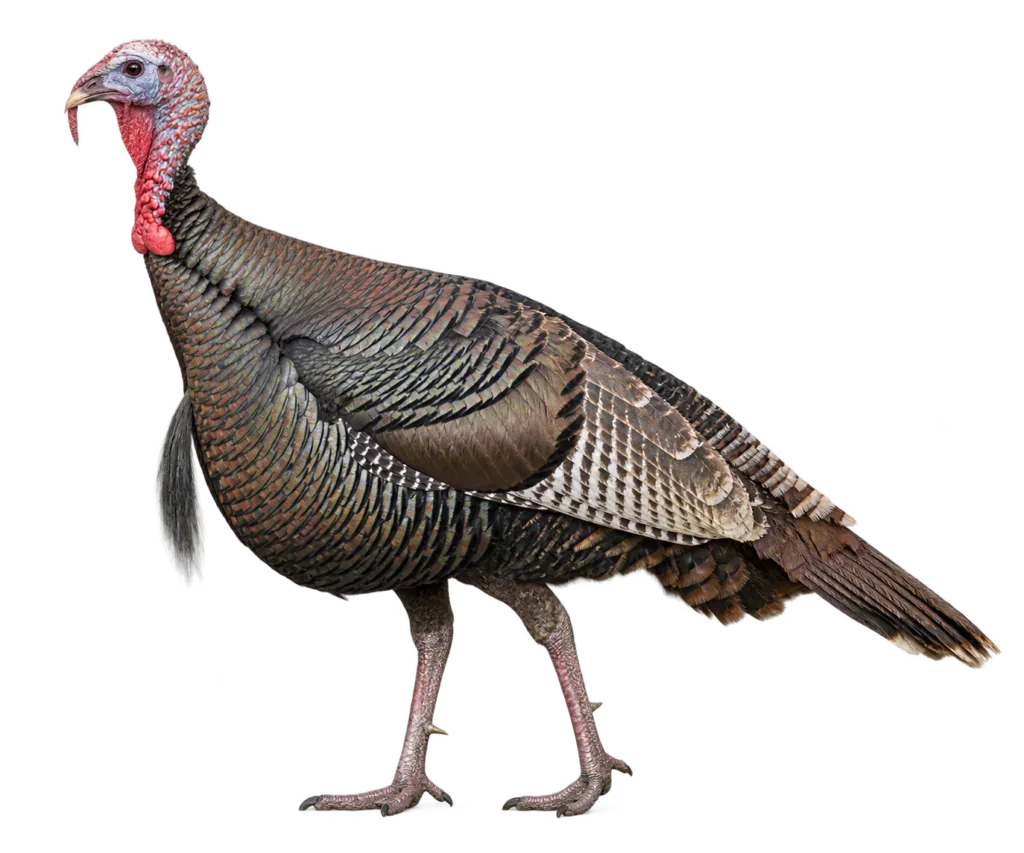
Size at a glance
How big is a Wild Turkey?
True-scale visual
Wild Turkey compared with a 175 cm person
When a transparent species asset and body-length data are available, BirdSize places the real bird asset and the fixed human reference on one mathematical centimetre scale.
Compare
Compare Wild Turkey with another bird
Search by common or scientific name.
Morphology
Detailed measurements
Taxonomy
Classification
Wild Turkey size varies unusually strongly within a single species. Adult males and females share the same long-legged, long-necked outline, but mature toms carry much more body mass and develop larger ornamental structures. A displaying male can also look far wider and deeper than the same bird at rest because the feathers, wings, tail, neck, and head ornaments all change position during a strut.
Male and Female Wild Turkeys Occupy Different Size Ranges
The Wild Turkey, Meleagris gallopavo, shows strong sexual dimorphism. Adult toms are heavier, more strongly built, and more heavily ornamented than hens. The difference is large enough that a single species-wide weight figure can hide much of the bird’s actual size pattern.
These averages place a typical mature tom at roughly twice the mass of a typical hen, although individual birds can fall well outside the averages. Geography, age, season, body condition, and subspecies all contribute to the spread. Large adult males from some populations can exceed 11 kg (24 lb), while small females may weigh only a fraction of that.
The difference is not simply extra weight carried on an otherwise identical frame. Males usually have thicker-looking legs, larger feet, a bulkier torso, and a more imposing neck and head profile. Females appear narrower and less inflated, especially when both birds are walking normally rather than displaying.
A Strutting Tom Changes His Apparent Size
A male Wild Turkey does not keep the same outline throughout the day. During courtship, the bird erects much of its body plumage, raises and spreads the tail, lowers the wings, and draws the head and neck closer to the body. These movements turn the normal long-necked profile into a broad, rounded display shape.
The tail contributes much of the apparent increase. When closed, it extends behind the body as a compact stack of feathers. During a full display, those feathers spread into a large vertical fan. The back and breast feathers also stand away from the body, increasing the visible depth of the torso without changing the underlying skeletal dimensions.
A strutting tom may look dramatically larger than a resting bird because much of the extra width comes from feather position. Photographs of displaying males therefore give a poor basis for estimating actual body width or comparing structural size between individuals.
The dropped wings add another visual effect. Their tips may approach or brush the ground while the tail remains upright, making the entire display extend both vertically and laterally. A relaxed male quickly returns to a much slimmer outline once the feathers settle and the neck extends.
Long Legs and a Broad Tail Shape the Turkey Body Plan
Wild Turkeys are heavy ground birds, but their proportions are not compact in the same way as many smaller galliform birds. The legs are long, the neck can extend well above the body, and the tail is broad and rounded. The head itself is comparatively small.
The feet and legs carry much of the bird’s functional mass. Strong toes allow turkeys to walk for long periods and rake through leaf litter while feeding. The relatively high body position also gives the species a tall appearance that body mass alone does not capture.
The wings are broad and rounded rather than long and narrow. They are capable of producing the rapid lift needed to launch a heavy bird from the ground and reach a tree roost, but the wing shape is associated with powerful bursts rather than prolonged soaring. This combination explains why a Wild Turkey can look extremely heavy on the ground yet still make a fast, abrupt takeoff.
Published species measurements commonly place wingspan well above one meter, while total body length is also around the meter scale in large adults. Total length and wingspan describe different axes of the bird, so neither should be treated as a substitute for the other. Total length includes the tail; wingspan measures the distance between the extended wingtips.
The Head, Beard, and Spurs Alter the Male Profile
The bare head and upper neck give Wild Turkeys a shape that differs sharply from fully feathered game birds. Adult males carry much more developed fleshy ornamentation. The snood extends from the forehead above the bill, while wattles and caruncles add irregular contours along the throat and neck.
These structures are not fixed in appearance. A male’s snood can lengthen or contract, and the exposed skin of the head and neck can shift through red, bluish, pale, or whitish tones. The changes are especially noticeable during social and courtship displays. Hens also have bare skin and some fleshy structures, but they are generally much less developed.
The familiar beard projects from the center of the breast. Despite its hairlike appearance, it is formed from modified feathers rather than mammalian hair. Most mature males have one, and some develop more than one. A minority of hens can also grow beards, so the presence of a beard alone does not provide an absolute sex test.
Spurs form on the rear of the lower legs and are usually much more developed in males. Mature toms can carry long, pointed spurs, while females normally lack prominent ones. As with beard length, spur development varies among birds and populations rather than following one exact measurement throughout the species.
Tail and Wing Feathers Reveal More Than Overall Size
Young males, known as jakes, can approach adult females or smaller adult males in body size, so mass alone is not always enough to separate age classes. Feather structure provides additional information.
An adult male opening a complete tail normally produces a smooth outer curve because the mature tail feathers have reached a more even length. The fan of an immature male can look uneven because some feathers have not yet reached the adult pattern. This difference is easiest to see when the bird spreads its tail fully.
The outer wing feathers also change as a turkey matures. Adult primary feathers tend to have more rounded tips, with the pale barring continuing farther toward the end. Juvenile feathers are more pointed and can retain a plainer area near the tip.
Beard length is less dependable as a stand-alone age measurement. Beards can wear against the ground, break, or grow differently among individuals. A short beard can belong to a young male, but wear can also shorten the beard of an older bird. Body size, tail structure, wing feathers, spurs, and general plumage are more useful when considered together.
Regional Form Changes Across the Wild Turkey’s Range
The basic Wild Turkey body plan remains recognizable across North America, but regional populations differ in color, leg proportions, body mass, and the appearance of the tail and wing feathers. These differences help explain why measurements or photographs from separate parts of the range do not always look interchangeable.
| Regional Form | Useful Morphological Trait |
|---|---|
| Eastern | Usually shows chestnut-brown tail tips and strong black-and-white barring on the wings; adult males can become particularly heavy. |
| Osceola | Often appears darker through the wings, with narrow pale bars, dark tail tips, relatively long legs, and well-developed spurs. |
| Rio Grande | Commonly has tan or buff tail tips with clear dark-and-light barring through the wings. |
| Merriam’s | Shows much paler buff-to-white edging on the tail and upper tail coverts, producing a light border around an opened fan. |
| Gould’s | Noted for long legs, large feet, long central tail feathers, and broad pale or white areas along the tail margin. |
Regional differences are especially obvious in an open tail fan. An Eastern bird may show warm chestnut edging, while western forms can have much paler buff or white margins. The color difference can make two birds with nearly identical posture look quite different in photographs.
Body size also overlaps heavily among these forms. Subspecies names should therefore not be assigned from weight alone. Plumage pattern, geography, leg proportions, and other traits provide better context.
Wild and Domestic Turkey Measurements Are Not Interchangeable
Domestic turkeys descend from Meleagris gallopavo, but selective breeding has altered body proportions in many domestic lines. A domestic bird may carry far more breast mass than a wild individual and can have a broader, heavier torso.
Wild birds generally keep a leaner outline, longer-looking neck, rangier legs, and body proportions suited to regular walking and flight. Their head and neck ornaments can also appear smaller than those of some domestic strains. A domestic turkey weight should therefore not be used to fill a missing Wild Turkey measurement simply because both belong to the same species.
This distinction matters most when unusually high weights appear in general searches. Some figures refer to domestic breeds, farm-raised birds, or record individuals rather than representative wild adults.
Why Published Wild Turkey Measurements Can Differ
Wild Turkey measurements often vary between references because the underlying samples are not always equivalent. One dataset may combine males and females, while another may describe only adult toms, only hens, or a particular regional population. A value from an Eastern population cannot automatically be treated as the exact norm for every bird from Florida to the Rocky Mountains.
Measurement names can also hide different physical quantities. Total length follows the bird from bill to tail, wingspan measures the fully extended wings, standing height depends on posture, and body mass changes with sex, season, age, and condition. None of these measurements can be converted reliably into another simply from the bird’s proportions.
For that reason, an apparent conflict between two believable Wild Turkey size figures does not always mean one is wrong. The first check is whether both figures describe the same sex, age class, population, and physical measurement.
Data
Measurement sources
- Data status
- Measured
- Size measurements
- Cornell Lab of Ornithology – All About Birds
- Morphology source
- AVONET — Tobias et al. (2022)
- Morphology dataset
- AVONET v7 — BirdLife taxonomy
- Morphology dataset license
- CC BY 4.0
Full source links, dataset definitions, licensing details and measurement methodology are maintained on the Data Sources & Methodology page.