Bird size profile
Wood Duck
Aix sponsa
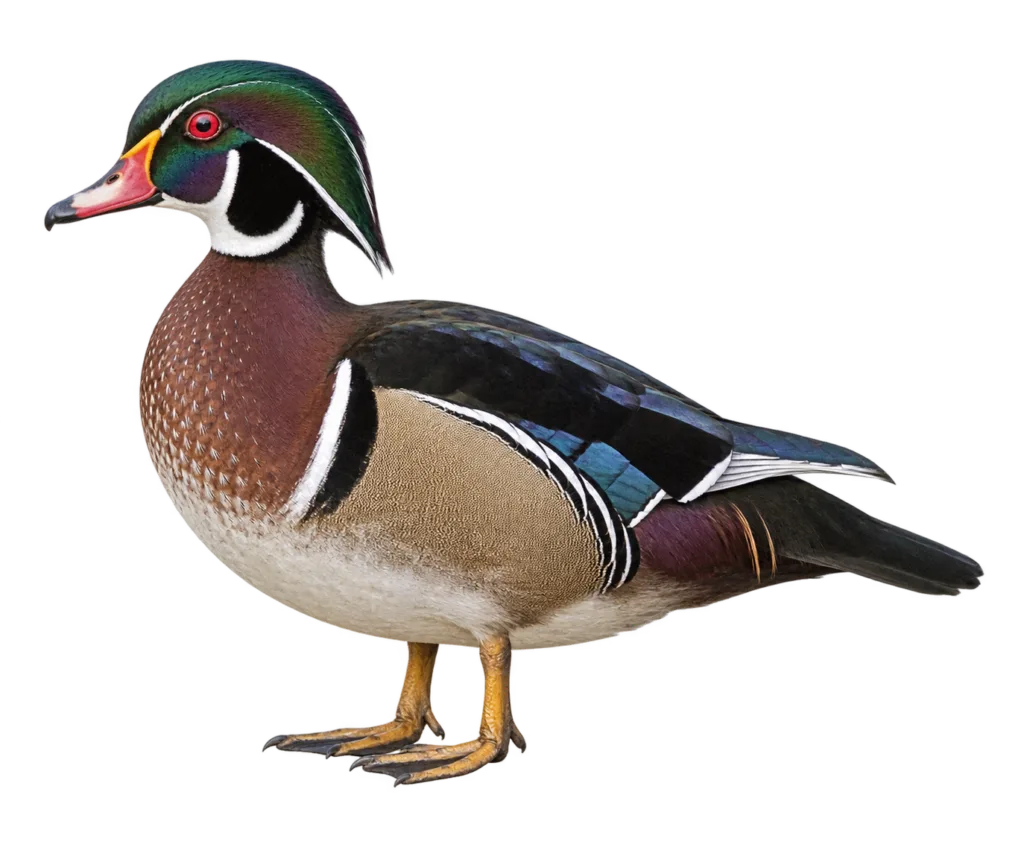
Size at a glance
How big is a Wood Duck?
True-scale visual
Wood Duck compared with a 175 cm person
When a transparent species asset and body-length data are available, BirdSize places the real bird asset and the fixed human reference on one mathematical centimetre scale.
Compare
Compare Wood Duck with another bird
Search by common or scientific name.
Morphology
Detailed measurements
Taxonomy
Classification
The Wood Duck (Aix sponsa) is a compact, medium-sized waterfowl species with proportions that differ noticeably from the long-necked or heavy-bodied shape of many familiar ducks. Adults measure about 18.5–21.3 inches (47–54 cm) in length, weigh roughly 16.0–30.4 ounces (454–862 g), and span about 26.0–28.7 inches (66–73 cm) across the wings. Its crested head, narrow neck, broad tail, and relatively short wings give those measurements a distinctive outline.
How Large Is a Wood Duck?
Body length places the Wood Duck well within the medium-sized range for North American ducks, but length alone does not describe how substantial the bird looks. Part of that measurement comes from a relatively long tail, while the body itself remains compact.
The weight range is broad enough that two adult Wood Ducks can have noticeably different body masses while still falling within normal measurements for the species. Body condition, sex, age, and seasonal changes can all affect mass, so weight should not be treated as a fixed value for an individual bird.
A Long Tail Changes the Bird’s Apparent Size
A Wood Duck does not distribute its length evenly through a large body. The silhouette combines a thin neck, elongated body line, and long, broad tail. The tail can therefore make a swimming or perched bird appear longer without giving it the bulky profile associated with a much heavier duck.
The head has an equally recognizable structure. It is fairly boxy and carries a crest that extends backward. The crest is especially conspicuous on an adult male in breeding plumage, although females also have a crested profile. Feather position can change how large the head appears, which is one reason apparent size can vary between resting, alert, and displaying birds.
Male and Female Size Differences Are Subtler Than Their Plumage
Adult males and females overlap extensively in overall dimensions. Males tend to be somewhat larger on average, but the physical size difference is far less obvious than the contrast in their plumage.
A breeding male has a strongly patterned head and body, a pronounced crest, and contrasting areas of dark green, chestnut, white, and buff. Those markings can make the bird look more substantial than its measurements suggest. The female is mostly gray-brown and has a distinctive pale marking around the eye. Her quieter pattern can create the opposite impression even when two birds are fairly close in body size.
This makes shape and plumage more useful than apparent bulk when distinguishing the sexes in the field. An eclipse male becomes less brightly patterned after breeding but retains features such as a reddish eye and characteristic bill coloration that help separate it from a female.
Short Wings and a Broad Tail Fit Its Wooded Habitat
The Wood Duck’s wings are relatively short and broad rather than long and narrow. Combined with the broad tail, this produces a body plan suited to rapid maneuvering around wooded wetlands.
Wood Ducks regularly move through environments containing tree trunks, branches, emergent vegetation, and narrow openings over water. Their wing and tail proportions help them make quick changes in direction instead of depending on the more open flight space used by many waterfowl.
A wingspan of 26.0–28.7 inches describes the distance from one wingtip to the other when the wings are extended. It does not mean the Wood Duck has unusually long individual wings. Its wings are comparatively short and broad in shape, which is an important part of its compact flight profile.
Its Feet Are Built for More Than Swimming
Wood Ducks are often called perching ducks because they regularly stand on branches and nest in tree cavities. Their feet have strong claws capable of gripping bark and woody surfaces, giving the species an ability that is especially useful in forested wetlands.
This feature affects how the bird is seen as much as its measurements do. A Wood Duck may appear low and compact while swimming, more upright when standing on a log, or elongated when perched with the neck raised. The underlying body dimensions have not changed; posture is changing the visible proportions.
Juvenile Shape Develops Before Adult Plumage
Young Wood Ducks approach the general proportions of adults before acquiring the full adult appearance. Juveniles resemble females in coloration, with a subdued brownish pattern rather than the ornate breeding plumage of an adult male.
The species’ structural features remain more useful for recognizing its basic form: a crested head, narrow neck, compact body, and relatively broad tail. Plumage then provides the finer clues needed to separate age and sex classes.
Data
Measurement sources
- Data status
- Measured
- Size measurements
- Cornell Lab of Ornithology – All About Birds
- Morphology source
- AVONET — Tobias et al. (2022)
- Morphology dataset
- AVONET v7 — BirdLife taxonomy
- Morphology dataset license
- CC BY 4.0
Full source links, dataset definitions, licensing details and measurement methodology are maintained on the Data Sources & Methodology page.