Bird size profile
American Crow
Corvus brachyrhynchos
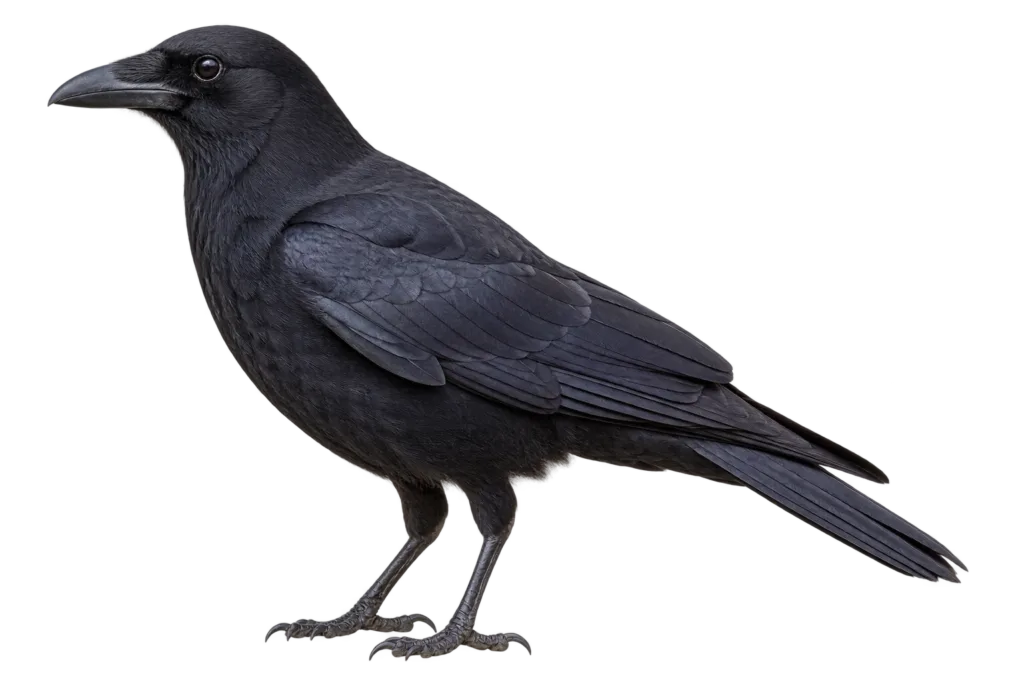
Size at a glance
How big is an American Crow?
True-scale visual
American Crow compared with a 175 cm person
When a transparent species asset and body-length data are available, BirdSize places the real bird asset and the fixed human reference on one mathematical centimetre scale.
Compare
Compare American Crow with another bird
Search by common or scientific name.
Morphology
Detailed measurements
Taxonomy
Classification
The American Crow (Corvus brachyrhynchos) is a large passerine with a body length of about 40–53 cm (15.8–20.9 in), a wingspan of 85–100 cm (33.5–39.4 in), and a recorded adult weight range of roughly 316–620 g (11.2–21.9 oz). Those figures describe a bird that is fairly compact when standing but becomes much broader once its wings are fully open.
Body Length Does Not Equal Standing Height
The American Crow’s published length is a full-body measurement rather than the vertical height of a standing bird. It runs along the bird from the tip of the bill to the end of the tail. A crow listed as 50 cm long is therefore not standing half a meter tall.
This distinction matters because much of that length is carried horizontally. The bill projects forward, while the folded wings and tail extend behind the body. The legs add visible height when the bird is walking, but they are not what the standard body-length measurement describes.
At rest, the species has a sturdy outline. The neck is fairly thick, the bill is heavy and straight, and the legs are long enough to hold the body well above the ground. The tail is comparatively short and usually looks squared or gently rounded rather than strongly tapered.
The Wingspan Nearly Doubles the Bird’s Visible Width
A perched American Crow can look narrower than its measurements suggest because the long flight feathers are folded tightly against the body. In flight, an 85–100 cm wingspan creates a very different impression.
The wings are broad and rounded, with separated primary feathers forming the familiar fingered wingtips of a large corvid. This shape helps explain why a crow passing overhead can appear much larger than the same bird standing on a lawn a few moments later.
A 40–53 cm body length should not be compared directly with an 85–100 cm wingspan as though one were an extension of the other. Length describes the bird from bill to tail, while wingspan measures the distance between the outstretched wingtips.
American Crows normally use steady, repeated wingbeats and do not rely on prolonged soaring in the way many large raptors do. Their broad wings, fingered tips, and relatively short tail remain useful size and shape cues even when the bird is seen only as a silhouette.
Weight Varies More Than the Familiar Crow Shape Suggests
The published adult weight range is broad: about 316–620 g. An often cited central value is around 450 g, but no single weight represents every adult American Crow.
Body mass can differ among individuals even when their overall length looks similar. Sex, geographic variation, body condition, and the amount of food carried in the digestive tract can all contribute to differences on a scale. Weight therefore gives useful information about body mass, but it is not a reliable way to predict exactly how long a crow will look.
The two sexes also overlap strongly in appearance. Males tend to average larger than females, yet both are black and share the same basic proportions. The overlap is too great for an observer to label an individual male or female simply because one crow looks slightly larger than another.
Size Separates Crows From Ravens Better Than It Separates Crow Species
The value of size becomes clearer when an American Crow is placed between two familiar look-alikes. A Fish Crow approaches the lower end of the American Crow’s dimensions, while a Common Raven extends well beyond its upper end.
| Species | Body Length | Weight | Wingspan |
|---|---|---|---|
| Fish Crow | 36–40 cm 14.2–15.8 in | 195–330 g 6.9–11.6 oz | About 84 cm 33.1 in |
| American Crow | 40–53 cm 15.8–20.9 in | 316–620 g 11.2–21.9 oz | 85–100 cm 33.5–39.4 in |
| Common Raven | 56–69 cm 22.1–27.2 in | 689–1,625 g 24.3–57.3 oz | 116–118 cm 45.7–46.5 in |
The Fish Crow demonstrates why a measurement should not be treated as an identification boundary. Its length reaches 40 cm, exactly where the published American Crow range begins, and its wingspan is almost the same as the lower end for an American Crow. A small American Crow and a large Fish Crow can therefore be extremely close in apparent size.
The Common Raven comparison is less subtle. Ravens are longer, much heavier, and broader across the open wings. Their proportions also differ: a raven has a more massive bill, longer-looking wings, a thicker neck with shaggy throat feathers, and a distinctly wedge-shaped tail in flight. An American Crow generally retains a shorter, squarer or softly rounded tail.
Posture Can Change the Apparent Size Without Changing the Bird
Crows are particularly easy to misjudge from photographs because their outline changes with posture. A relaxed bird may pull its neck inward and let the body feathers sit loosely, producing a compact, deep-bodied shape. An alert crow can extend its neck, raise its head, and stand taller on straightened legs.
Feather position changes the silhouette as well. Fluffed body plumage makes the torso look bulkier but does not indicate greater skeletal size. Sleek feathers can make the same individual appear narrower. Perspective adds another source of error: a bill pointing partly toward the camera looks shorter, while a tail angled away can disappear behind the folded wings.
For scale comparisons, the most useful view is therefore a neutral full-body profile with the bird standing naturally and the wings folded. That pose shows the real relationship among the bill, torso, legs, folded wings, and tail without a display posture altering the outline.
Young Crows Can Already Be Close to Adult Size
Juvenile American Crows should not automatically be interpreted as miniature versions of adults. By the time young birds are moving around outside the nest, their overall dimensions can already be close to adult dimensions.
Age is often easier to judge from feather and soft-part details than from body size. Young crows can show bluish eyes and a pinkish interior to the mouth before these features darken. Their first wing and tail feathers also tend to become browner and more worn than fresh adult feathers.
The tail can provide another clue at close range. Juvenile tail feathers are more pointed at their ends, while mature feathers develop the broader tips associated with the adult tail outline. As the first plumage ages, worn flight feathers may make a young crow look narrower or more ragged even though the underlying bird has already reached nearly adult proportions.
Data
Measurement sources
- Data status
- Measured
- Size measurements
- Cornell Lab of Ornithology – All About Birds
- Morphology source
- AVONET — Tobias et al. (2022)
- Morphology dataset
- AVONET v7 — BirdLife taxonomy
- Morphology dataset license
- CC BY 4.0
Full source links, dataset definitions, licensing details and measurement methodology are maintained on the Data Sources & Methodology page.