Bird size profile
Common Raven
Corvus corax
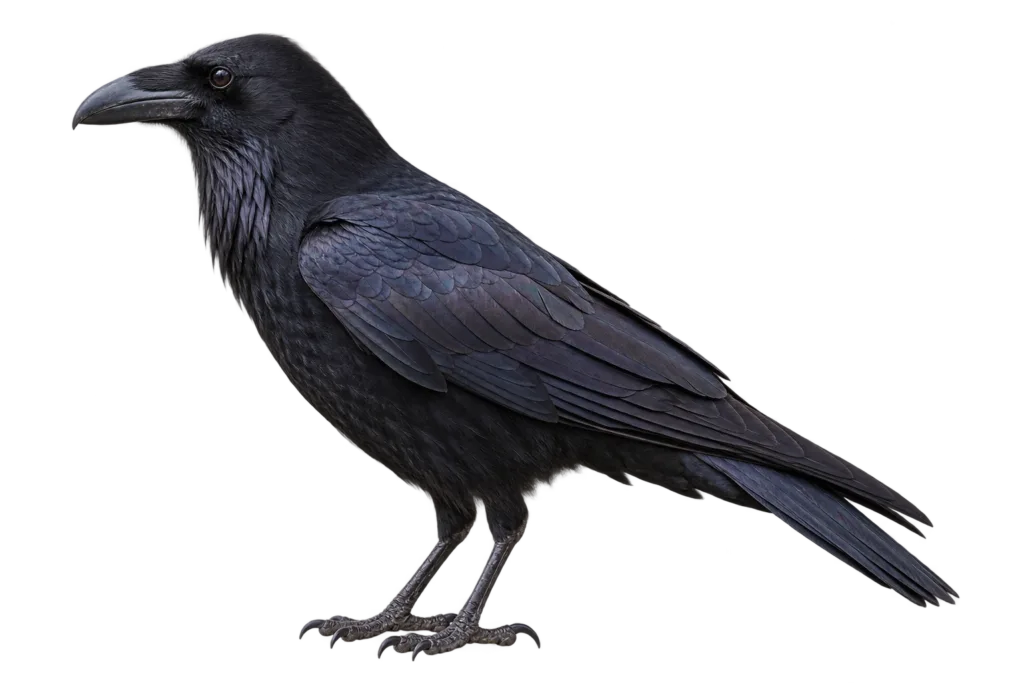
Size at a glance
How big is a Common Raven?
True-scale visual
Common Raven compared with a 175 cm person
When a transparent species asset and body-length data are available, BirdSize places the real bird asset and the fixed human reference on one mathematical centimetre scale.
Compare
Compare Common Raven with another bird
Search by common or scientific name.
Morphology
Detailed measurements
Taxonomy
Classification
The Common Raven (Corvus corax) is one of the largest passerine birds. Adult body length commonly falls around 56–69 cm (22–27 in), while recorded body mass spans roughly 689–1,625 g (1.5–3.6 lb) in North American reference data. Those numbers describe a bird that is not merely a large crow: its long wings, heavy bill, thick neck and extended tail give it a distinctly larger physical presence.
Measurements also need context. A raven’s listed body length is not its standing height, and published wingspan figures are not identical across regional datasets. Understanding what each measurement represents gives a much clearer picture of the bird’s true size.
Body Length Is Not Standing Height
A length of 56–69 cm is normally measured along the bird from the bill toward the end of the tail. It should not be interpreted as the distance from the ground to the top of a standing raven’s head.
This distinction matters because ravens rarely hold their bodies vertically. When standing or perched, the body is angled, the legs account for only part of the visible profile, and the tail projects behind the bird. Posture can also change as the neck stretches or the feathers are raised.
Reading the Length Correctly
A 69 cm raven should not be represented as a bird standing 69 cm tall. Body length and standing height are different physical measurements, and one should not be converted into the other without direct measurement data.
Much of the Raven’s Size Comes From Its Proportions
Common Ravens have a combination of features that makes them look especially substantial at close range. The bill is deep and heavy, the neck is thick, and elongated throat feathers can create a shaggy outline. The folded wings are long, while the tail extends well beyond the compact central body.
This is why body length alone does not capture the bird’s appearance. Two birds can have fairly similar head-to-tail measurements yet look very different if one has a lighter bill, shorter wings or a slimmer torso.
Flight makes the raven’s proportions even easier to see. The species has relatively long wings and a wedge-shaped tail, with the central tail feathers projecting farther than the outer feathers. The long flight feathers at the wingtips also create a more extended outline than the broader, shorter-winged appearance of an American Crow.
Published Wingspans Do Not Always Use One Global Range
Cornell Lab measurements for Common Ravens in North America give a wingspan of about 116–118 cm (45.7–46.5 in). British reference material uses a broader figure, with the RSPB listing 120–150 cm (47–59 in) for ravens.
These figures are better treated as values from different reference datasets rather than combined into an artificially precise worldwide range. The Common Raven occupies an enormous Northern Hemisphere range, and populations are not identical in body dimensions. Measurement datasets can also differ in the populations and samples they represent.
For visual comparison, the important point remains consistent: a raven has a broad aerial footprint. Even the lower published wingspan values put it well beyond the typical span of the familiar American Crow.
The Size Gap Between a Raven and a Crow
Size becomes particularly useful when a Common Raven can be compared with another corvid. Cornell Lab measurements show clear differences between the Common Raven, American Crow and Chihuahuan Raven.
| Species | Body Length | Body Mass | Wingspan |
|---|---|---|---|
| Common Raven | 56–69 cm | 689–1,625 g | 116–118 cm |
| American Crow | 40–53 cm | 316–620 g | 85–100 cm |
| Chihuahuan Raven | 46–53 cm | 442–667 g | 104–110 cm |
The mass difference is especially revealing. The upper end of the American Crow’s published weight range remains below the lower end of Cornell’s Common Raven range. A Common Raven can therefore have considerably more body mass even when distance makes the difference in linear size difficult to judge.
Length is still only one identification clue. A distant black bird has no convenient ruler beside it, and perspective can make size deceptive. The raven’s heavier bill, shaggy throat, long wings and tapered tail provide useful confirmation when apparent size alone is uncertain.
Why Ravens Can Look Almost Hawk-Sized in Flight
A Common Raven flying overhead may look surprisingly close to a medium-sized raptor in scale. That impression comes partly from span, but also from flight shape. Long primary feathers extend the wingtips, the tail adds length behind the body, and ravens regularly glide or soar rather than relying only on continuous flapping.
The resemblance is about apparent scale rather than anatomy. Ravens remain passerines with corvid proportions, but their large body and long flight surfaces place them far outside the dimensions associated with most songbirds.
When the wings are folded, much of that span disappears from view. A perched raven can therefore seem much smaller than the same individual circling overhead, even though its actual body dimensions have not changed.
Male and Female Size Overlaps
Male and female Common Ravens look alike, so there is no obvious plumage difference that separates the sexes. Males tend to be larger on average, and research has reported greater average mass in males, but individual measurements overlap.
That overlap makes size unsuitable as a simple field test for sex. A relatively small raven is not necessarily female, and a large individual cannot safely be labelled male from appearance alone. Geographic origin and individual variation can also affect where a bird falls within the species’ broad size range.
Data
Measurement sources
- Data status
- Measured
- Size measurements
- Cornell Lab of Ornithology – All About Birds
- Morphology source
- AVONET — Tobias et al. (2022)
- Morphology dataset
- AVONET v7 — BirdLife taxonomy
- Morphology dataset license
- CC BY 4.0
Full source links, dataset definitions, licensing details and measurement methodology are maintained on the Data Sources & Methodology page.