Bird size profile
Emperor Penguin
Aptenodytes forsteri
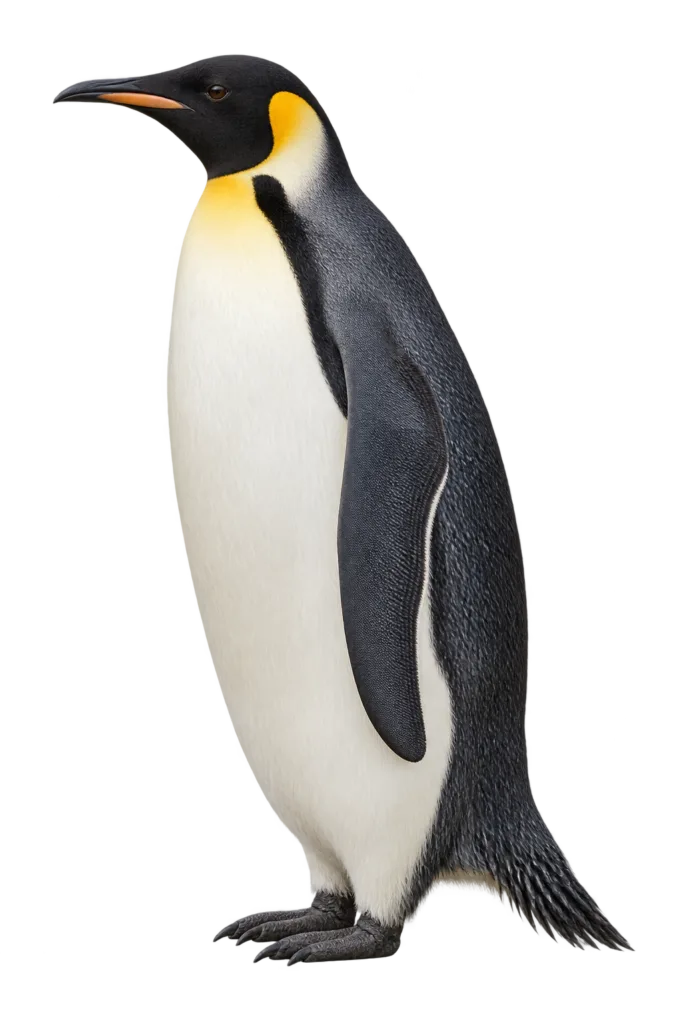
Size at a glance
How big is an Emperor Penguin?
Compare
Compare Emperor Penguin with another bird
Search by common or scientific name.
Morphology
Detailed measurements
Taxonomy
Classification
The emperor penguin, Aptenodytes forsteri, is the largest living penguin, but its size is harder to express with one number than it first appears. Upright height and bill-to-tail length are different measurements, while body mass can change by many kilograms during the annual breeding cycle. A well-fed adult entering the breeding season is therefore a very different measurement subject from the same bird after weeks of fasting.
How Large Is an Emperor Penguin?
These ranges place the emperor above every other living penguin in both overall stature and body mass. Current Australian Antarctic Program information describes adults as reaching about 40 kg at the start of the breeding season, while other institutional measurement records extend the upper end to around 45 kg.
The difference is not necessarily a disagreement about how large the species can become. An emperor penguin’s mass changes substantially with feeding and fasting, so the time of year and the condition of the bird matter when interpreting a weight.
Height and Body Length Should Not Be Treated as the Same Measurement
The emperor penguin is often described as being around 1.2 m, or nearly 4 ft, tall. That description is useful for visual scale, but published figures do not always measure exactly the same thing.
Some references give an upright standing height, while others report body length from the bill toward the tail. A penguin’s posture adds another source of variation. The neck may be extended, the head may be lowered, and the body can lean forward rather than forming a vertical column.
A value near 1.2 m may describe either a tall standing bird or a bill-to-tail body measurement depending on the source. For accurate comparisons, the measurement definition matters as much as the number.
This distinction becomes especially important in size-comparison graphics. Using a body-length figure as a strict vertical height can make an emperor penguin appear taller than the measurement actually supports.
Body Mass Moves with the Breeding Calendar
Weight is one of the least fixed measurements of an adult emperor penguin. Adults build large energy reserves before periods when feeding is impossible or limited. Those reserves are then consumed during breeding, incubation, chick care and moulting.
A study that sampled hundreds of emperor penguins across the breeding season illustrates how large the changes can be.
| Period | Male Mean Mass | Female Mean Mass | Breeding Context |
|---|---|---|---|
| May | 31.7 kg | 25.4 kg | Courtship period |
| August | 24.8 kg | 26.9 kg | Males had completed their long incubation fast; females had returned from feeding at sea |
| November | 24.5 kg | 22.7 kg | Both parents were making feeding trips for growing chicks |
The May males in that sample lost an average of 6.9 kg by August, about 22% of their starting mass. The female average moved in the opposite direction over the same part of the cycle because the females had been feeding at sea while the males remained with the egg.
This is why a statement such as “an emperor penguin weighs 30 kg” should be understood as a useful reference value rather than a permanent body weight. A healthy adult can move through a wide mass range without any corresponding change in skeletal size.
Males Are Usually Heavier, but Size Overlap Is Strong
Male and female emperor penguins look very similar. Both have the same basic body plan and adult plumage, and the difference in structural size is small enough that an isolated bird usually cannot be sexed reliably from apparent height alone.
Males tend to be heavier when breeding begins. The seasonal data, however, show why even body mass is not a simple sex marker. After the male’s incubation fast, females returning from the sea can temporarily be heavier than males.
The useful distinction is therefore between structural size and current body condition. Height, bill dimensions and skeletal proportions change little in a mature bird. Fat reserves can change rapidly.
Its Bulk Comes from More Than Height
An emperor penguin does not have the long legs or elongated neck that make many large birds appear tall. Much of its size is concentrated in a deep, broad torso. The neck is thick, the visible legs are short, and the flippers remain compact relative to the body’s overall volume.
That compact shape has a thermal advantage. The Australian Antarctic Program notes that emperor penguins have relatively small bills and flippers for their body size, reducing exposed areas through which heat can escape. Dense plumage and substantial fat reserves add further insulation.
The same proportions help explain why an emperor can look unusually massive beside another bird of similar standing height. Height alone does not capture the volume of the trunk, insulation and seasonal fat stores.
Chicks Change Scale Remarkably Quickly
An emperor penguin begins life at only a fraction of adult size. Newly hatched chicks are commonly around 150–200 g. At that stage they have little insulation of their own and remain dependent on a parent’s feet and brood pouch for warmth.
Growth accelerates once regular feeding begins. In one large breeding-season sample, chicks measured in late September, roughly five weeks after hatching, averaged 2.95 kg. By about four months of age, sampled males averaged 9.8 kg and females 10.1 kg, with no clear sex difference in the measured head, bill and foot dimensions at that age.
Tracked fledglings in another study averaged about 15.5 kg when they began their first journeys away from the colony. They were already large birds, but still much lighter than adults carrying full pre-breeding reserves.
The growth pattern also changes the bird’s appearance. Small chicks begin as rounded, down-covered animals with short-looking extremities. As the skeleton grows and juvenile plumage develops, the elongated head-and-neck profile and adult-like body proportions become much more obvious.
Emperor Penguin vs. King Penguin Size
The king penguin, Aptenodytes patagonicus, is the emperor penguin’s closest living relative and the second-largest penguin. Their similar upright shape can make the difference seem smaller in photographs than it is in actual measurements.
The greatest visual difference is usually not a few centimetres of height but body volume. An emperor has a broader, heavier trunk and can carry far more mass than a king penguin. Even when an emperor has lost considerable weight during breeding, it remains a very large penguin structurally.
Modern emperor penguins are the largest members of their family alive today, although the fossil record includes extinct penguins that exceeded them in estimated body size. The emperor is therefore the modern size limit for penguins, not the largest form the penguin lineage has ever produced.
Data
Measurement sources
- Data status
- Measured
- Size measurements
- AVONET — Tobias et al. (2022)
- Morphology source
- AVONET — Tobias et al. (2022)
- Morphology dataset
- AVONET v7 — BirdLife taxonomy
- Morphology dataset license
- CC BY 4.0
Full source links, dataset definitions, licensing details and measurement methodology are maintained on the Data Sources & Methodology page.