Bird size profile
King Penguin
Aptenodytes patagonicus
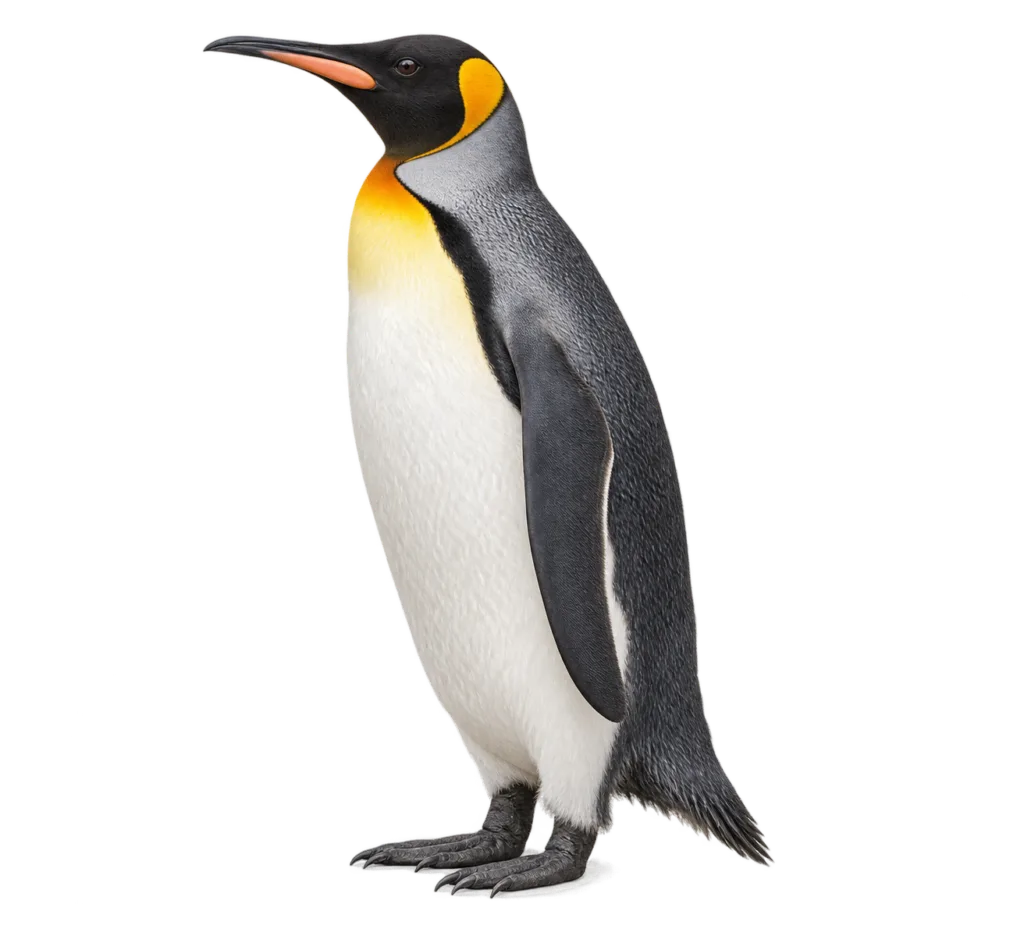
Size at a glance
How big is a King Penguin?
Compare
Compare King Penguin with another bird
Search by common or scientific name.
Morphology
Detailed measurements
Taxonomy
Classification
The King Penguin, Aptenodytes patagonicus, is the second-largest living penguin. Adults commonly stand about 85–95 cm (33–37 in) tall, but body mass is much less fixed. Their long, upright shape can look remarkably constant while weight changes through breeding, fasting, feeding, and molt.
Why King Penguin Weight Changes So Much
A single average weight does not describe a King Penguin very well. Adults may return to a breeding colony weighing about 10–15 kg (22–33 lb), then fall to roughly 8–11 kg (18–24 lb) later in the breeding cycle. Males tend to be heavier than females, but the ranges overlap.
Bill and flipper lengths change little once a bird is fully grown. Body mass can change sharply as stored fat is gained or used. Two adult King Penguins with nearly identical skeletal dimensions can therefore have noticeably different weights.
Molt creates another large shift. King Penguins remain ashore while replacing their feathers and cannot feed normally during this period. Field measurements have recorded birds entering molt at far higher body masses than birds near its end. This explains why published weight ranges can appear unusually broad without representing different adult size classes.
A Tall Body Does Not Mean a Fixed Height
The familiar 85–95 cm figure describes the standing dimensions of an adult rather than a rigid anatomical length. A penguin can stretch its neck, lower its head, lean forward, or compress its posture. Measurements reported as height or length are therefore not always directly interchangeable.
This matters when comparing values from different references. Figures around 90 cm are typical for an upright adult, while broader published ranges may extend toward 100 cm depending on measurement method and the birds included.
The King Penguin’s build is relatively narrow for such a large penguin. The torso is streamlined, the neck is long enough to create a clear transition between head and chest, and the bill projects well beyond the rounded head profile. These proportions contribute to the species’ tall appearance even when two birds differ little in actual structural size.
Males and Females Overlap Heavily in Size
Male and female King Penguins have very similar external plumage and body shape. Males are usually somewhat larger in structural measurements, but there is too much overlap to identify every individual reliably by appearance alone.
A study of adult King Penguins from the Crozet Archipelago measured 119 males and 51 females. Male averages were higher for bill, flipper, and foot measurements:
| Measurement | Male Mean | Female Mean |
|---|---|---|
| Bill length | 123.4 mm | 118.8 mm |
| Flipper length | 325.6 mm | 316.8 mm |
| Foot measurement | 119.3 mm | 116.4 mm |
The bill showed the clearest average difference between the sexes in that dataset. Even so, individual measurements overlapped. Bill length by itself classified sex correctly in about 79% of the study birds, making it useful for population-level research but not a certain visual test for an individual penguin.
Color ornament size was less useful for separating males and females. The bright ear patches and chest markings may look prominent, but their measured dimensions did not separate the sexes in the same way as bill and flipper measurements.
The Bill Is a Major Part of the King Penguin’s Proportions
King Penguins have a long, slender bill that makes the head look smaller in relation to the body. Adult bills also carry a colored plate along the lower mandible, usually in orange to pink-orange tones. Combined with the orange ear patches, this creates one of the clearest visual boundaries between the dark head and the paler body.
The bill is more than a visual feature in morphometric work. Researchers often use bill length alongside flipper measurements as an indicator of structural body size because these dimensions remain much more stable than body mass.
Measurements must still be interpreted according to method. Bill length can be taken from different anatomical starting points, while flipper length may be measured from different reference positions. Values from separate studies should not automatically be treated as though they describe exactly the same measurement.
Flippers Add to the Species’ Long, Narrow Shape
The wings of a penguin are transformed into stiff swimming flippers. In King Penguins they are relatively long in proportion to body size. When held close to the sides, they reinforce the smooth outline of the torso; when extended, their length becomes much more apparent.
Adult field measurements commonly place King Penguin flippers in roughly the low-30-centimeter range, though recorded values vary with sex, individual size, and measurement technique. The Crozet sample ranged from about 287 mm to 350 mm across the measured females and males.
King Penguins belong to the same genus as the larger Emperor Penguin, but their proportions are more slender. Their relatively long bill, narrower body profile, and proportionally large flippers make height alone a poor description of how the bird is built.
Plumage Changes How Body Size Is Perceived
An adult has a dark head, a silvery gray to dark back, a white underside, and bright orange markings around the ears and upper chest. The strong boundary between the dark upper body and pale belly can make the torso appear narrower than its actual girth.
Chicks create a very different impression. Their thick brown down produces a round, bulky outline that can make an older chick look exceptionally large beside an adult. Much of that apparent bulk comes from the insulating coat rather than adult-like body proportions. As juvenile plumage replaces the down, the familiar streamlined King Penguin silhouette becomes much clearer.
Data
Measurement sources
- Data status
- Measured
- Size measurements
- AVONET — Tobias et al. (2022)
- Morphology source
- AVONET — Tobias et al. (2022)
- Morphology dataset
- AVONET v7 — BirdLife taxonomy
- Morphology dataset license
- CC BY 4.0
Full source links, dataset definitions, licensing details and measurement methodology are maintained on the Data Sources & Methodology page.